Introduction
The field of intelligent machines is undergoing a rapid and historic transformation, and humanoid robotics sits at the center of this global shift. By combining artificial intelligence, machine learning, advanced sensors, robotics engineering, and cognitive computing, engineers design these systems to replicate human movement and decision-making in real-world environments. Unlike traditional automation, these advanced platforms operate in spaces built for humans, which makes them highly adaptable and practical.
Over the past few years, development updates regarding these systems have gained significant global attention as industries transition from experimental labs to real-world deployment. Rising labor shortages, increasing operational costs, and the demand for higher productivity drive this shift across sectors such as manufacturing, healthcare, logistics, and retail. Consequently, specialized bipedal automation is no longer a future concept but an active part of today’s industrial transformation.
Growing Importance of Humanoid Robotics in Modern Industries
Digital transformation and automation are rapidly reshaping modern industries. Businesses face constant pressure to reduce costs while improving efficiency, safety, and output quality. In this environment, human-shaped machines offer increasingly valuable support because they can perform complex tasks that traditionally required human labor.
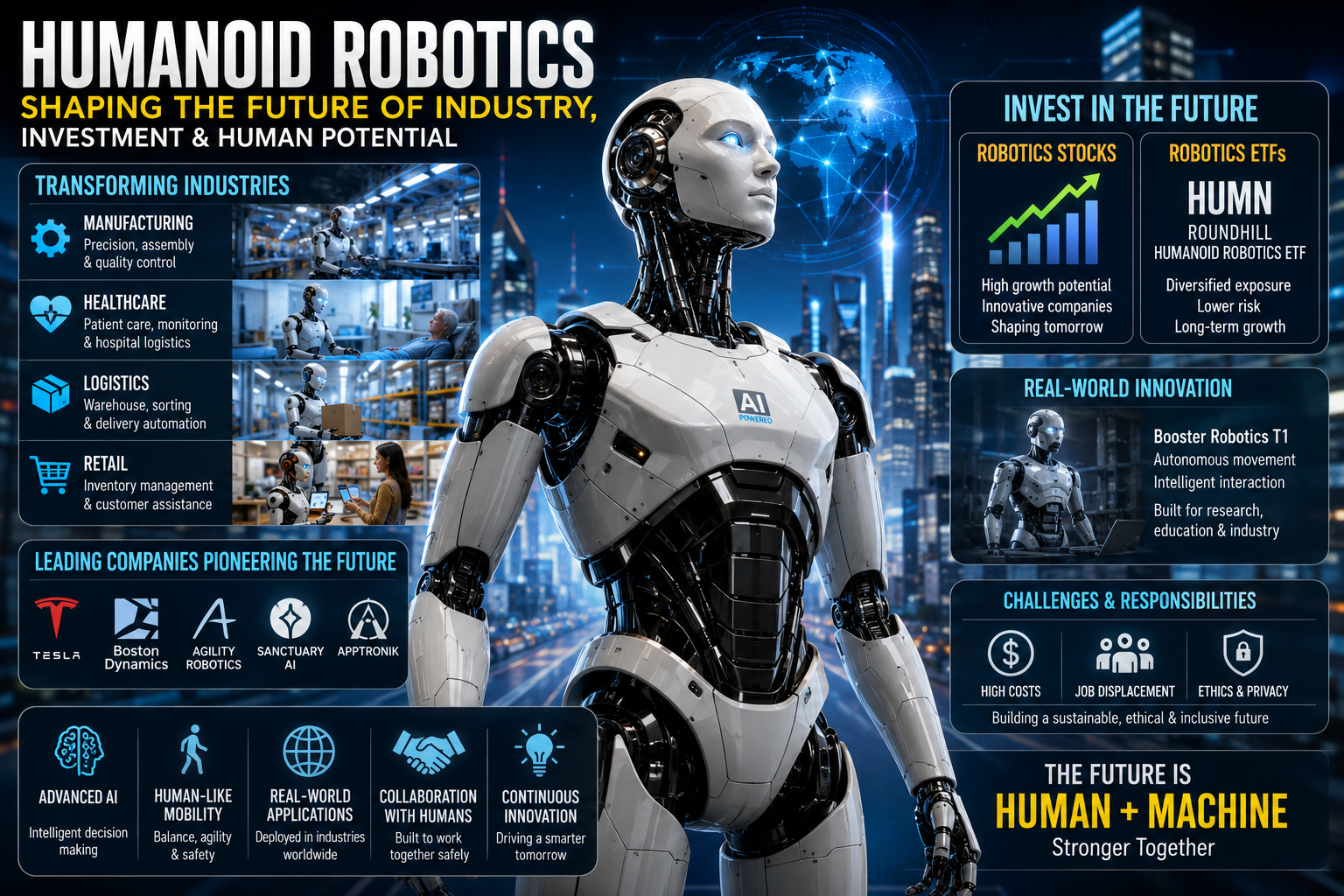
The surge in current field news reflects how organizations actively adopt these systems for real-world applications. In manufacturing facilities, workers use them for precision-based assembly and repetitive tasks that require absolute consistency. Healthcare professionals rely on them to assist with patient monitoring, the care of older adults, and hospital logistical operations. Meanwhile, retail and logistics companies deploy them for inventory handling, customer assistance, and warehouse automation.
Unlike traditional industrial machines, anthropomorphic systems function in human-designed environments without requiring expensive infrastructure modifications. This makes scalable humanoid robotics a practical solution for modern businesses.

Technological Advancements Driving Humanoid Robotics Growth
Rapid progress in artificial intelligence has significantly accelerated the capabilities of human-centric machines. Earlier models relied strictly on repetitive, pre-programmed actions. In contrast, modern intelligent platforms learn from experience, analyze environments, and make autonomous decisions.
Recent breakthroughs highlight major improvements in machine perception, balance control, and real-time learning systems. Advanced computer vision allows robots to identify objects and people accurately, while natural language processing enables human-like communication. These improvements turn industrial units into interactive assistants rather than simple machinery.
Similarly, industry reports frequently cover milestones in motion control, energy efficiency, and adaptive intelligence. These developments push the entire sector closer to widespread commercial use, where hardware can work safely alongside humans in dynamic environments.
Industry Coverage and Global Developments in Automation
Media coverage of these advanced machines shows how quickly the industry is evolving. Companies continuously release updated prototypes with better agility, longer battery life, and stronger computational capabilities. These innovations represent a massive global race toward advanced automation rather than isolated achievements.
At the same time, current headlines emphasize real-world deployment over laboratory experiments. Teams are now testing robots in logistics centers, hospitals, airports, and retail environments. This real-world integration demonstrates that research-driven development has officially transitioned to commercial adoption.
Leading Companies Pioneering Humanoid Robotics
Several major technology companies drive innovation in this specialized sector:
Tesla develops anthropomorphic systems for both industrial and domestic use.
Boston Dynamics commands industry respect for its advanced mobility and balance technologies.
Agility Robotics focuses on human-friendly navigation.
Sanctuary AI builds cognitive robotic intelligence.
Apptronik specializes in collaborative industrial robots.
These top organizations invest heavily in artificial intelligence, mechanical design, and machine learning systems. Their intense competition accelerates innovation, resulting in faster development cycles and improved real-world capabilities. As a result, the technology continues to evolve rapidly, with new advancements emerging each year.
Financial Market Trends: Humanoid Robotics Stocks
The financial market shows increasing interest in automation technologies. Sector-specific equities have become a popular topic among investors seeking exposure to high-growth industries. Typically, these listings belong to companies involved in artificial intelligence, hardware manufacturing, and advanced automation systems.
However, direct equity investments also carry risk due to market volatility and technological uncertainty. While long-term growth potential remains strong, short-term price fluctuations occur frequently. Investors should therefore analyze company fundamentals, technological leadership, and market adoption trends before investing.
Diverse ETF Opportunities in Robotics
For investors seeking diversified exposure, exchange-traded funds offer a balanced approach. A sector ETF distributes investment across multiple companies involved in hardware and AI development, reducing risk compared to investing in a single stock.
One of the most recognized options, the Roundhill Humanoid Robotics ETF (HUMN), tracks companies developing advanced physical technologies. This specific fund focuses on firms involved in next-generation automation and intelligent systems. Similarly, individual fund products are winning over long-term investors due to their built-in diversification benefits.
These investment vehicles provide direct market exposure without requiring individual stock selection, making them suitable for both beginner and experienced investors.
Strategic Paths for Investing in Humanoid Robotics Tech
Understanding how to back this technological wave involves evaluating both direct and indirect strategies. Direct investments in manufacturing companies can yield higher returns, but they expose your portfolio to greater risk from market fluctuations and rapid technological changes.
Conversely, investing through diversified funds provides a safer, more stable approach. Many financial analysts recommend combining both strategies depending on your personal risk tolerance and investment goals. Because the space is still in a growth phase, long-term investment strategies tend to outperform short-term trading approaches.
Real-World Innovations and Bipedal Applications
One of the most significant technological advancements in recent years is the Booster Robotics T1 system. This machine demonstrates exactly how teams can apply advanced mechanics in education, research, and industrial environments. It features autonomous movement, intelligent decision-making, and the ability to interact with humans in structured environments.
Industry news frequently highlights such innovations, showing that real-world adoption is accelerating. These platforms are no longer theoretical concepts; companies are actively testing and implementing them in various industries worldwide.
Structural Challenges and Ethical Considerations
Despite rapid advancements, several challenges remain. High development and production costs still limit widespread adoption, and smaller businesses often struggle to implement these systems due to financial constraints.
Ethical concerns also demand attention. Discussions in the developer community often focus on job displacement, data privacy, and the responsible use of artificial intelligence. Governments and organizations are working to develop regulatory frameworks to ensure the safe and ethical deployment of automated systems.
Stakeholders must address these challenges to ensure that humanoid robotics develops in a sustainable, socially responsible manner.
Frequently Asked Questions
What is humanoid robotics and why is it important?
It refers to machines designed to resemble and function like humans. They are important because they improve productivity, reduce operational costs, and enhance efficiency across multiple industries.
Why is news about human-shaped robots increasing in popularity?
Interest is surging because of rapid technological advancements in AI, machine learning, and successful real-world deployment across industries.
Are automation and robotics stocks a good investment?
These equities offer high-growth opportunities, but they carry risks due to market volatility and emerging technology uncertainty.
What is a humanoid robotics ETF?
It is an investment fund that bundles multiple engineering and AI companies together, offering diversified exposure to the entire sector.
How does the Roundhill fund work?
The Roundhill fund tracks companies involved in advanced bipedal and intelligent machine development, giving investors an easy way to back the growing automation industry.
What is the best way to invest in humanoid robotics?
The best approach depends on your risk tolerance, but many investors prefer a mix of diversified ETFs and selected engineering stocks for balanced exposure.
Conclusion
The development of human-centric hardware is reshaping the global technological landscape by bridging the gap between human capabilities and machine intelligence. Its applications expand daily across industries such as healthcare, manufacturing, logistics, and retail.
With increasing media attention, rising demand for tech stocks, and the growing popularity of fund investments, the sector is positioned for long-term expansion. Continuous innovation in artificial intelligence, mechanical engineering, and autonomous systems will ensure that humanoid robotics becomes an integral part of the global economy.
As development continues, these systems will play a crucial role in shaping the future of automation, improving efficiency, and redefining human-machine collaboration in the modern world.

Leave a Reply