
Introduction
Artificial intelligence is rapidly evolving beyond traditional automation systems and simple chatbots. Businesses worldwide are exploring Autonomous AI Agents, agentive AI, and agentic AI to improve operational efficiency and automate complex workflows. Unlike conventional software that follows predefined rules, these intelligent systems can reason, plan, learn from experience, and make decisions with minimal human intervention. As organizations continue investing in digital transformation initiatives, intelligent workflow automation is becoming a critical competitive advantage. From customer service and finance to cybersecurity and human resources, AI-powered business operations are helping organizations streamline processes, reduce costs, and enhance productivity at scale.
What Are Autonomous AI Agents?
Autonomous AI Agents are intelligent software systems capable of independently completing tasks through reasoning, planning, memory, and automation. Unlike traditional AI assistants that simply respond to commands, autonomous agents can understand objectives, create execution strategies, and perform multi-step workflows without continuous human supervision.
The growing adoption of agentive AI and agentic AI reflects the increasing demand for systems that can automate complex business processes while adapting to changing environments. These intelligent systems are becoming essential tools for organizations seeking greater efficiency and operational agility.

Why Enterprises Are Adopting Autonomous AI Agents in 2026
Enterprise adoption of Autonomous AI Agents is accelerating because organizations are under constant pressure to improve productivity, reduce operational costs, and enhance customer experiences. Businesses are increasingly managing large volumes of data, complex workflows, and distributed teams that require faster decision-making.
By implementing AI workflow automation, organizations can automate repetitive tasks, optimize resource allocation, and improve service delivery. Industries such as healthcare, finance, cybersecurity, logistics, and SaaS are investing heavily in autonomous AI technologies to gain competitive advantages and support long-term growth.
Industry analysts, including reports from firms such as McKinsey & Company and Gartner, suggest that autonomous AI technologies will become a foundational component of enterprise operations over the next decade, particularly as organizations pursue advanced automation and intelligent decision-making capabilities.
Key Technologies Behind Autonomous AI Agents
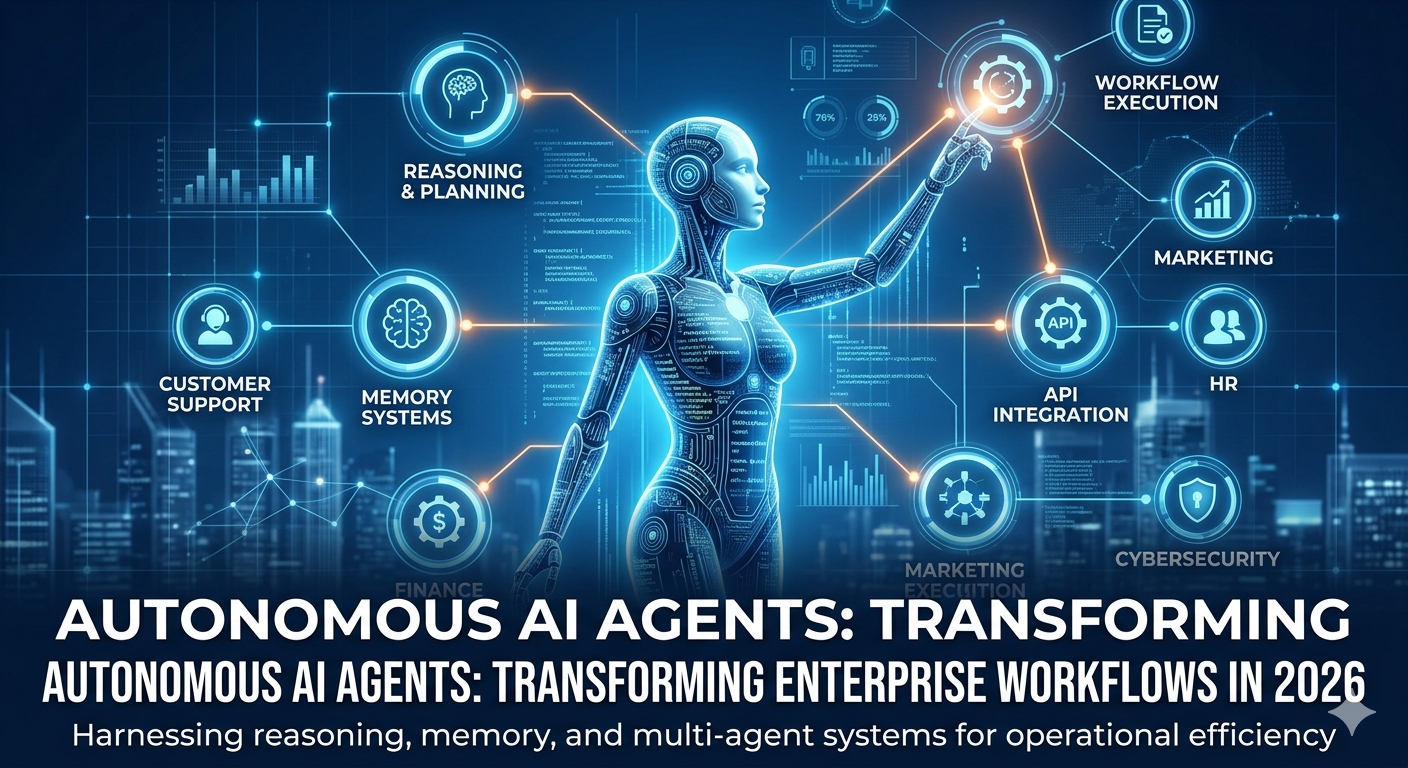
The effectiveness of Autonomous AI Agents depends on several advanced technologies working together to support reasoning, learning, and workflow execution.
Large Language Models such as GPT, Claude, and Gemini provide the reasoning layer that enables agents to understand instructions, process information, and generate responses. Memory systems allow agents to maintain context through both short-term and long-term knowledge retention.
Decision-making engines help prioritize objectives, evaluate available options, and monitor workflow progress. Additionally, AI tool integration enables autonomous systems to connect with APIs, CRM platforms, ERP systems, cloud applications, and enterprise databases.
The combination of these technologies allows enterprise AI systems to automate increasingly sophisticated business processes while maintaining operational efficiency and scalability.
Enterprise Applications of Autonomous AI Agents
Organizations are implementing Autonomous AI Agents across multiple business functions to improve performance and reduce manual workloads.
Customer support teams use AI customer support solutions to provide around-the-clock assistance, improve response times, and personalize customer interactions. Finance departments leverage autonomous systems for fraud detection, invoice processing, compliance monitoring, and financial forecasting.
Marketing teams benefit from AI workflow automation for audience segmentation, predictive analytics, content generation, and campaign optimization. Human resources departments use AI agents to streamline recruitment, onboarding, and workforce management processes.
In cybersecurity, AI cybersecurity systems continuously monitor network activity, identify suspicious behavior, detect vulnerabilities, and support threat response efforts. These applications demonstrate how autonomous AI can deliver measurable value across diverse operational environments.

Benefits and Business Impact of Autonomous AI Agents
The benefits of Autonomous AI Agents extend beyond simple automation. Organizations adopting these systems often experience significant improvements in productivity, operational efficiency, and decision-making speed.
By automating repetitive and time-consuming tasks, businesses can redirect human resources toward strategic initiatives and innovation. Autonomous AI systems also help reduce operational costs, improve workflow consistency, and enhance customer satisfaction through faster service delivery.
Another significant advantage is scalability. Organizations can expand operations without proportionally increasing staffing requirements, allowing for more sustainable growth and improved profitability.
Challenges and Risks of Autonomous AI Systems
Despite their benefits, Autonomous AI Agents present several challenges that organizations must carefully address. One of the most widely discussed concerns is AI hallucination, where systems may generate inaccurate or misleading information.
Data privacy and cybersecurity risks also require attention, particularly when AI systems interact with sensitive enterprise information. Compliance with regulatory requirements and ethical AI governance frameworks remains critical for responsible deployment.
Organizations must also consider infrastructure costs, ongoing maintenance requirements, and the need for human oversight when implementing autonomous AI solutions at scale.
Best Practices for Successful Enterprise Deployment
Organizations seeking to maximize the value of enterprise AI automation should begin with clearly defined business objectives and focused implementation strategies.
Starting with high-value use cases allows businesses to measure performance and refine processes before scaling adoption. Human oversight remains essential for validating critical decisions and ensuring accountability.
Companies should establish governance frameworks, implement continuous monitoring, document workflows, and maintain transparency regarding AI-generated outputs. These practices help improve trust, reduce risks, and support long-term operational success.
The Future of Intelligent Workflow Automation
The future of Autonomous AI Agents, agentive AI, and agentic AI is expected to extend far beyond current automation capabilities. Emerging technologies will enable autonomous digital employees, advanced multi-agent AI systems, predictive operations, and highly personalized customer experiences.
As organizations continue investing in enterprise automation and intelligent workflow technologies, autonomous AI systems are likely to become a core component of modern business infrastructure. Businesses that embrace these innovations early may gain lasting competitive advantages through improved efficiency, agility, and scalability.
Frequently Asked Questions
What are Autonomous AI Agents?
Autonomous AI Agents are intelligent software systems that independently perform tasks using reasoning, planning, memory, and automation capabilities.
How do AI workflow systems work?
AI workflow systems analyze objectives, create execution plans, integrate with enterprise tools, and automate workflows through intelligent decision-making engines.
What industries benefit most from Autonomous AI Agents?
Healthcare, finance, cybersecurity, logistics, manufacturing, retail, SaaS, and eCommerce are among the industries seeing significant benefits from autonomous AI adoption.
What are the benefits of AI workflow automation?
Benefits include improved productivity, reduced operational costs, enhanced customer experiences, faster decision-making, and greater business scalability.
What challenges should organizations consider before implementing Autonomous AI Agents?
Organizations should evaluate data privacy requirements, cybersecurity risks, compliance obligations, governance frameworks, infrastructure costs, and the need for human oversight.
Conclusion
Autonomous AI Agents are transforming the future of enterprise operations by combining reasoning, planning, memory, and automation into intelligent workflow systems. Businesses across industries are increasingly adopting agentive AI, agentic AI, and AI workflow automation to improve productivity, reduce costs, and enhance decision-making. While challenges related to governance, security, and compliance remain important considerations, the long-term business value is substantial. As technology continues to evolve, autonomous AI systems will play a central role in digital transformation and enterprise automation strategies. Organizations that successfully implement these solutions today will be better positioned to compete in an increasingly AI-driven future.
