Blog

  • Best Garment Steamers in Pakistan 2026: Top Picks and Buying Guide

    Best Garment Steamers in Pakistan 2026: Top Picks and Buying Guide

    Introduction

    Keeping clothes wrinkle-free has become easier than ever with modern garment steamers. Whether you need perfectly pressed office wear, school uniforms, formal dresses, or everyday clothing, a quality garment steamer can save time while protecting delicate fabrics. In Pakistan, the demand for garment steamers continues to grow as more households seek convenient alternatives to traditional ironing. From powerful stand steamers for families to compact handheld models for travelers, there are many options available in 2026. This guide explores the best garment steamers in Pakistan, compares stand and handheld models, and helps you choose the right steamer based on your budget and household needs.

    Stand Steamers vs Handheld Steamers – Which One Do You Need?

    The first decision buyers face is choosing between a stand steamer and a handheld steamer. Both options remove wrinkles effectively, but they serve different purposes.

    Stand steamers are designed for frequent use and larger loads of clothing. They typically feature larger water tanks, higher steam output, and longer operating times. These models are ideal for families, boutiques, and users who steam multiple garments every week.

    Handheld steamers, on the other hand, focus on portability and convenience. Their compact size makes them perfect for travel, small apartments, and quick touch-ups before meetings or events. While they may not match the power of stand steamers, they offer excellent flexibility for everyday use.

    If you regularly steam several garments at once, a stand steamer is the better investment. If convenience and portability matter most, a handheld model will likely meet your needs.

    Best Garment Steamers in Pakistan 2026

    Several models stand out in the Pakistani market due to their performance, reliability, and value for money.

    The Philips GC482/26 is widely considered the best overall stand steamer. With a powerful 1600W heating system and a 1.4-liter water tank, it provides consistent steam output for efficient wrinkle removal. It works well on cotton, linen, silk, and synthetic fabrics.

    For users seeking premium performance, the Philips STE1030/26 offers an impressive 1800W motor and a large 1.8-liter water tank. Its strong steam production makes it suitable for larger households and users who demand professional-level results.

    The Decora DGS-0271 delivers excellent value by combining 1800W power with a built-in ironing board. This unique feature provides additional convenience and versatility, making it an attractive option for budget-conscious buyers.

    Travelers and professionals will appreciate the Philips GC362, a portable handheld steamer that offers 1300W of power in a lightweight design. It heats quickly and is easy to carry in luggage.

    For those looking for an affordable handheld option, the Decora DHS-0271 offers compact performance and fast steaming capabilities at a budget-friendly price point.

    Compare the best garment steamers in Pakistan for 2026, including powerful stand steamers and portable handheld models designed for every budget and lifestyle.

    Garment Steamer vs Steam Iron – What’s the Real Difference?

    Many buyers wonder whether a garment steamer can completely replace a traditional steam iron. The answer depends on your specific needs.

    A garment steamer uses hot steam to relax fabric fibers and remove wrinkles without direct contact. This makes it safer for delicate materials such as silk, chiffon, velvet, embroidered garments, and suits. Steamers also sanitize fabrics and eliminate odors while refreshing clothing.

    A steam iron relies on a heated metal plate combined with steam pressure. It creates crisp edges and sharp creases, making it ideal for dress shirts, formal trousers, and uniforms. However, irons require more effort and can potentially damage sensitive fabrics if used incorrectly.

    For everyday wrinkle removal and fabric care, a garment steamer offers greater convenience. For achieving perfectly pressed creases and professional finishes, a steam iron remains the preferred choice. Many households benefit from owning both appliances for different purposes.

    Why Philips Dominates the Pakistani Market

    Philips continues to lead the garment steamer market in Pakistan due to its reputation for quality, innovation, and reliability. Consumers trust the brand because its products consistently deliver strong performance and long-term durability.

    One major advantage is Philips’ advanced steam technology, which ensures even steam distribution and efficient wrinkle removal. The company also focuses heavily on user-friendly designs, including adjustable poles, large water tanks, and ergonomic handheld models.

    Another reason for Philips’ popularity is its extensive after-sales support and product availability across Pakistan. Replacement parts, accessories, and warranty services are generally easier to access compared to lesser-known brands.

    Although Philips products often carry a higher price tag, many users consider them a worthwhile investment because of their reliability and long lifespan.

    Buying Guide Based on Your Budget & Family Size

    Choosing the right garment steamer depends largely on your budget and the number of people in your household.

    For single users, students, and travelers, an affordable handheld steamer such as the Decora DHS-0271 provides enough power for occasional use while remaining highly portable.

    Small families with two to four members may find the Philips GC482/26 offers the perfect balance between performance and affordability. Its tank capacity and steam output are sufficient for weekly garment care.

    Larger families that frequently steam multiple outfits should consider the Philips STE1030/26. Its larger water reservoir reduces refill frequency and supports longer steaming sessions.

    Users seeking maximum versatility may prefer the Decora DGS-0271 because its integrated ironing board combines steaming and ironing functionality in one appliance.

    Ultimately, selecting the right model involves balancing your budget, garment volume, storage space, and desired convenience features.

    Frequently Asked Questions

    1. Are garment steamers better than irons?

    Garment steamers are better for delicate fabrics, quick wrinkle removal, and fabric refreshing. Irons remain superior for creating sharp creases and formal finishes.

    2. Which garment steamer is best in Pakistan in 2026?

    The Philips GC482/26 is considered one of the best overall options due to its strong performance, reliability, and value for money.

    3. Can a garment steamer remove wrinkles from all fabrics?

    Most garment steamers work effectively on cotton, polyester, silk, linen, wool, and many delicate materials. Always check garment care labels before steaming.

    4. Is a handheld steamer powerful enough for daily use?

    Yes. Modern handheld steamers such as the Philips GC362 provide sufficient power for daily touch-ups and light household use.

    5. How long does a garment steamer typically last?

    A high-quality garment steamer can last five to ten years or more with proper maintenance, regular cleaning, and correct usage.

    Final Verdict – Which Steamer Should You Buy Today?

    The best garment steamer ultimately depends on your lifestyle and household requirements. The Philips GC482/26 offers the best overall balance of performance and value, while the Philips STE1030/26 is ideal for users seeking premium features. Budget-conscious buyers can confidently choose the Decora DGS-0271 or Decora DHS-0271. For travelers, the Philips GC362 remains one of the most practical handheld options available. By selecting a steamer that matches your budget and garment care needs, you can enjoy faster, safer, and more convenient wrinkle removal throughout 2026.
     

  • Humanoid Robotics: 15 Powerful Trends Shaping the Future of Intelligent Machines

    Humanoid Robotics: 15 Powerful Trends Shaping the Future of Intelligent Machines

    Introduction

    The field of intelligent machines is undergoing a rapid and historic transformation, and humanoid robotics sits at the center of this global shift. By combining artificial intelligence, machine learning, advanced sensors, robotics engineering, and cognitive computing, engineers design these systems to replicate human movement and decision-making in real-world environments. Unlike traditional automation, these advanced platforms operate in spaces built for humans, which makes them highly adaptable and practical.

    Over the past few years, development updates regarding these systems have gained significant global attention as industries transition from experimental labs to real-world deployment. Rising labor shortages, increasing operational costs, and the demand for higher productivity drive this shift across sectors such as manufacturing, healthcare, logistics, and retail. Consequently, specialized bipedal automation is no longer a future concept but an active part of today’s industrial transformation.

    Growing Importance of Humanoid Robotics in Modern Industries

    Digital transformation and automation are rapidly reshaping modern industries. Businesses face constant pressure to reduce costs while improving efficiency, safety, and output quality. In this environment, human-shaped machines offer increasingly valuable support because they can perform complex tasks that traditionally required human labor.

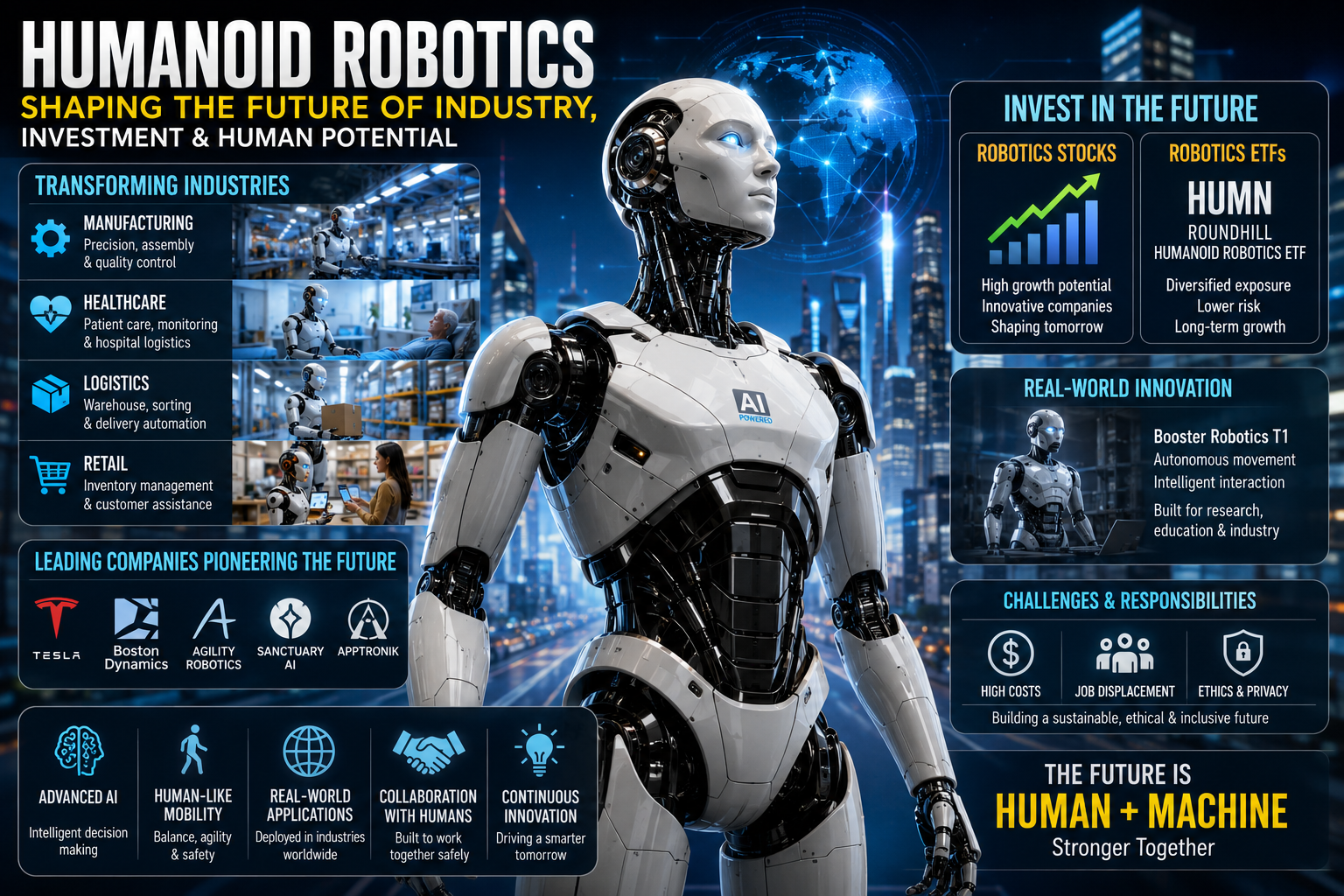
    The surge in current field news reflects how organizations actively adopt these systems for real-world applications. In manufacturing facilities, workers use them for precision-based assembly and repetitive tasks that require absolute consistency. Healthcare professionals rely on them to assist with patient monitoring, the care of older adults, and hospital logistical operations. Meanwhile, retail and logistics companies deploy them for inventory handling, customer assistance, and warehouse automation.

    Unlike traditional industrial machines, anthropomorphic systems function in human-designed environments without requiring expensive infrastructure modifications. This makes scalable humanoid robotics a practical solution for modern businesses.

    Humanoid Robotics

    Technological Advancements Driving Humanoid Robotics Growth

    Rapid progress in artificial intelligence has significantly accelerated the capabilities of human-centric machines. Earlier models relied strictly on repetitive, pre-programmed actions. In contrast, modern intelligent platforms learn from experience, analyze environments, and make autonomous decisions.

    Recent breakthroughs highlight major improvements in machine perception, balance control, and real-time learning systems. Advanced computer vision allows robots to identify objects and people accurately, while natural language processing enables human-like communication. These improvements turn industrial units into interactive assistants rather than simple machinery.

    Similarly, industry reports frequently cover milestones in motion control, energy efficiency, and adaptive intelligence. These developments push the entire sector closer to widespread commercial use, where hardware can work safely alongside humans in dynamic environments.

    Industry Coverage and Global Developments in Automation

    Media coverage of these advanced machines shows how quickly the industry is evolving. Companies continuously release updated prototypes with better agility, longer battery life, and stronger computational capabilities. These innovations represent a massive global race toward advanced automation rather than isolated achievements.

    At the same time, current headlines emphasize real-world deployment over laboratory experiments. Teams are now testing robots in logistics centers, hospitals, airports, and retail environments. This real-world integration demonstrates that research-driven development has officially transitioned to commercial adoption.

    Leading Companies Pioneering Humanoid Robotics

    Several major technology companies drive innovation in this specialized sector:

    • Tesla develops anthropomorphic systems for both industrial and domestic use.

    • Boston Dynamics commands industry respect for its advanced mobility and balance technologies.

    • Agility Robotics focuses on human-friendly navigation.

    • Sanctuary AI builds cognitive robotic intelligence.

    • Apptronik specializes in collaborative industrial robots.

    These top organizations invest heavily in artificial intelligence, mechanical design, and machine learning systems. Their intense competition accelerates innovation, resulting in faster development cycles and improved real-world capabilities. As a result, the technology continues to evolve rapidly, with new advancements emerging each year.

    Financial Market Trends: Humanoid Robotics Stocks

    The financial market shows increasing interest in automation technologies. Sector-specific equities have become a popular topic among investors seeking exposure to high-growth industries. Typically, these listings belong to companies involved in artificial intelligence, hardware manufacturing, and advanced automation systems.

    However, direct equity investments also carry risk due to market volatility and technological uncertainty. While long-term growth potential remains strong, short-term price fluctuations occur frequently. Investors should therefore analyze company fundamentals, technological leadership, and market adoption trends before investing.

    Diverse ETF Opportunities in Robotics

    For investors seeking diversified exposure, exchange-traded funds offer a balanced approach. A sector ETF distributes investment across multiple companies involved in hardware and AI development, reducing risk compared to investing in a single stock.

    One of the most recognized options, the Roundhill Humanoid Robotics ETF (HUMN), tracks companies developing advanced physical technologies. This specific fund focuses on firms involved in next-generation automation and intelligent systems. Similarly, individual fund products are winning over long-term investors due to their built-in diversification benefits.

    These investment vehicles provide direct market exposure without requiring individual stock selection, making them suitable for both beginner and experienced investors.

    Strategic Paths for Investing in Humanoid Robotics Tech

    Understanding how to back this technological wave involves evaluating both direct and indirect strategies. Direct investments in manufacturing companies can yield higher returns, but they expose your portfolio to greater risk from market fluctuations and rapid technological changes.

    Conversely, investing through diversified funds provides a safer, more stable approach. Many financial analysts recommend combining both strategies depending on your personal risk tolerance and investment goals. Because the space is still in a growth phase, long-term investment strategies tend to outperform short-term trading approaches.

    Real-World Innovations and Bipedal Applications

    One of the most significant technological advancements in recent years is the Booster Robotics T1 system. This machine demonstrates exactly how teams can apply advanced mechanics in education, research, and industrial environments. It features autonomous movement, intelligent decision-making, and the ability to interact with humans in structured environments.

    Industry news frequently highlights such innovations, showing that real-world adoption is accelerating. These platforms are no longer theoretical concepts; companies are actively testing and implementing them in various industries worldwide.

    Structural Challenges and Ethical Considerations

    Despite rapid advancements, several challenges remain. High development and production costs still limit widespread adoption, and smaller businesses often struggle to implement these systems due to financial constraints.

    Ethical concerns also demand attention. Discussions in the developer community often focus on job displacement, data privacy, and the responsible use of artificial intelligence. Governments and organizations are working to develop regulatory frameworks to ensure the safe and ethical deployment of automated systems.

    Stakeholders must address these challenges to ensure that humanoid robotics develops in a sustainable, socially responsible manner.

    Frequently Asked Questions

    What is humanoid robotics and why is it important?

    It refers to machines designed to resemble and function like humans. They are important because they improve productivity, reduce operational costs, and enhance efficiency across multiple industries.

    Why is news about human-shaped robots increasing in popularity?

    Interest is surging because of rapid technological advancements in AI, machine learning, and successful real-world deployment across industries.

    Are automation and robotics stocks a good investment?

    These equities offer high-growth opportunities, but they carry risks due to market volatility and emerging technology uncertainty.

    What is a humanoid robotics ETF?

    It is an investment fund that bundles multiple engineering and AI companies together, offering diversified exposure to the entire sector.

    How does the Roundhill fund work?

    The Roundhill fund tracks companies involved in advanced bipedal and intelligent machine development, giving investors an easy way to back the growing automation industry.

    What is the best way to invest in humanoid robotics?

    The best approach depends on your risk tolerance, but many investors prefer a mix of diversified ETFs and selected engineering stocks for balanced exposure.

    Conclusion

    The development of human-centric hardware is reshaping the global technological landscape by bridging the gap between human capabilities and machine intelligence. Its applications expand daily across industries such as healthcare, manufacturing, logistics, and retail.

    With increasing media attention, rising demand for tech stocks, and the growing popularity of fund investments, the sector is positioned for long-term expansion. Continuous innovation in artificial intelligence, mechanical engineering, and autonomous systems will ensure that humanoid robotics becomes an integral part of the global economy.

    As development continues, these systems will play a crucial role in shaping the future of automation, improving efficiency, and redefining human-machine collaboration in the modern world.

  • Autonomous AI Agents: How Intelligent Workflow Systems Are Transforming Enterprises in 2026

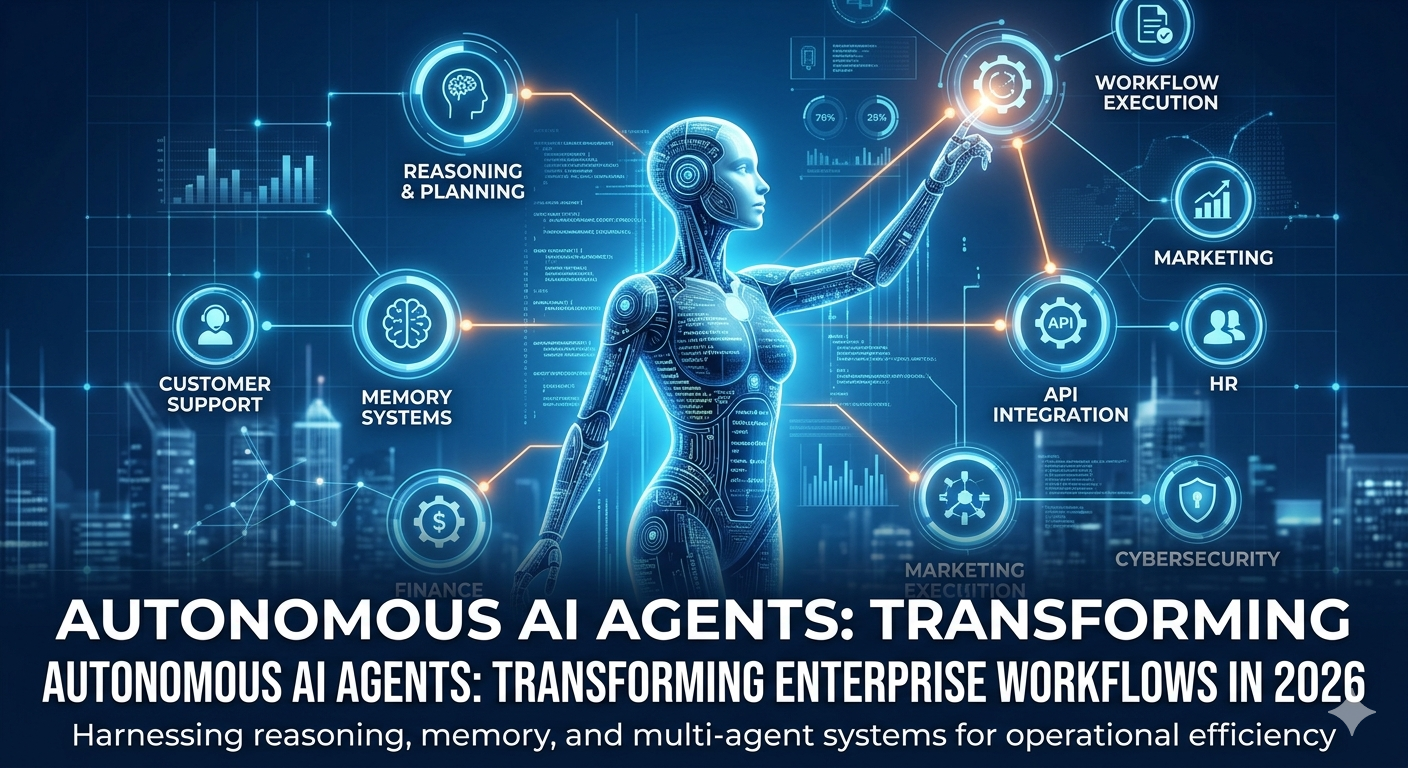
    Autonomous AI Agents: How Intelligent Workflow Systems Are Transforming Enterprises in 2026

    Introduction

    Artificial intelligence is rapidly evolving beyond traditional automation systems and simple chatbots. Businesses worldwide are exploring Autonomous AI Agents, agentive AI, and agentic AI to improve operational efficiency and automate complex workflows. Unlike conventional software that follows predefined rules, these intelligent systems can reason, plan, learn from experience, and make decisions with minimal human intervention. As organizations continue investing in digital transformation initiatives, intelligent workflow automation is becoming a critical competitive advantage. From customer service and finance to cybersecurity and human resources, AI-powered business operations are helping organizations streamline processes, reduce costs, and enhance productivity at scale.

    What Are Autonomous AI Agents?

    Autonomous AI Agents are intelligent software systems capable of independently completing tasks through reasoning, planning, memory, and automation. Unlike traditional AI assistants that simply respond to commands, autonomous agents can understand objectives, create execution strategies, and perform multi-step workflows without continuous human supervision.

    The growing adoption of agentive AI and agentic AI reflects the increasing demand for systems that can automate complex business processes while adapting to changing environments. These intelligent systems are becoming essential tools for organizations seeking greater efficiency and operational agility.


    Autonomous AI Agent
    Autonomous AI Agent


    Why Enterprises Are Adopting Autonomous AI Agents in 2026

    Enterprise adoption of Autonomous AI Agents is accelerating because organizations are under constant pressure to improve productivity, reduce operational costs, and enhance customer experiences. Businesses are increasingly managing large volumes of data, complex workflows, and distributed teams that require faster decision-making.

    By implementing AI workflow automation, organizations can automate repetitive tasks, optimize resource allocation, and improve service delivery. Industries such as healthcare, finance, cybersecurity, logistics, and SaaS are investing heavily in autonomous AI technologies to gain competitive advantages and support long-term growth.

    Industry analysts, including reports from firms such as McKinsey & Company and Gartner, suggest that autonomous AI technologies will become a foundational component of enterprise operations over the next decade, particularly as organizations pursue advanced automation and intelligent decision-making capabilities.

    Key Technologies Behind Autonomous AI Agents

    The effectiveness of Autonomous AI Agents depends on several advanced technologies working together to support reasoning, learning, and workflow execution.

    Large Language Models such as GPT, Claude, and Gemini provide the reasoning layer that enables agents to understand instructions, process information, and generate responses. Memory systems allow agents to maintain context through both short-term and long-term knowledge retention.

    Decision-making engines help prioritize objectives, evaluate available options, and monitor workflow progress. Additionally, AI tool integration enables autonomous systems to connect with APIs, CRM platforms, ERP systems, cloud applications, and enterprise databases.

    The combination of these technologies allows enterprise AI systems to automate increasingly sophisticated business processes while maintaining operational efficiency and scalability.

    Enterprise Applications of Autonomous AI Agents

    Organizations are implementing Autonomous AI Agents across multiple business functions to improve performance and reduce manual workloads.

    Customer support teams use AI customer support solutions to provide around-the-clock assistance, improve response times, and personalize customer interactions. Finance departments leverage autonomous systems for fraud detection, invoice processing, compliance monitoring, and financial forecasting.

    Marketing teams benefit from AI workflow automation for audience segmentation, predictive analytics, content generation, and campaign optimization. Human resources departments use AI agents to streamline recruitment, onboarding, and workforce management processes.

    In cybersecurity, AI cybersecurity systems continuously monitor network activity, identify suspicious behavior, detect vulnerabilities, and support threat response efforts. These applications demonstrate how autonomous AI can deliver measurable value across diverse operational environments.

    Autonomous AI Agent
    Autonomous AI Agent


    Benefits and Business Impact of Autonomous AI Agents

    The benefits of Autonomous AI Agents extend beyond simple automation. Organizations adopting these systems often experience significant improvements in productivity, operational efficiency, and decision-making speed.

    By automating repetitive and time-consuming tasks, businesses can redirect human resources toward strategic initiatives and innovation. Autonomous AI systems also help reduce operational costs, improve workflow consistency, and enhance customer satisfaction through faster service delivery.

    Another significant advantage is scalability. Organizations can expand operations without proportionally increasing staffing requirements, allowing for more sustainable growth and improved profitability.

    Challenges and Risks of Autonomous AI Systems

    Despite their benefits, Autonomous AI Agents present several challenges that organizations must carefully address. One of the most widely discussed concerns is AI hallucination, where systems may generate inaccurate or misleading information.

    Data privacy and cybersecurity risks also require attention, particularly when AI systems interact with sensitive enterprise information. Compliance with regulatory requirements and ethical AI governance frameworks remains critical for responsible deployment.

    Organizations must also consider infrastructure costs, ongoing maintenance requirements, and the need for human oversight when implementing autonomous AI solutions at scale.

    Best Practices for Successful Enterprise Deployment

    Organizations seeking to maximize the value of enterprise AI automation should begin with clearly defined business objectives and focused implementation strategies.

    Starting with high-value use cases allows businesses to measure performance and refine processes before scaling adoption. Human oversight remains essential for validating critical decisions and ensuring accountability.

    Companies should establish governance frameworks, implement continuous monitoring, document workflows, and maintain transparency regarding AI-generated outputs. These practices help improve trust, reduce risks, and support long-term operational success.

    The Future of Intelligent Workflow Automation

    The future of Autonomous AI Agents, agentive AI, and agentic AI is expected to extend far beyond current automation capabilities. Emerging technologies will enable autonomous digital employees, advanced multi-agent AI systems, predictive operations, and highly personalized customer experiences.

    As organizations continue investing in enterprise automation and intelligent workflow technologies, autonomous AI systems are likely to become a core component of modern business infrastructure. Businesses that embrace these innovations early may gain lasting competitive advantages through improved efficiency, agility, and scalability.

    Frequently Asked Questions

    What are Autonomous AI Agents?
    Autonomous AI Agents are intelligent software systems that independently perform tasks using reasoning, planning, memory, and automation capabilities.

    How do AI workflow systems work?
    AI workflow systems analyze objectives, create execution plans, integrate with enterprise tools, and automate workflows through intelligent decision-making engines.

    What industries benefit most from Autonomous AI Agents?
    Healthcare, finance, cybersecurity, logistics, manufacturing, retail, SaaS, and eCommerce are among the industries seeing significant benefits from autonomous AI adoption.

    What are the benefits of AI workflow automation?
    Benefits include improved productivity, reduced operational costs, enhanced customer experiences, faster decision-making, and greater business scalability.

    What challenges should organizations consider before implementing Autonomous AI Agents?
    Organizations should evaluate data privacy requirements, cybersecurity risks, compliance obligations, governance frameworks, infrastructure costs, and the need for human oversight.

    Conclusion

    Autonomous AI Agents are transforming the future of enterprise operations by combining reasoning, planning, memory, and automation into intelligent workflow systems. Businesses across industries are increasingly adopting agentive AI, agentic AI, and AI workflow automation to improve productivity, reduce costs, and enhance decision-making. While challenges related to governance, security, and compliance remain important considerations, the long-term business value is substantial. As technology continues to evolve, autonomous AI systems will play a central role in digital transformation and enterprise automation strategies. Organizations that successfully implement these solutions today will be better positioned to compete in an increasingly AI-driven future.

  • Autonomous AI Agents: The Future of Intelligent Workflow Automation

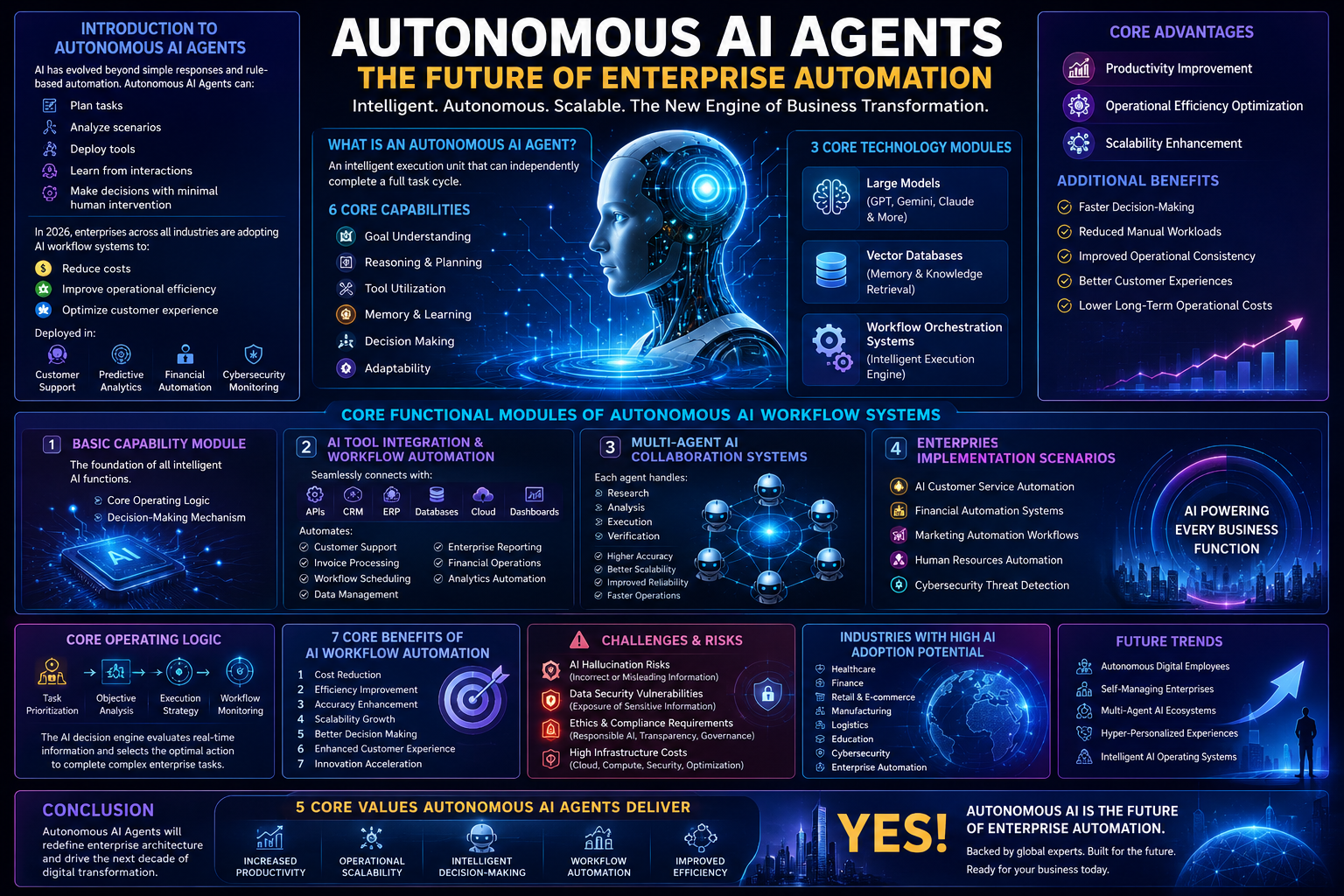
    Autonomous AI Agents: The Future of Intelligent Workflow Automation

    Introduction to Autonomous AI Agents

    Artificial intelligence has long surpassed its traditional boundaries, which once limited it to only responding to prompts and following fixed automation rules, and has formally entered a new development stage where it can independently:

    • Plan tasks
    • Analyze scenarios
    • Deploy tools
    • Learn from interactions
    • Make decisions with minimal human intervention

    The core driving force behind this wave of industrial innovation is exactly Autonomous AI Agents.

    In 2026, enterprises across all global industries are integrating intelligent AI workflow systems equipped with this technology into their core business operations, aiming to achieve the following goals:

    • Reducing costs
    • Improving operational efficiency
    • Optimizing customer experience

    The application scenarios that have already been deployed include:

    • Automated customer support
    • Predictive analytics
    • Financial automation
    • Cybersecurity monitoring

    Autonomous AI agents have also become a core strategic component driving enterprises’ digital transformation.

    Compared with traditional AI chatbots and conventional automation software, autonomous AI agents have several unique advantages:

    • Independently complete complex multi-step tasks
    • Coordinate operations across software platforms
    • Access core database information
    • Continuously optimize workflows through memory and reasoning systems
    • Dynamically respond to real-time changing business scenarios

    Autonomous AI Agents
    Autonomous AI Agents

    Core Definition and Capabilities of Autonomous AI Agents

    This paper formally provides a clear definition of autonomous AI agents, which possess six core capabilities.

    The three core technology modules that support their real-world implementation include:

    • General large models such as GPT, Gemini, and Claude
    • Vector databases
    • Intelligent workflow orchestration systems

    Subsequent sections of this paper will further explore:

    • Working principles of autonomous AI agents
    • Supporting technologies
    • Enterprise implementation use cases
    • Deployment benefits
    • Existing challenges
    • Future development trends of intelligent workflow automation

    Core Operating Logic of Autonomous AI Systems

    This paper first starts from the core operating logic of autonomous AI agents, clarifying that their prerequisite tasks include:

    • Task prioritization
    • Objective analysis
    • Execution strategy formulation
    • Workflow progress monitoring

    This set of preliminary actions underpins the operating mechanism of the AI decision engine.

    Relying on predefined business objectives and full-link real-time information, the system determines the optimal execution action after multi-dimensional evaluation across different business scenarios.

    This capability supports AI systems in independently completing complex enterprise-level operational tasks.

    Core Functional Modules of Autonomous AI Workflow Systems

    Basic Capability Module

    The first module is the basic capability module, whose:

    • Core operating logic
    • Decision-making mechanism

    lay a solid foundation for implementing all intelligent AI functions.

    AI Tool Integration and Workflow Automation Module

    The second module is the AI tool integration and workflow automation module, which can seamlessly connect with:

    • APIs
    • CRM platforms
    • ERP systems
    • Databases
    • Cloud applications
    • Analytics dashboards

    This module enables automation for multiple enterprise operations including:

    • Customer support
    • Invoice processing
    • Workflow scheduling
    • Data management
    • Enterprise reporting
    • Financial operations
    • Analytics automation

    Its built-in workflow orchestration framework further improves:

    • System efficiency
    • Operational scalability
    • Automation accuracy

    Multi-Agent AI Collaboration Systems in 2026

    The third module focuses on the 2026 frontier trend of multi-agent AI collaboration systems.

    In this architecture, each individual AI agent can independently handle tasks such as:

    • Research
    • Information analysis
    • Workflow execution
    • Output verification

    This distributed AI architecture provides significant advantages including:

    • Higher accuracy
    • Better scalability
    • Improved reliability
    • Faster operational speed

    These systems can be implemented in industries such as:

    • Healthcare
    • Cybersecurity
    • Finance
    • Logistics
    • Enterprise automation

    Enterprise Implementation Scenarios of Autonomous AI

    The fourth module focuses on vertical enterprise implementation scenarios.

    AI Customer Service Automation

    AI systems help enterprises by providing:

    • 24/7 customer support
    • Automated ticket handling
    • Real-time information retrieval
    • Personalized customer interactions

    Financial Automation Systems

    Autonomous AI systems support:

    • Invoice processing
    • Fraud detection
    • Expense management
    • Financial forecasting
    • Accounts payable automation
    • Accounts receivable management

    Marketing Automation Workflows

    AI workflow systems improve:

    • Audience segmentation
    • Campaign optimization
    • Ad targeting
    • Predictive analytics
    • Conversion tracking
    • Content generation

    Human Resources Automation

    AI-powered HR systems automate:

    • Resume screening
    • Employee onboarding
    • Interview scheduling
    • Training management
    • Workforce operations

    Cybersecurity Threat Detection

    Autonomous AI systems monitor:

    • Network activity
    • Security threats
    • Vulnerability patterns
    • Suspicious behavior
    • Real-time cyber risks

    Each implementation scenario is matched with specific AI functions and corresponding cost-reduction and efficiency-improvement benefits.

    Autonomous AI Agents

    Core Advantages of Autonomous AI Agents

    The fifth module outlines the three core values of autonomous AI agents:

    • Productivity improvement
    • Operational efficiency optimization
    • Scalability enhancement

    All technical capabilities are directly mapped to measurable business benefits with no vague or abstract statements.

    Additional enterprise advantages include:

    • Faster decision-making
    • Reduced manual workloads
    • Improved operational consistency
    • Better customer experiences
    • Lower long-term operational costs

    Core Value of Autonomous AI Workflow Systems

    The core value of autonomous AI workflow systems lies in enabling enterprises to:

    • Support full-chain real-time decision-making
    • Reduce overall operational costs
    • Improve scalability
    • Increase automation efficiency

    Challenges and Risks of Autonomous AI Systems

    The current implementation of autonomous AI systems still faces four major challenges:

    • AI hallucination risks
    • Data security vulnerabilities
    • Ethics and compliance requirements
    • High infrastructure investment costs

    AI Hallucination Risks

    AI systems may occasionally generate inaccurate or misleading information.

    Data Security Vulnerabilities

    Workflow transmission systems may expose sensitive enterprise information if security measures are insufficient.

    Ethics and Compliance Requirements

    Organizations must ensure:

    • Responsible AI usage
    • Transparency
    • Regulatory compliance
    • Ethical governance

    High Infrastructure Costs

    Large-scale AI deployments require:

    • Advanced cloud infrastructure
    • Computing resources
    • Ongoing optimization
    • Enterprise-grade security systems

    Future Trends and Industry Forecasts for Autonomous AI

    Industry analysts predict that autonomous AI will become the core supporting technology for global enterprise operations over the next decade.

    Enterprises that complete their AI strategy implementation early are expected to build long-term competitive advantages that are difficult to replicate.

    This paper also identifies:

    • 7 core benefits of AI workflow automation
    • 8 industries with rapid AI adoption potential
    • Major future technology development directions

    Future enterprise AI trends include:

    • Autonomous digital employees
    • Self-managing enterprises
    • Multi-agent AI ecosystems
    • Hyper-personalized customer experiences
    • Intelligent AI operating systems

    FAQ and Foundational Definitions

    This paper also clarifies several foundational concepts through an embedded FAQ structure.

    What Is an Autonomous AI Agent?

    An autonomous AI agent refers to an intelligent execution unit capable of independently completing a full task cycle.

    What Is an AI Workflow System?

    An AI workflow system is an automated scheduling platform that links multiple intelligent systems together.

    Will autonomous AI become the future direction of enterprise automation?

    The answer is yes, and this conclusion is strongly supported by industry experts and enterprise technology analysts worldwide.

    Conclusion:

    The Future of Enterprise Automation

    This paper concludes that autonomous AI will reshape enterprise technological architecture from the ground up, creating a foundational layer for the digital transformation of entire industries.

    Autonomous AI agents can provide five core values to enterprise automation:

    • Increased productivity
    • Operational scalability
    • Intelligent decision-making
    • Workflow automation
    • Improved efficiency

  • Agentic AI: AI Agents, Enterprise Workflows & Real-World Applications in 2026

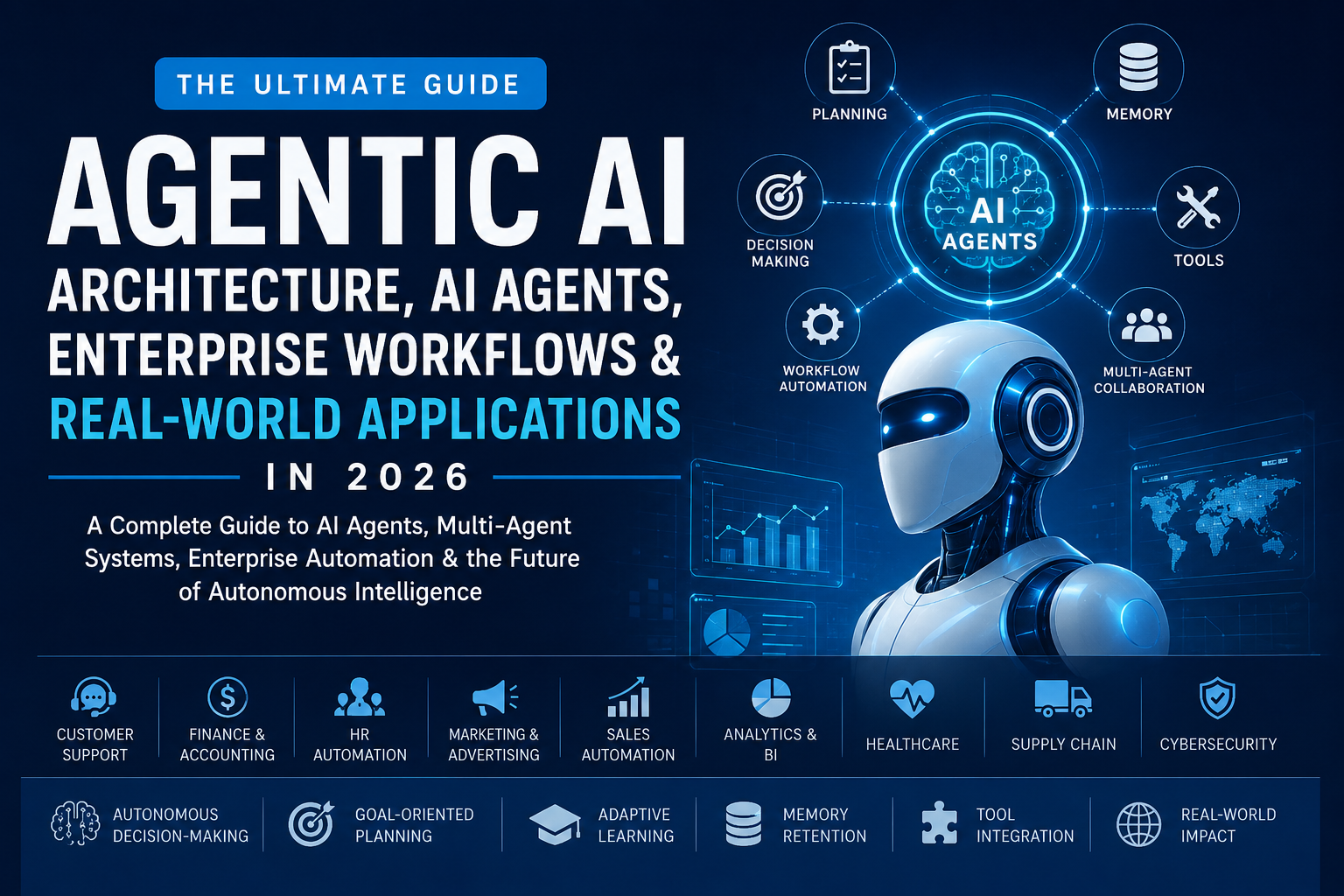
    Agentic AI: AI Agents, Enterprise Workflows & Real-World Applications in 2026

    Agentic AI: The Future of Autonomous AI Systems in 2026

    Introduction to Agentic AI

    Artificial intelligence is evolving beyond basic automation into systems capable of reasoning, planning, and executing tasks independently. This new generation of intelligent systems is known as Agentic AI. In 2026, businesses are increasingly adopting AI agents to automate enterprise workflows, improve operational efficiency, and deliver personalized customer experiences at scale.

    Unlike traditional AI tools that only respond to prompts, Agentic AI systems can analyze objectives, make decisions, retain memory, interact with external tools, and continuously improve through feedback loops. According to enterprise AI trends and industry research, organizations investing in autonomous AI systems are seeing significant improvements in productivity, scalability, and workflow automation.

    This guide explains how Agentic AI works, its core architecture, enterprise applications, challenges, and the long-term impact of autonomous AI systems across industries.

    What is Agentic AI?

    Agentic AI refers to autonomous AI systems designed to complete tasks with minimal human supervision. These systems combine Large Language Models (LLMs), memory frameworks, planning engines, and tool integrations to solve complex problems in real time.

    Modern AI agents are capable of:

    • Autonomous decision-making
    • Goal-oriented task execution
    • Adaptive learning
    • Memory retention
    • Multi-step workflow automation
    • Collaboration with other AI agents

    Unlike traditional chatbots or rule-based automation systems, Agentic AI can proactively manage workflows, retrieve data, update enterprise software, and optimize business operations.

    Industry experts consider Agentic AI one of the most important advancements in enterprise automation because it bridges the gap between conversational AI and autonomous digital operations.

    Core Components of Agentic AI

    Large Language Models (LLMs)

    Large Language Models are the reasoning engine behind Agentic AI systems. Popular models such as GPT, Gemini, and Claude help AI agents understand context, process information, generate responses, and perform advanced reasoning tasks.

    These models enable AI systems to analyze large datasets, summarize information, automate communication, and support enterprise decision-making.

    Memory Systems

    Memory architecture plays a critical role in Agentic AI performance. Short-term memory helps AI maintain conversational context, while long-term memory stores historical interactions and workflow data for future use.

    Many enterprises now use vector databases for AI memory retrieval because they improve contextual accuracy and information recall across large datasets.

    Planning and Decision-Making Engines

    Planning engines allow AI agents to break complex objectives into executable tasks. Decision-making systems evaluate multiple outcomes and select the most effective actions based on goals, business rules, and real-time data.

    This capability enables AI agents to operate autonomously in enterprise environments.

    Tool Integration and Workflow Automation

    Agentic AI systems integrate with APIs, CRMs, ERP systems, databases, analytics dashboards, and cloud platforms. These integrations allow AI agents to automate repetitive business operations such as customer support, reporting, invoice processing, and marketing optimization.

    Workflow orchestration frameworks help coordinate tasks between multiple systems and AI agents for improved scalability and operational efficiency.

    Real-World Applications of Agentic AI

    Customer Support Automation

    AI support agents are transforming customer service operations by providing 24/7 support, instant ticket resolution, and personalized interactions. Autonomous AI systems can retrieve real-time customer information, analyze previous conversations, and deliver faster responses with reduced operational costs.

    Finance and Accounting Automation

    Businesses are increasingly using Agentic AI for invoice processing, fraud detection, expense management, and financial forecasting. Accounts payable and accounts receivable AI agents help automate payment approvals, duplicate detection, collections management, and cash flow monitoring.

    These systems improve financial accuracy while reducing manual administrative work.

    Marketing and Sales Automation

    AI-powered marketing systems optimize campaign performance using audience segmentation, conversion analysis, ad targeting, and predictive analytics. Sales automation tools assist with lead scoring, customer follow-ups, CRM updates, and prospect outreach.

    Organizations using AI-driven marketing strategies are improving customer engagement and increasing conversion rates through data-driven optimization.

    HR and Enterprise Workflow Automation

    Human resource departments are adopting AI workflow automation for employee onboarding, resume screening, interview scheduling, and training management. AI agents streamline repetitive administrative tasks and improve operational efficiency across enterprise departments.

    Industries such as healthcare, finance, cybersecurity, logistics, SaaS, and eCommerce are rapidly implementing AI-driven workflow systems to improve scalability and productivity.

    Challenges and Governance in Agentic AI

    AI Hallucinations and Reliability

    AI systems may occasionally generate inaccurate or misleading information, commonly known as hallucinations. Businesses must implement validation systems and human oversight to ensure reliable outputs.

    Data Privacy and Security Risks

    Since AI agents interact with enterprise systems and sensitive business data, organizations must prioritize cybersecurity, access control, and regulatory compliance to reduce risks.

    Ethical AI Usage

    Responsible AI development requires transparency, accountability, and ethical governance frameworks. Enterprises must ensure AI systems align with legal requirements and organizational policies.

    Infrastructure Costs

    Deploying large-scale autonomous AI systems requires advanced computing resources, cloud infrastructure, and ongoing optimization, which may increase operational costs for some businesses.

    The Future of Agentic AI

    Industry analysts predict that Agentic AI will become a foundational technology for enterprise automation over the next decade. Autonomous AI employees, multi-agent collaboration networks, and self-managing enterprises are expected to redefine business operations.

    Future AI systems will deliver hyper-personalized customer experiences, real-time analytics, predictive decision-making, and intelligent workflow management across connected enterprise platforms.

    Businesses investing in AI integration today are positioning themselves for long-term competitive advantages in automation, scalability, and operational intelligence.

    Conclusion

    Agentic AI represents the next major evolution of artificial intelligence. By combining advanced LLMs, memory systems, planning engines, and enterprise workflow automation, AI agents are transforming how modern businesses operate.

    From customer support and finance to marketing, HR, and cybersecurity, organizations are using autonomous AI systems to improve productivity, efficiency, and customer experiences at scale.

    While challenges such as data privacy, governance, and infrastructure costs remain important considerations, the long-term impact of Agentic AI is expected to reshape enterprise technology and digital transformation in the years ahead.

    Frequently Asked Questions (FAQ)

    What is Agentic AI?

    Agentic AI is an autonomous AI system capable of reasoning, planning, learning, and performing tasks independently with minimal human supervision.

    How is Agentic AI different from traditional AI?

    Traditional AI mainly reacts to commands, while Agentic AI can make decisions, retain memory, use tools, and automate multi-step workflows autonomously.

    What are AI agents?

    AI agents are intelligent software systems designed to complete tasks, interact with tools, analyze information, and automate workflows independently.

    Which industries use Agentic AI?

    Industries such as healthcare, finance, logistics, cybersecurity, SaaS, eCommerce, and enterprise automation actively use Agentic AI technologies.

    Is Agentic AI the future of automation?

    Yes. Industry experts believe Agentic AI will play a major role in the future of enterprise automation because of its scalability, efficiency, and autonomous decision-making capabilities.

  • Beginner Guide to AI Chatbots for Online Businesses 2026

    Beginner Guide to AI Chatbots for Online Businesses 2026

    Introduction

    Ever feel like you’re stuck waiting forever for answers online, switching between tabs just to figure something simple out? It can get frustrating when you just want quick help, but everything feels slow or confusing. That’s exactly why so many people are turning to AI chatbots to make life a little easier and faster.

    In this blog, we’ll break down what ai chatbots actually are and why they’re becoming so popular in everyday use. You’ll also see how they can help with tasks, answer questions, and even save you time in ways you might not expect. By the end, you’ll have a clear, simple understanding of how they work and how you can use them to your advantage.

    What Are AI Chatbots?

    AI Chatbots are intelligent software programs designed to simulate human conversation. They use artificial intelligence chatbots technology to understand user messages and respond in a natural, human-like way. Instead of waiting for a human agent, customers get instant replies.

    At their core, these systems act like a digital assistant for your business. They can answer questions, guide users through products, and even help with basic troubleshooting. Many conversational AI platforms now rely on them to improve customer interaction without increasing support costs.

    In simple terms, AI Chatbots make communication faster, smarter, and more scalable. They reduce pressure on human teams while ensuring customers always feel heard.

    How AI Chatbots Work

    To understand AI Chatbots, you need to know how they process language. These systems use machine learning chatbots technology to learn from data and improve over time. The more conversations they handle, the better they become at responding.

    When a user sends a message, the chatbot breaks it down using natural language processing. It then analyzes intent, context, and keywords before generating the best possible reply. This is what powers AI customer support systems across modern websites.

    Behind the scenes, these bots are constantly learning patterns. This allows them to respond more accurately and handle complex queries without human intervention. Over time, they become more efficient and reliable.

    Why Online Businesses Need AI Chatbots

    Online businesses today rely heavily on speed and availability. Customers don’t want to wait hours for answers. This is why AI Chatbots have become essential for modern digital operations.

    They help businesses provide instant support, capture leads, and improve engagement. With chatbot automation tools, even small teams can manage thousands of conversations at once without delays or missed messages.

    AI Chatbots in Real Business Use Cases

    In real-world scenarios, AI Chatbots are used for order tracking, answering FAQs, and guiding users through purchases. For example, an online store can help customers choose products instantly while also suggesting related items. This improves both user experience and sales performance.

    Businesses also use AI-powered virtual assistant systems to manage bookings, handle complaints, and collect feedback. This level of automation helps companies stay active 24/7 without hiring large support teams.

    Key Features of AI Chatbots

    Modern AI Chatbots come with powerful features designed to improve business operations. One of the most important is automation, which allows businesses to respond instantly without human involvement. This reduces delays and improves efficiency.

    Another key feature is personalization. These smart AI messaging bots can adjust responses based on user behavior and past interactions. Many systems also support chatbot integration for websites, making it easy to connect with ecommerce chatbot solutions and CRM tools.

    Additionally, they can operate 24/7 without breaks. This ensures customers always receive support, even outside business hours. Over time, this consistency builds trust and improves customer satisfaction.

    Types of AI Chatbots for Businesses

    There are different types of AI Chatbots, each designed for specific use cases. Rule-based chatbots follow predefined scripts and are best for simple tasks. AI-driven bots, on the other hand, learn and adapt through interactions.

    Ecommerce chatbot solutions are widely used in online stores. They help customers find products, track orders, and complete purchases. Meanwhile, marketing automation chatbot systems focus on lead generation and customer engagement.

    Some businesses also use hybrid models that combine rule-based logic with AI learning. This approach offers both structure and flexibility, depending on customer needs.

    Benefits of Using AI Chatbots in Online Business

    The benefits of AI Chatbots go far beyond simple messaging. They help businesses reduce response time and improve customer satisfaction significantly. Quick replies often lead to better user experiences and higher conversion rates.

    Another major advantage is cost efficiency. With customer service automation AI, companies can handle large volumes of queries without expanding their support teams. This reduces operational costs while maintaining quality service.

    Businesses also benefit from improved sales. When customers get instant answers, they are more likely to complete purchases. Many companies report higher conversion rates after integrating chatbot for business website solutions.

    Challenges of AI Chatbots

    Even though AI Chatbots are powerful, they still come with challenges. One common issue is understanding complex human emotions. While they handle simple queries well, they may struggle with sensitive or unclear requests.

    Another challenge is deciding between AI chatbot vs human customer support. Humans still outperform bots in empathy-driven situations. This means businesses must balance automation with human interaction carefully.

    There are also technical challenges, such as setup complexity and training requirements. Businesses need to ensure proper configuration to avoid poor user experiences.

    How to Choose the Best AI Chatbot for Your Business

    Choosing the right AI Chatbots solution depends on your business goals. Start by identifying what you want the chatbot to do, whether it’s support, sales, or marketing.

    Next, consider ease of use and integration. The best chatbot platform for business owners should connect easily with your website and tools. If you’re a beginner, free AI chatbot tools for beginners can be a good starting point.

    Scalability is also important. As your business grows, your chatbot should handle increasing traffic without performance issues. Always choose tools that support chatbot automation for ecommerce stores and marketing systems.

    Future of AI Chatbots in Online Business

    The future of AI Chatbots is becoming more advanced and intelligent. Businesses are moving toward systems that feel more human and predictive. Instead of just responding, they will anticipate user needs.

    Soon, digital assistants for business tools will manage entire workflows automatically. From customer service to sales forecasting, everything will become more integrated and seamless.

    We will also see improvements in voice interaction and emotional intelligence. The future of AI chatbots in digital business is focused on creating smoother, faster, and more natural customer experiences.

    FAQs

    1. What are AI chatbots used for in online businesses?

    They are used for customer support, lead generation, sales assistance, and automating repetitive tasks.

    2. Do AI chatbots improve customer support?

    Yes, they provide instant responses, reduce waiting time, and improve overall customer satisfaction.

    3. Can small businesses afford AI chatbots?

    Yes, many affordable and free tools are available, making them accessible for small businesses.

    4. How difficult is chatbot integration for websites?

    Most modern tools offer simple drag-and-drop or plugin-based integration, making setup easy.

    5. Are AI chatbots better than human support agents?

    They are faster for basic tasks, but humans are still better for complex or emotional issues.

    Conclusion

    AI Chatbots have become a powerful tool for modern online businesses. They help automate communication, improve customer service, and increase efficiency across multiple areas.

    As technology continues to evolve, businesses that adopt AI early will gain a strong competitive advantage. Whether you run a small store or a large platform, integrating chatbot solutions today can help you stay ahead in the fast-moving digital world. If you want more helpful guides and practical content on digital growth and AI tools, you can also explore https://goshywrites.com/ for more insights.

  • AI Data Center News 2026: Growth, Investment, and Innovation Insights

    AI Data Center News 2026: Growth, Investment, and Innovation Insights

    Keeping up with ai data center news can feel overwhelming, especially when every week there’s a new breakthrough, upgrade, or massive investment announcement. If you’ve been trying to understand what’s really changing in the world of AI infrastructure, it’s easy to feel like you’re always one step behind. Most updates are full of technical terms that don’t really explain what it means for everyday users or businesses.

    In this blog post, we’ll break down the latest news in a simple and clear way so you can actually understand what’s happening and why it matters. You’ll get key insights into new developments, trends shaping the industry, and what to expect next in AI-powered data centers. By the end, you’ll have a much clearer picture of where this fast-moving technology is heading.

    Introduction to AI Data Center News in 2026

    The world of technology is moving faster than most people can keep up with, and ai data center news has become one of the most talked-about topics in 2026. Every week, new announcements about massive AI infrastructure projects, cloud expansions, and chip breakthroughs are reshaping how digital systems work. If you’ve felt like this space is confusing or overly technical, you’re not alone.

    What makes this topic even more interesting is how deeply it affects everyday digital life. From apps you use to search engines and streaming platforms, everything now depends on powerful AI systems running in large-scale data centers. In this article, we’ll break down the latest news, explain what is driving the growth, and show you where the industry is heading next.

    What Is Driving the Growth of Data Centers?

    The demand behind modern ai data center news is mostly driven by one major factor: artificial intelligence itself. AI models today require massive computing power, especially for training large language models and running real-time applications. This has led to rapid expansion of artificial intelligence data centers around the world.

    Another key driver is the explosive rise of cloud-based services. Companies are no longer relying on small server setups. Instead, they are shifting toward hyperscale data centers that can handle AI computing infrastructure at global levels. As a result, AI server farms are growing faster than traditional IT systems ever did, pushing cloud data center expansion into a new era.

    Major Investments in AI Data Center Infrastructure

    When looking at news, one trend stands out clearly: huge investments from tech giants. Companies like Microsoft, Google, Amazon, and Meta are pouring billions into building next generation data centers designed specifically for AI workloads.

    These investments are not just about size but also about efficiency. Modern data center investment trends focus heavily on GPU clusters for AI training, advanced cooling systems, and distributed computing networks. The goal is simple: build faster, smarter, and more scalable infrastructure that can support the future of AI powered cloud computing.

    How AI Is Changing Data Architecture

    One of the most fascinating shifts in news is how AI itself is now reshaping data center design. Instead of traditional static systems, new facilities are becoming intelligent and adaptive. This means data center automation AI is now used to manage performance, cooling, and workload distribution.

    In addition, machine learning infrastructure is being built directly into operations. For example, AI systems can now predict hardware failures before they happen or automatically balance server loads. This evolution marks a shift toward fully autonomous next generation data centers that require less human intervention and deliver higher efficiency.

    Energy Consumption Challenges in Data Centers

    A major concern highlighted in news is energy usage. AI systems require enormous computing power, and that means high electricity consumption. Many experts are now asking: how much energy do AI use, and is it sustainable long term?

    To solve this, companies are investing in green data centers and sustainable computing systems. Liquid cooling technology is also becoming more common because it reduces heat more efficiently than traditional air cooling. Still, energy remains one of the biggest challenges in AI infrastructure growth, and it will likely shape future innovation.

    Role of Cloud Computing in AI News

    Cloud computing plays a central role in every discussion about ai news. Without cloud platforms, modern AI systems would not scale the way they do today. Cloud providers are now integrating AI powered cloud computing directly into their infrastructure to support real-time processing and global accessibility.

    This shift has also improved cloud scalability solutions. Businesses no longer need to build their own infrastructure. Instead, they can access powerful AI systems through cloud networks. This has made advanced computing more accessible while accelerating the expansion of distributed computing networks worldwide.

    Key Companies Leading Data Expansion

    When analyzing ai data center news, it’s impossible to ignore the companies leading this transformation. Tech giants like Amazon Web Services, Microsoft Azure, Google Cloud, and Nvidia are at the center of this growth.

    These companies are not just building infrastructure; they are defining the future of AI computing infrastructure. Nvidia, for example, plays a crucial role in semiconductor chips for AI, which power almost every modern AI workload. Meanwhile, cloud providers are expanding hyperscale data centers globally to meet increasing demand.

    Innovation Trends in AI Data Centers

    Innovation is moving quickly in the world of ai data center news. One major trend is edge computing AI, which allows data processing closer to users instead of relying only on central servers. This reduces latency and improves performance.

    Another major innovation is liquid cooling technology, which is becoming essential for managing heat in high-density AI server farms. At the same time, data center automation AI is improving efficiency by reducing manual operations. These advancements are shaping smarter, faster, and more sustainable systems.

    Regional Growth of AI Data Centers

    Global expansion is another major theme in ai data center news. The United States remains a leader, but regions like the Middle East, Europe, and Asia-Pacific are rapidly increasing their investments in AI infrastructure.

    Countries are building cloud data center expansion projects to support local digital economies. This regional growth is not just about technology but also about digital independence. Many governments now see AI infrastructure growth as a strategic priority for economic development.

    Challenges Facing AI Data Center Industry

    Despite rapid progress, ai data center news also highlights several challenges. One major issue is cost. Building and maintaining AI server farms is extremely expensive due to hardware, energy, and cooling requirements.

    Another challenge is scalability. As AI models become larger, infrastructure must constantly evolve. There is also pressure to improve sustainability while handling increasing workloads. These challenges show that while growth is strong, the industry still faces important technical and environmental limits.

    Future of AI Data Centers Beyond 2026

    future-of-ai-data-centers

    Looking ahead, AI data center news suggests that the future will be defined by even deeper integration between AI and infrastructure. We can expect fully autonomous data centers powered by AI systems that manage themselves in real time.

    Advancements in semiconductor chips for AI and cloud scalability solutions will continue to push performance boundaries. At the same time, sustainable computing systems will become a necessity rather than an option. The future of AI data centers in 2026 and beyond will focus on speed, intelligence, and energy efficiency.

    FAQs

    What is driving AI data center growth?

    The main drivers are increasing AI workloads, cloud adoption, and demand for high-performance computing infrastructure.

    How much energy do AI data centers use?

    They consume large amounts of electricity due to GPU-heavy processing, but new cooling and efficiency systems are helping reduce usage.

    Which companies are leading AI data center expansion?

    Major leaders include Microsoft, Google, Amazon, and Nvidia, all investing heavily in AI infrastructure.

    What is the future of AI data centers?

    The future will focus on automation, sustainability, and faster AI-powered cloud computing systems.

    Are AI data centers sustainable?

    They are improving with green technologies, but energy efficiency remains a major challenge for the industry.

    Conclusion

    The evolution of ai data center news shows how quickly the digital world is transforming. From massive infrastructure investments to AI-driven automation, the industry is entering a new era of computing power and intelligence.

    As demand continues to grow, AI data centers will become the backbone of global technology systems. The next few years will define how efficient, sustainable, and powerful these systems become, shaping the future of digital innovation for everyone. If you want to explore more insights like this in a simple and easy-to-understand way, you can visit https://goshywrites.com/ for more helpful content and updates.

  • AI Transformation Is a Problem of Governance in 2026

    AI Transformation Is a Problem of Governance in 2026

    Introduction:

    In 2026, AI transformation goes beyond adding technology to existing systems. It redefines the thinking, decision, and operational approaches of entire organizations. For organizations in the UK, USA, and Canada, AI transformation in business effectively means integrating intelligent systems into all organizational levels and business functions. AI transformation in business means a complete rethinking of the business functions of hiring, marketing, finance, logistics, and legal. AI transformation in business is much more than automation; today’s AI systems are capable of sophisticated decision making and are designed to accomplish tasks in the real world unassisted.

    AI transformation in business is governance issue. The technologies integrate in a way organizations cannot control and begin to govern the organization almost immediately. The transformation vs adoption dichotomy creates a governance issue because transformation means an organization is dependent on technology. There is increasing understanding across different contexts that AI transformation in business and the governance issues it creates is a race against the speed of control relative to the pace of technological advancement.

    Transformation introduces issues such as machine learning model drift, unpredictable outputs, and scaling. Without strong data governance in AI, the financial and reputational risks of using AI are high. This is why industry experts strongly recommend the integration of control and governance frameworks in the design of AI systems.

    Why AI Transformation Is a Governance Problem

    The rapid transformation brought on by AI is a challenge for governance. Technology changes faster than accountability. That’s what makes AI transformation a governance issue. Improving services is, of course, a key priority for businesses. Sadly, during this process, many of them neglect ethical considerations and potential long-term challenges. When AI systems make decisions about client loans, staff recruitment, or health care support, it is hard to identify who is accountable. This is especially problematic.

    AI systems are often considered “black boxes,” so even knowing the outputs of an AI system does not inform decision-makers about how the AI arrived at that output. This leads to a breakdown of corporate responsibility, aggravated by the AI output control crisis. The absence of transparency leads to distrust, and corporations begin to struggle to meet the emerging AI-related legal frameworks, particularly in the European Union region with the EU AI Act.

    An issue of fragmentation is also present. During the broad deployment of enterprise AI systems, many governance frameworks become fragmented and are not consistently implemented. The fragmentation of enterprise AI systems is a challenge for businesses because it introduces decision-making inconsistency and operational errors caused by algorithm bias. In such an environment, governance is not optional. Governance becomes the basis for trust, safety, and the overall performance of AI systems.

    WhyAI Transformation Strategies Fail Without Governance

    AI transformation is a governance issue, as many AI projects fail due to a lack of governance frameworks. The majority of failed AI projects, according to many consulting firms, are the result of poor governance and a lack of oversight and accountability frameworks.

    Without AI risk management, organizations begin using siloed systems. One department could apply AI to a program using up-to-date data, while another uses out-of-date data. This leads to inconsistent outcomes and fails to meet business objectives. Companies that don’t implement monitoring and auditing for their AI systems miss early-stage errors, and small disruptions become larger, more costly issues.

    The absence of AI policies and standards is another of the leading disruptive factors. In the absence of development policies, disparate departments create their own models. It is only a matter of time before disruptive duplicative models are found when the business is finally able to scale.

    Reasons for

    AI Transformation Project Failure and Their Business Impact

    • Poor governance structure
    • Inconsistent results
    • No data standardization
    • Low prediction accuracy
    • Lack of monitoring
    • Late error detection
    • Weak accountability
    • Regulatory exposure
    • The failures of the systems prove that without governance AI is unstable, ineffective, and expensive.

    AI Transformation Governance Versus Traditional IT Governance

    Most IT governance efforts deal with the management of the governance framework, software updates, and the performance of systems. IT systems are static until the next manual update. In contrast, AI systems operate with a level of autonomy and manage some risk on their own. This creates a fundamentally different risk management challenge.

    Contemporary AI governance frameworks include oversight for ethical implications, rules for transparency, and a mandate for ongoing evaluation of AI models. Unlike most IT systems, AI models change in ways that require governance to be constantly updated and maintained. This drift in machine learning models places a premium on ongoing governance. As such, AI Transformation Is a Problem of Governance in the complex realities of the contemporary digital world.

    In addition, the ethical dimension of IT governance is virtually non-existent. By contrast, the ethical dimension of AI governance is concerned with ensuring fairness of outcomes, such as for employment or lending decisions. In the absence of ethical AI governance, organizations may face negative outcomes, such as discrimination and loss of reputation. This manifests the AI Transformation Is a Problem of Governance in the majority of industries that deal with sensitive information and automated decision-making.

    Basic Elements of a Good AI Governance Framework

    A good AI transformation governance framework ensures that a business’s use of AI is innovative and responsible. For governance to work effectively, there should be both transparency and accountability for AI systems and the outcomes that those systems produce. AI governance frameworks must also safeguard the privacy and security of the sensitive data that AI systems process. AI governance frameworks must also safeguard the privacy and security of the sensitive data that AI systems process. AI governance systems must also ensure that systems are monitored throughout the entire AI lifecycle.

    Oversight of ethics and compliance is equally as essential. Responsible use of AI reduces bias and promotes fairness, and while maintaining legal compliance. AI transformation governance is focused on incorporating innovative solutions while ensuring responsible use.

    The AI Transformation Governance Maturity Model: An Overview

    Establishing AI transformation governance isn’t instantaneous. Organizations advance through staged levels. Early stage companies are typically disorganized, while more established companies implement governance layers through all levels of their decision-making framework. This evolution demonstrates ai transformation aligns with governance across all levels of maturity.

    At early stages, usage of AI is mostly unsupervised. Later stages allow greater levels of monitoring with more autonomy. Organizations at later stages of maturity design governance that enables oversight and monitoring before the need actually arises.

    • Maturity Level
    • Characteristics
    • Initial
    • No governance
    • Developing
    • Basic policies
    • Defined
    • Standardized rules
    • Optimized
    • Continuous oversight
    • These maturity levels depict governance and how it stabilizes and enhances operational performance.

    Governance of AI: Board and Leadership Roles

    The defining characteristics of enterprise AI governance are the actions taken by senior leadership. AI governance in the absence of senior leadership is generally unstructured. The board’s understanding of risks and ethical compliance is imperative to responsible guidance of transformation efforts.

    Leading from the front is the most important requirement for all governance of AI. The investment of resources governs from a place of policy rather than a place of reaction. When senior management understands the implications of governance on the transformation of AI, then the alignment of the innovative with the long-term strategic of the organization takes precedence over the short-term.

    Why is Executive Accountability Important for AI Oversight?

    Having accountable executives means that AI systems will not be deployed without oversight. AI risk management and governance strategies are expected to be understood and approved by the Board. Without oversight, organizations may be sued and suffer public outrage.

    AI Oversight Integrity as a Result of the EU AI Act and Other Emerging Regulations

    Most countries are in the process of developing stricter regulations, and the EU AI Act is the first of its kind. The EU AI Act will shape compliance to AI Acts in the UK, USA and Canada. Developing AI Systems with Risk and Safety focused regulations will become the corporate standard due to strict compliance regulations.

    The AI transformation of governance, especially in the Healthcare and Finance sectors, is warranted by this challenge.

    Major Governance Issues Related to the Deployment of AI Systems

    Most organizations are becoming aware of the problems related to governance caused by the deployment of AI systems. One of the major issues is the lack of coordination of the numerous AI teams. This results in inconsistent work and wasted resources. Another challenge is the lack of skills to manage sophisticated AI systems.

    Most companies experience the challenge of the AI systems being able to operate at a high level in a contained environment, but not once deployed to an enterprise level. Without adequate oversight and auditing of AI systems, these failures may remain hidden, until the damage is done.

    Developing an AI Governance Framework: A Practical Guide

    Creating structured AI governance means first establishing accountability and ownership and creating AI policies as well as AI development standards. After policies and standards are set, monitoring mechanisms are established.

    Ensuring the continuous assessment of AI lifecycle management also means the governance framework is flexible. Depending on the stage of development, governance takes precedence over business strategy to ensure the longevity of the structure.

    Using AI Transformation Governance as a Business Strategy

    Robust AI transformation governance creates competitive advantage, particularly when developing AI ethically. Furthermore, the development of ethical AI strengthens AI governance, reduces regulatory risk, and improves both the performance and reputation of an organization.

    When AI governance is integrated into business strategy, the performance of organizations improves. This is especially true when optimizing the quality of business decisions and operations. Governance transforms the use of AI from a business risk to a strategic advantage.

    Final Thoughts

    Both governance and AI are transforming the business landscape in North America and the United Kingdom. The use of AI without appropriate governance is the equivalent of racing ahead while blind.

    Organizations that will invest in AI governance and oversight will have a competitive advantage. Those that will not invest in AI governance will risk failing operationally and will be subjected to regulatory scrutiny.

    Overall, the companies that achieve the best results will be the ones that integrate innovation and accountability. These companies will ensure that AI is working both effectively and efficiently. For more information on artificial intelligence, digital acceleration, and advanced content strategies, you can continue perusing the site for more balanced and thoughtful perspectives on technology and content.

    FAQs

    What will AI governance be like in 2026?

    AI governance in 2026 will be systems of rules and controls implemented to govern AI systems to ensure equity, safety and compliance.

    Why is AI transformation a governance issue?

    Because the speed of AI evolution is greater than the speed of policy generation, creating risks related to accountability and ethical governance.

    How do organizations demonstrate AI accountability?

    They establish clear ownership structures and design feedback mechanisms to monitor and justify every AI-related decision.

    What leads to the failure of AI systems in organizations?

    Inadequate data governance, poor oversight, and issues like model drift and algorithm bias.

    What are the benefits of AI governance for organizations?

    It delivers a competitive edge, fosters trust, and enables organizations to leverage AI at scale in a safe and prudent manner.

  • AI App Builder: Create Apps Without Coding Easily Using AI App Builder Tools in 2026

    AI App Builder: Create Apps Without Coding Easily Using AI App Builder Tools in 2026

    Introduction to AI App Builder

    The digital world is shifting fast, and AI App Builder tools are now at the center of that change. Across the UK, USA, and Canada, people are discovering a smarter way to build apps without coding skills. Instead of hiring expensive developers, users now rely on AI-powered app creation systems that turn ideas into real applications in minutes. This shift is not just a trend. It is a complete transformation of how software is built today.

    What makes AI App so powerful is its simplicity combined with intelligence. These platforms use automation and machine learning to guide users through the entire development process. As a result, beginners and professionals alike can focus on creativity instead of technical coding. Many experts even call it the fastest way to create an app without coding, especially for startups and small businesses trying to enter the digital market quickly.

    What is an AI App Builder?

    An AI App Builder is a modern solution that helps users create applications without writing a single line of code. It belongs to the world of no-code app development platforms, where visual tools and AI systems handle the technical side of development. This means you simply describe your idea, and the system builds the structure, design, and features automatically.

    To understand what an AI app builder is and how it works, imagine giving instructions to a smart assistant. The platform analyzes your input, selects the right templates, and creates a working app. This is part of AI-based software development, which reduces complexity and speeds up production. Many businesses now prefer intelligent app builder software because it removes technical barriers completely.

    How AI App Builders Work

    The process behind AI App Builder tools is based on automation and intelligent learning models. These systems analyze user requirements and convert them into functional app structures. They use AI application development tools to design layouts, connect databases, and even suggest features automatically.

    Most platforms rely on drag and drop app builder systems combined with app development automation. This allows users to visually build applications while AI handles the backend logic. For example, if you want an e-commerce app, the system automatically adds payment gateways, product pages, and user authentication.

    Here is a simple breakdown of how it works:

    StepProcess
    Idea InputUser describes app concept
    AI AnalysisSystem interprets requirements
    Auto DesignUI is generated automatically
    Feature SetupFunctions are added by AI
    TestingApp is optimized for performance

    This entire system shows how AI helps in app development by reducing time, cost, and complexity.

    Key Features of AI App Builder Tools

    Modern AI App Builder tools come packed with powerful features that make development simple and fast. One of the most important features is AI-driven app design platforms, which automatically generate clean and modern user interfaces. This eliminates the need for design skills.

    Another major feature is cross-platform app builder support. It allows users to create apps that work on Android, iOS, and web at the same time. This makes mobile app builder software more efficient for businesses targeting multiple audiences. Many platforms also include app prototyping with AI, which helps users test ideas before launching.

    These features make AI App systems a core part of modern rapid app development tools, especially for startups and freelancers.

    Benefits of Using AI App Builder

    benefits-of-using-ai-app-builder

    The biggest benefit of AI App Builder tools is that they allow anyone to create mobile apps without programming skills. This opens doors for entrepreneurs, students, and small businesses who previously could not afford development teams.

    Another advantage is speed. Users can build apps without coding using AI tools in a fraction of the time compared to traditional methods. These systems also help reduce errors because AI automatically checks and optimizes the app during creation.

    A simple comparison shows the difference:

    Traditional DevelopmentAI App Builder
    Weeks or monthsMinutes or hours
    High costLow cost
    Coding requiredNo coding needed

    These benefits clearly show why AI App is becoming a global trend in low-code no-code development.

    Best Use Cases of AI App Builders

    The flexibility of AI App Builder tools makes them useful in many industries. Startups use them for startup app development tools because they can quickly test ideas without spending large budgets. This helps them launch faster and adjust based on feedback.

    Educators, freelancers, and small businesses also use these tools for easy app creation using AI software. For example, a fitness trainer can build a personal training app, while a restaurant can create a booking system. These platforms show how startups use AI app builders to grow faster in competitive markets.

    Popular AI App Builder Platforms

    Today’s market is filled with best no-code AI app builder platforms that offer different features depending on user needs. Some focus on business apps, while others specialize in creative or educational tools.

    These platforms are part of AI tools for building Android and iOS apps, allowing users to reach global audiences quickly. Many of them also include automation, analytics, and integration features that support AI-powered app creation at scale.

    A key fact is that over 60% of new startups in 2026 use some form of AI app builder tools for their first product launch.

    Challenges of AI App Builders

    Despite their benefits, AI App Builder platforms still face challenges. One major issue is limited customization. While they are powerful, they may not support very complex or unique systems.

    Another challenge is scalability. Some mobile app builder software solutions struggle with large enterprise-level applications. This is why developers still play a role in advanced systems.

    However, improvements in AI-based software development are rapidly solving these problems, making tools more flexible every year.

    AI App Builder vs Traditional App Development

    Traditional development requires coding expertise, large teams, and longer timelines. In contrast, AI Apps platforms focus on speed and simplicity. They use app development automation to handle technical tasks instantly.

    Many experts believe that AI app builders replacing developers is a key question today. The answer is not fully yes, but they are changing the role of developers. Instead of coding everything, developers now focus more on customization and innovation.

    This shift shows how AI-driven app design platforms are reshaping the industry.

     Future of AI App Builders

    The future of AI App Builder tools looks extremely promising. Experts predict that the future of AI in app development will include fully automated systems where apps are built using voice commands or simple text prompts.

    We will also see stronger integration of cross-platform app builder systems that work instantly across all devices. These tools will become more intelligent, learning from user behavior to improve app performance automatically.

    In the coming years, AI application development tools will likely become the standard for digital creation worldwide.

    Conclusion

    The rise of AI App Builder platforms marks a major shift in how apps are created. From startups to enterprises, everyone is now exploring the best platforms for no-code app building to save time and reduce costs.

    As technology evolves, AI App Builder tools will continue to grow smarter and more powerful. They are not just simplifying development. They are redefining how we think about innovation, creativity, and digital growth in the modern world.

    FAQs

    1. What is an AI App Builder and how does it work?
    An AI App Builder is a no-code tool that uses AI to turn ideas into apps by generating design, features, and structure automatically.

    2. Can I build apps without coding using AI tools?
    Yes, you can build apps without coding using AI App Builder platforms that handle all technical development through automation.

    3. Are AI app builders good for beginners?
    Yes, they are perfect for beginners because they require no coding skills and offer simple drag-and-drop interfaces with AI support.

    4. Do AI app builders create Android and iOS apps?
    Most AI App Builder platforms support cross-platform development, allowing you to build apps for both Android and iOS easily.

    5. Are AI app builders replacing traditional developers?
    Not completely. They reduce manual coding but developers are still needed for complex customization and advanced app systems.

  • Best AI Apps to Boost Productivity in 2026: Complete Guide to Smarter Work and Efficiency

    Best AI Apps to Boost Productivity in 2026: Complete Guide to Smarter Work and Efficiency

    Introduction: Why AI Apps Are Changing Productivity in 2026

    The digital world is moving faster than ever, and ai apps are now at the center of this transformation. In 2026, professionals in the UK, USA, and Canada depend on AI apps to manage tasks, create content, and make smarter decisions in less time. These tools are no longer optional. They are part of daily work culture.

    What makes ai apps so powerful is their ability to learn and adapt. They don’t just follow commands. Instead, they analyze behavior and suggest better ways to work. As a result, people can improve productivity with AI while reducing stress and mental fatigue. Whether you are a student, freelancer, or business owner, these tools are reshaping how you work and think.

    In simple words, AI apps help you do more in less time. They allow users to automate repetitive tasks, save time using AI tools, and focus on meaningful work instead of boring routines.

    What Are AI Apps and How Do They Improve Productivity?

    Modern ai apps are advanced digital tools built using machine learning and automation systems. These AI-based applications understand user behavior and complete tasks intelligently. Instead of manual effort, they rely on AI-powered solutions that think, predict, and execute actions.

    The biggest advantage of ai apps is their ability to streamline workflow. For example, they can summarize long emails, generate reports, or schedule meetings automatically. This helps users increase work efficiency without extra effort. Many professionals now call them essential digital productivity tools because they reduce complexity in everyday tasks.

    A major reason behind their popularity is their flexibility. From writing to coding, AI apps fit into almost every profession. They are not just tools. They are assistants that help users optimize time management and work smarter.

    Key Benefits of Using AI Apps in Daily Life

    The rise of AI app has changed how people handle everyday responsibilities. One major benefit is their ability to enhance daily productivity by simplifying routine tasks. Whether it is organizing schedules or drafting messages, these tools act like personal assistants.

    Another powerful benefit is their ability to reduce manual effort. Instead of doing repetitive work, users can rely on intelligent automation apps that complete tasks instantly. This allows individuals to focus on creativity and decision-making.

    A simple comparison shows the difference:

    Task TypeWithout AI AppsWith AI Apps
    Email Writing15–20 minutes2–3 minutes
    Data EntryManual & slowAutomated instantly
    SchedulingConfusing & time-consumingSmart AI suggestions

    Many users also rely on AI tools for daily tasks because they help maintain balance in both personal and professional life. As a result, AI app for efficiency are now part of modern lifestyles across the globe.

    Best AI Apps to Boost Productivity in 2026

    The market is full of the latest AI apps, but only a few stand out for performance and reliability. These ai apps fall into different categories based on their purpose, such as writing, design, automation, and task management.

    Businesses and individuals now depend on AI productivity apps to handle complex workflows. These tools are designed to support smart work with AI, helping users complete tasks faster and with fewer errors.

    Let’s explore the most powerful categories shaping the future of productivity.

    AI Writing Assistants

    AI writing tools are among the most popular AI apps for content creation in 2026. They help users write blogs, emails, reports, and social media posts in seconds. These tools are widely used by marketers and bloggers who want to boost workplace efficiency without spending hours writing.

    A freelancer in New York shared this experience:
    “I used to spend 3 hours writing client content. Now I finish it in 30 minutes using AI writing assistants.”

    These tools also help users improve grammar, tone, and clarity while maintaining a natural writing style. They are essential AI tools for freelancers and content creators worldwide.

    AI Task and Project Management Apps

    Managing tasks becomes simple with ai apps for time management. These tools automatically organize deadlines, assign priorities, and track progress. They are widely used in remote teams across Canada and the UK.

    These AI apps for remote work ensure that teams stay connected and productive. They help users simplify complex tasks and reduce confusion in project planning. Many companies now rely on them as core AI tools for better performance.

    AI Design and Creativity Tools

    Creative professionals benefit greatly from AI app for Android and iPhone that generate visuals, edit images, and suggest design ideas. These AI tools for content creation allow even beginners to produce professional-level designs.

    These tools also support smart AI applications that analyze trends and suggest modern design patterns. Designers now use them to speed up workflows and explore creative possibilities they could not imagine before.

    AI Automation Tools

    Automation has become a game changer in 2026. AI automation tools help businesses handle emails, data processing, and customer support without human intervention. These tools are designed to automate repetitive tasks and improve efficiency.

    A small UK startup reported a 40% productivity boost after using automation tools. This proves how AI-driven productivity solutions are transforming modern businesses.

    These tools are now essential for companies that want to stay competitive in fast-moving markets.

    AI Note-Taking and Research Apps

    Students and professionals use AI apps for students to take notes, summarize lectures, and organize research materials. These tools help users enhance daily productivity by turning long content into simple summaries.

    Researchers also use them to analyze data faster. These AI software for productivity tools are especially useful for academic work where time and accuracy matter.

    How to Choose the Right AI App for Your Needs

    Choosing the right ai app depends on your goals. Some users need writing support, while others need automation or design help. The key is to identify your daily challenges first.

    A simple evaluation method includes checking usability, integration, and performance. The best top AI tools for work are those that adapt to your workflow instead of complicating it. Always choose tools that help you improve productivity with AI naturally.

    Free vs Paid AI Apps – Which One Is Better?

    free-vs-paid-ai-apps

    Many users start with free AI app for productivity because they are easy to access. These tools are great for learning and small tasks. However, they often come with limited features.

    Paid ai app offer advanced functions, better accuracy, and faster performance. They are designed for professionals who want long-term results and stronger AI-powered solutions.

    Here is a quick comparison:

    FeatureFree AI AppsPaid AI Apps
    FeaturesLimitedAdvanced
    SpeedModerateFast
    AccuracyBasicHigh
    SupportLimitedPriority

    In most cases, paid tools provide better value for serious users.

    Tips to Maximize Productivity Using AI Apps

    To get the most out of AI app, users should combine them with smart planning. Instead of relying fully on automation, it is better to guide the tools for better results.

    Professionals who use AI tools for better performance often review their workflows weekly. This helps them identify areas where they can optimize time management and improve output.

    Experts suggest using AI for personal productivity alongside traditional methods. This balance ensures better control and long-term efficiency.

    Future of AI Apps in Productivity

    The future of AI apps is highly advanced and exciting. Experts predict that by 2026 and beyond, these tools will become more personalized and intelligent. They will predict user needs before actions are taken.

    We will also see deeper integration of AI in everyday life, where everything from emails to project planning is handled by smart systems. This will redefine how people work globally.

    A tech analyst stated:
    “The next generation of AI will not just assist work. It will think with you.”

    This shows how the future of AI in work is moving toward full automation and smart decision-making systems.

    Conclusion

    In today’s world, ai app are no longer just helpful tools. They are essential partners in productivity. From writing and design to automation and research, these tools are reshaping how people work across the UK, USA, and Canada.

    As technology evolves, AI apps will continue to grow smarter, faster, and more useful. Those who adopt them early will always stay ahead in productivity and innovation.

    FAQs

    1. What are the best AI apps in 2026 for productivity?
    The best AI apps 2026 include writing, task management, and automation tools that help users work faster and smarter daily.

    2. How do AI apps improve productivity?
    AI apps improve productivity by automating repetitive tasks, saving time, and helping users focus on important work instead.

    3. Are AI apps useful for students and freelancers?
    Yes, AI apps are highly useful for students and freelancers as they help with writing, research, planning, and time management.

    4. Do I need paid AI apps or are free ones enough?
    Free AI apps are good for basics, but paid AI apps offer better features, accuracy, and advanced productivity tools.

    5. Can AI apps replace human work completely?
    No, AI apps support human work but do not fully replace creativity, decision-making, or emotional intelligence in tasks.