Blog

  • AI Agents News: Latest Updates in Artificial Intelligence (2026 Guide to AI Innovation)

    AI Agents News: Latest Updates in Artificial Intelligence (2026 Guide to AI Innovation)

    Introduction to AI Agents News and Artificial Intelligence Updates

    AI agents news is moving fast in 2026, and you probably feel that shift already. Every week brings new artificial intelligence updates that change how businesses work in the UK, USA, and Canada. These updates are not small tweaks. Instead, they reshape entire systems through autonomous AI systems that think and act like digital workers.

    Interestingly, companies now track AI agents’ news like stock market reports. Why? Because even one update can improve productivity or cut costs dramatically. For example, a new AI workflow automation news release can instantly upgrade how customer support runs in global companies. So, staying updated is no longer optional. It is survival in a fast digital economy powered by AI innovation breakthroughs and next-gen AI technologies.

    What Are AI Agents in Artificial Intelligence? Understanding AI Agents Latest News

    AI agents are intelligent software systems that perform tasks, make decisions, and learn from data. They sit inside modern enterprise AI solutions and act like digital employees. Unlike basic bots, they don’t just follow instructions. Instead, they adapt using machine learning advancements and real-time feedback loops.

    When you read what is the latest news about AI agents, you’ll notice one key idea. These agents are becoming more independent. They now handle workflows, customer support, data analysis, and even decision-making in business environments. This shift is part of a bigger movement called AI-driven decision systems, where machines help humans think faster and smarter.

    To make it simple, here is how AI agents work in real life:

    StepWhat Happens
    InputAI receives data from systems
    ProcessingIt analyzes patterns using AI models
    DecisionIt selects the best action
    ExecutionIt performs the task automatically
    LearningIt improves from outcomes

    This cycle runs continuously inside smart AI assistants and AI automation tools updates, making systems more efficient every day.

    Latest Developments in AI Agents (2026 Updates and AI Developments)

    The year 2026 has brought massive changes in AI. One major highlight in AI agents’ latest news is the rise of fully autonomous systems that can manage entire workflows without supervision. These systems are part of generative AI agents, which make decisions instead of just following rules.

    Another big shift comes from AI agent technology trends, where companies now deploy multi-agent systems. These systems allow different AI agents to work together like a digital team. For example, one agent handles data collection while another manages customer responses. Together, they form a powerful ecosystem of AI-powered automation tools updates.

    A recent case study from a US logistics company shows the impact clearly. After adopting advanced AI agents, they reduced delivery delays by 42 percent. At the same time, customer satisfaction increased significantly. This proves that AI agents news and AI developments 2026 are not theoretical. They are already changing real business outcomes.

    Here are key trends shaping the industry:

    TrendImpact
    Multi-agent systemsBetter coordination
    Generative AI agentsSmarter decision-making
    Real-time learningFaster adaptation
    Cloud-based AIEasy scalability

    How AI Agents Are ChaHow AI Agents Are Changing Industries with Intelligent Automation News

    Industries are transforming rapidly due to intelligent automation news and continuous AI breakthroughs. In finance, agents detect fraud instantly. Healthcare teams use them to assist with diagnosis, while retailers rely on them to personalize shopping in real time. Each industry benefits differently, but the outcome is the same: faster and smarter operations.

    For example, a UK banking system recently integrated AI-driven decision systems to manage fraud detection. As a result, false alerts dropped by 30 percent. Meanwhile, approval processes became faster. This shows how AI is transforming business automation is not just theory but real-world impact.

    Another interesting example comes from Canada, where healthcare providers use AI agents to monitor patient data. These systems act like smart AI assistants, alerting doctors when anomalies appear. This reduces response time and improves patient safety.

    Transparency remains a key concern in AI agents news conversations

    Here is how industries currently use AI agents:

    • Finance uses AI for fraud detection and trading decisions
    • Healthcare uses AI for diagnostics and patient monitoring
    • Retail uses AI for personalization and inventory control
    • Logistics uses AI for routing and delivery optimization

    These examples highlight the growing importance of AI workflow automation news in modern industries.

    Top AI Agent Tools Making News in 2026 AI Innovation Breakthroughs

    The rise of AI automation tools updates has introduced powerful platforms that dominate AI agents news. These tools help companies automate tasks, analyze data, and improve decision-making processes.

    Many businesses now rely on platforms built for enterprise AI solutions. These tools support everything from customer support to advanced analytics. They are part of a larger ecosystem of next-gen AI technologies that reshape how companies operate , and they continue to gain attention in AI agents news for their rapid real-world adoption.

    ?

    Here is a comparison of popular AI agent tool categories:

    Tool TypePurposeIndustry
    Workflow AI AgentsAutomate tasksBusiness operations
    Generative AI AgentsCreate content & decisionsMarketing & research
    Analytical AI SystemsData insightsFinance & analytics

    A quote from an industry analyst sums it up well:

    “AI agents are no longer tools. They are becoming digital colleagues.”

    This reflects how the latest breakthroughs in generative AI agents are shaping the future of automation.

    Benefits of AI Agents in Modern Systems and AI Workflow Automation News

    benefits-of-ai-agents

    The benefits of AI agents are becoming clearer with every AI agent’s latest news update. One major advantage is speed. Tasks that once took hours now complete in seconds. Another benefit is accuracy, especially in data-heavy industries.

    Businesses using AI-driven decision systems report better productivity and lower costs. This happens because AI reduces human error and improves consistency. As a result, teams can focus more on strategy instead of repetitive work.

    A quick breakdown of benefits:

    BenefitImpact
    SpeedFaster operations
    AccuracyFewer mistakes
    ScalabilityEasy growth
    EfficiencyLower costs

    Companies also use AI innovation breakthroughs to improve customer experience. For example, e-commerce brands now personalize product suggestions in real time using AI agents.

    Challenges and Concerns in AI Agent Development and AI AI Developments 2026

    Even though AI is powerful, it comes with challenges. One major issue is trust. Businesses often ask whether autonomous AI systems make safe decisions. Transparency remains a key concern in AI agents news discussions.

    Another challenge is job disruption. Many people worry about AI agents replacing human jobs. While AI automates tasks, it also creates new roles in AI management and system supervision. So the reality is more balanced than extreme predictions.

    Security is another concern. Since AI systems process sensitive data, companies must ensure strong protection. Without it, risks increase significantly in AI-driven decision systems.

    Future of AI Agents in Artificial Intelligence and Next-Gen AI Technologies

    The future of AI agents looks extremely advanced. Experts believe that the future of AI agents in 2026 and beyond will involve fully autonomous digital ecosystems. These systems will run entire companies with minimal human input.

    We are moving toward a world where autonomous AI systems collaborate across industries. They will manage supply chains, customer service, and even financial planning. This shift represents the next phase of next-gen AI technologies.

    Here is a simple forecast:

    YearDevelopment
    2026Multi-agent systems expand
    2027Fully autonomous workflows
    2028AI-managed enterprises

    A key insight from researchers states:

    “The future is not human versus machine. It is human with machines.”

    This reflects how AI innovation breakthroughs will shape global industries.

    Why AI Agents News Matters for Businesses and AI Innovation Breakthroughs

    Businesses that follow AI agents’ news updates gain a strong competitive advantage. They understand trends early and adopt tools before competitors. This helps them stay ahead in fast-moving industries.

    Companies also use AI workflow automation news to improve decision-making. When new tools launch, they quickly adjust strategies. This flexibility is crucial in modern markets powered by AI automation tool updates.

    A real example comes from a USA-based SaaS company. They integrated smart AI assistants into their workflow and improved efficiency by 50 percent in six months. This shows how staying updated drives real business growth.

    Conclusion

    AI agents are shaping the future of technology faster than ever. Every AI agent’s latest news update shows progress in intelligence, automation, and decision-making. Businesses in the UK, USA, and Canada are already adapting to this shift.

    The rise of AI-driven decision systems and generative AI agents marks a new era. Companies that embrace these tools will lead innovation. Those that ignore them risk falling behind in a world driven by AI developments in 2026 and beyond.

    In the end, AI agents are not just technology. They are the foundation of tomorrow’s digital economy, and their influence continues to grow across every industry discussed in AI agents news.

    FAQs

    1. What is the latest news about AI agents?

    AI agents are becoming more autonomous in 2026, handling complex tasks, decision-making, and workflow automation across industries.

    2. How are AI agents changing artificial intelligence?

    They shift AI from simple task execution to intelligent decision systems that learn, adapt, and operate independently.

    3. Are AI agents replacing human jobs?

    Not fully. They automate repetitive tasks but also create new roles in AI management, oversight, and strategy.

    4. How do autonomous AI systems work?

    They collect data, analyze patterns, make decisions, execute actions, and continuously improve through machine learning.

    5. What are the best AI agent platforms in 2026?

    Top platforms focus on enterprise AI solutions, generative AI agents, and workflow automation tools for businesses.


  • AI Workflow Agents: The Future of Intelligent Automation and AI Workflow Automation in Business

    AI Workflow Agents: The Future of Intelligent Automation and AI Workflow Automation in Business

    Introduction to AI Workflow Agents and AI Workflow Automation

    AI workflow agents are quickly changing how businesses run daily operations across the UK, USA, and Canada. At their core, they are autonomous AI agents designed to handle tasks, make decisions, and optimize processes without constant human control. These systems sit inside modern AI workflow automation environments where they connect apps, analyze data, and execute actions in real time. Unlike traditional tools, they don’t just follow instructions, they think, learn, and adapt as conditions change.

    Today, companies rely heavily on AI-powered workflow management because speed and accuracy matter more than ever. Businesses no longer want slow manual processes or rigid systems. Instead, they prefer flexible intelligent workflow systems that can scale easily. For example, a marketing team can use AI productivity tools to automatically schedule campaigns, track engagement, and adjust targeting without manual input. This shift marks a major step in digital workflow automation, where intelligence replaces repetition.

    A simple comparison helps you understand the difference:

    Traditional SystemsAI Workflow Agents
    Rule-based actionsAdaptive decision-making
    Manual monitoringSelf-learning automation
    Limited scalabilityHigh scalability
    Static workflowsDynamic workflows

    In short, what AI workflow agents are and how they work becomes clear when you see them as digital workers that never sleep and constantly improve performance.

    How AI Workflow Agents Work in Intelligent Workflow Systems

    AI workflow agents function through a mix of data processing, machine learning, and automation logic. They operate inside AI task automation systems where they receive input, analyze patterns, and execute actions across platforms. These agents are deeply connected with machine learning automation tools, which help them improve accuracy over time. Every action they take becomes part of a learning cycle that strengthens future decisions.

    When a business uses AI automation tools, the workflow usually follows a structured path. First, data enters the system from emails, apps, or customer interactions. Then the AI agent processes this data using trained models. After that, it selects the best action, such as sending a response, updating records, or triggering another system. Finally, it learns from the outcome and adjusts its behavior.

    A real-world example shows this clearly. Imagine an online store in Canada. A customer places an order. The AI workflow agent checks inventory, updates stock, sends confirmation emails, and schedules delivery automatically. No human steps in unless something unusual happens.

    This process is often compared with robotic process automation (RPA) AI, but AI workflow agents go further because they think instead of just repeating steps. That is why businesses increasingly invest in enterprise AI automation to reduce workload and improve speed.

    Key Features of AI Workflow Agents in AI Workflow Automation Systems

    AI workflow agents stand out because they combine intelligence with execution. One major feature is autonomy. These systems can operate as autonomous AI agents, meaning they do not require constant human direction. They analyze conditions and make decisions based on learned data patterns.

    Another powerful feature is integration. These agents connect with tools like CRMs, marketing platforms, and finance software. This creates a seamless ecosystem of AI-driven business operations, where every tool communicates with each other automatically.

    Here is a simple breakdown of key features:

    FeatureDescription
    AutonomyWorks independently
    Learning AbilityImproves through data
    IntegrationConnects with business tools
    ScalabilityHandles large workloads
    AdaptabilityAdjusts to changes

    These features make smart workflow software highly valuable for modern companies. They also support workflow optimization tools that improve efficiency across departments. Businesses that adopt these systems often see faster turnaround times and fewer operational errors.

    Benefits of Using AI Workflow Agents in Business Process Automation AI

    AI workflow agents bring major advantages to companies of all sizes. One of the biggest benefits is productivity. When businesses use AI workflow automation systems, they reduce repetitive tasks and free employees to focus on strategic work. This is where how AI workflow agents improve productivity becomes very clear.

    Another major benefit is cost savings. Companies reduce operational expenses by automating tasks that once required manual labor. At the same time, accuracy improves because machines don’t get tired or distracted. This makes AI automation tools essential for competitive industries.

    A short comparison table highlights the impact:

    AreaBefore AI Workflow AgentsAfter AI Workflow Agents
    Task SpeedSlowFast
    CostHighReduced
    AccuracyHuman errorHigh precision
    ScalabilityLimitedFlexible

    Businesses also benefit from better decision-making. With AI-powered workflow management, leaders receive real-time insights that help them act quickly. This creates stronger, more responsive organizations.

    Use Cases of AI Workflow Agents in AI-Powered Workflow Management

    AI workflow agents are used across many industries. In marketing and sales, they handle customer segmentation, email campaigns, and lead scoring. This is a strong example of AI automation for marketing and sales, where companies increase conversions with minimal manual effort.

    In healthcare, these systems manage patient records, appointment scheduling, and diagnostic support. In finance, they detect fraud, automate reporting, and monitor transactions. E-commerce companies use them for inventory tracking and order fulfillment.

    A real case study comes from a UK-based retail brand. They implemented AI tools that automate business processes to manage their customer support system. Within three months, response time improved by 60 percent and customer satisfaction increased significantly.

    This shows how companies use AI workflow agents is not just theory, it is already transforming industries globally.

    AI Workflow Agents vs Traditional Automation Tools

    The biggest difference between AI workflow agents and traditional systems lies in intelligence. Traditional automation tools follow fixed rules, while AI agents adapt and learn. This is why the difference between AI agents and automation tools is becoming a major discussion in tech industries.

    Traditional systems are useful for simple tasks, but they fail when situations change. AI workflow agents, however, adjust dynamically. They use real-time data and machine learning to improve outcomes.

    Here is a simple comparison:

    AspectTraditional AutomationAI Workflow Agents
    IntelligenceLowHigh
    FlexibilityFixedAdaptive
    LearningNoneContinuous
    Decision-makingRule-basedData-driven

    Because of this, many companies are upgrading to AI automation technology to stay competitive in fast-moving markets.

    Challenges and Limitations of AI Automation Systems

    Even though AI workflow are powerful, they come with challenges. One major concern is data privacy. Companies must protect sensitive information while using enterprise AI automation systems. Regulations in the UK, USA, and Canada require strict compliance.

    Another challenge is complexity. Implementing AI task automation systems requires technical expertise. Many businesses struggle with integration into older systems. This slows down adoption for small and medium companies.

    A simple breakdown of challenges includes:

    ChallengeImpact
    Data PrivacySecurity risks
    High Setup CostInitial investment
    Integration IssuesSystem compatibility
    Skill GapLack of trained experts

    Despite these issues, companies continue adopting AI workflow automation systems because long-term benefits outweigh short-term difficulties.

    Future of AI and Intelligent Systems

    The future of AI agents looks highly advanced. Experts predict that businesses will move toward fully autonomous operations powered by the future of AI workflow automation technology. This means systems will not only assist but also manage entire business functions.

    We are already seeing early versions of this in AI-driven business operations, where systems manage logistics, marketing, and customer support without human input. In the next decade, autonomous AI agents will become standard in most industries.

    A major shift will also happen in jobs. Instead of replacing humans, AI will transform roles. People will focus more on creativity and strategy while machines handle execution. This leads to better efficiency and smarter organizations.

    Best Practices for Implementing AI Agents in Business

    Successful adoption of AI agents requires a smart approach. Businesses should start small and scale gradually. Testing AI workflow automation tools in one department first helps reduce risk and improve results.

    Data quality is another key factor. Clean and structured data improves the performance of machine learning automation tools. Without good data, even the best systems fail.

    Companies should also train employees to work alongside AI. This ensures smooth collaboration between humans and machines.

    A simple guide includes:

    StepAction
    Start SmallPilot projects
    Improve DataClean datasets
    Train TeamsAI skill development
    Scale GraduallyExpand systems

    These steps ensure successful implementation of AI agents for small businesses and large enterprises alike.

    Conclusion 

    AI workflow agents are no longer future technology, they are already reshaping industries today. They combine intelligence, automation, and adaptability to create powerful systems that improve productivity and reduce costs. As AI workflow automation continues to evolve, businesses in the UK, USA, and Canada will increasingly depend on these systems to stay competitive.

    The shift toward intelligent workflow systems is not just about technology. It is about building smarter, faster, and more efficient organizations. Companies that adopt early will lead the future, while others may struggle to keep up.

    In the end, AI agents are not replacing humans. Instead, they are becoming powerful partners in building the next generation of digital business.

    FAQs

    1. What are AI workflow agents and how do they work?
    AI workflow agents are smart systems that automate tasks, learn from data, and make decisions to improve business processes.

    2. How do AI agents improve productivity?
    They reduce manual work, speed up tasks, and allow teams to focus on higher-value activities instead of repetitive jobs.

    3. What is the difference between AI agents and automation tools?
    Automation tools follow fixed rules, while AI agents learn, adapt, and make intelligent decisions based on real-time data.

    4. Are AI workflow agents suitable for small businesses?
    Yes, small businesses can use them to save time, cut costs, and automate marketing, support, and operations easily.

    5. Will AI workflow agents replace human workers?
    No, they mainly assist humans by handling repetitive tasks, while people focus on creativity and strategy.

  • iPhone 18 Pro Colors: Four New Shades, But No Black Option

    iPhone 18 Pro Colors: Four New Shades, But No Black Option

    • Four New Colors Expected for iPhone 18 Pro
    • Dark Cherry (Pantone 6076) – New Signature Deep Wine Red
    • Light Blue (Pantone 2121) – Soft Airy Shade
    • Dark Gray (Pantone 426C) – Closest Option to Black
    • Silver (Pantone 427C) – Returning Classic Neutral
    • No Black Option for Second Year in a Row
    • Foldable iPhone Ultra May Offer Black & Space, Gray
    • Dark Cherry Would Be First Red on Pro Model Since 2022
    • iPhone 18 Pro Launch Expected September 2026
    • Pricing Likely to Stay the Same as the Current Model

    Apple is getting ready to launch the iPhone 18 Pro this September. And if you love black phones, I have some bad news for you. The company is reportedly skipping black again this year.

    Instead, Apple is preparing four new color options. The headliner is a deep wine shade called Dark Cherry. Let me walk you through every rumored color, what is changing, and when you can expect to see these phones in stores.

    The Four Rumored Colors for iPhone 18 Pro

    According to supply chain sources, Apple is working on four distinct finishes for the iPhone 18 Pro and Pro Max. These colors are still in development. But here is what the company is testing right now.

    Light Blue (Pantone 2121)

    This shade looks similar to the Mist Blue color on the current base iPhone 17. It is a soft, airy blue that feels calm and sophisticated. If you like subtle colors, this might be your pick.

    Dark Cherry (Pantone 6076)

    This is the big one. Dark Cherry is a deep wine-like red. It is much more muted than last year’s bright Cosmic Orange. Think less fruit punch, more fine wine. Bloomberg’s Mark Gurman confirmed Apple is testing a deep red finish for the Pro models.

    Dark Gray (Pantone 426C)

    This is your closest option to black. Dark Gray is a rich, almost charcoal shade. But Apple is not calling it black. The company has reportedly canceled the classic black option for the second year in a row.

    Silver (Pantone 427C)

    Silver is returning from the current generation. It is a clean, bright neutral that never goes out of style. This is probably the safest choice for most buyers.

    Close-up shot of iPhone 18 Pro back glass in Dark Cherry red color, showing the deep wine-like shade and premium matte texture
    Fig 2: Dark Cherry is expected to be the signature color for iPhone 18 Pro. It is a deep wine red, much more muted than last year’s bright orange.

    Wait, No Black Option Again?

    That is correct. Apple has not offered a black or dark gray Pro iPhone since the iPhone 16 Pro. Last year’s iPhone 17 Pro launched in only three colors: Silver, Cosmic Orange, and Deep Blue. Black was completely absent.

    The same thing is happening this year. According to Weibo leaker Instant Digital, Apple will not offer a black color option for the iPhone 18 Pro. This is surprising. Black is usually a staple color for premium phones.

    Some earlier leaks suggested Apple was considering brown and purple finishes. According to Gurman, those shades are simply different versions of the same red concept.

    What About the Foldable iPhone?

    Apple is also launching a foldable iPhone this year. It might be called the iPhone Ultra. And here is good news for fans of classic colors. Apple plans to stay away from fun colors for the foldable model.

    Gurman said the foldable iPhone will stick to more conservative shades like space gray, black, and silver or white. So if you want a dark, professional-looking iPhone, the foldable might be your best option.

    Dark Cherry: The Signature Color for 2026

    Every year, Apple introduces a signature color for its Pro models. Last year, it was Cosmic Orange. That shade was very popular, especially in China. Some reports say it helped Apple hit record iPhone sales there.

    This year, the signature color is Dark Cherry. It is a deep, wine-like red. The hue is much closer to wine than a bright cherry red . It looks classy and bold at the same time.

    If Dark Cherry makes it to the final lineup, this will be a historic moment. It would be the first time red appears on a Pro model iPhone. The last red iPhone was the iPhone 14 with the (PRODUCT)RED finish in 2022.

    Why Is Apple Changing the Colors?

    Apple changes its color lineup every year for one simple reason. It wants new phones to look different from old ones. A fresh color makes people want to upgrade.

    The company also tests many colors before making a final decision. Last year, Apple considered launching the iPhone 17 Pro in black or steel gray. Neither color made it to production. The same situation could repeat with the upcoming model. One of the four rumored shades might be dropped before the September launch.

    When Will We Know for Sure?

    September 2026 is the anticipated release window for the iPhone 18 Pro and Pro Max. Mass production has not started yet. So Apple still has time to make changes to the color lineup.

    The foldable iPhone Ultra might arrive later in the year after the September event.

    What About Pricing?

    Good news for your wallet. The iPhone 18 Pro is expected to keep the same starting price as the current model. In Hong Kong, that means around 9,399 HKD for the base model. Apple is absorbing higher component costs instead of passing them to customers.

    Quick Summary: iPhone 18 Pro Colors at a Glance

    Color NamePantone CodeNotes
    Light Blue2121Similar to current Mist Blue
    Dark Cherry6076New signature color, deep wine red
    Dark Gray426CClosest to black
    Silver427CReturning from current generation
    Comparison image showing iPhone 18 Pro colors (Light Blue, Dark Cherry, Dark Gray, Silver) on top and iPhone 17 Pro colors (Silver, Cosmic Orange, Deep Blue) below
    Fig 3: iPhone 18 Pro colors (top) compared to last year’s iPhone 17 Pro colors (bottom). Cosmic Orange is gone, replaced by Dark Cherry.

    Final Thoughts

    The iPhone 18 Pro color lineup is shaping up to be interesting. Dark Cherry is a bold, classy choice for anyone who wants to stand out. Light Blue and Silver offer softer, more traditional options. And Dark Gray gives you a dark finish without being true black.

    If you absolutely need a black iPhone, you might be disappointed. Apple seems committed to keeping black out of the Pro lineup for now. Your best bet is either the Dark Gray option or the upcoming foldable iPhone.

    We will know the final colors closer to September. But for now, these four shades are the ones to watch.

    FAQs for iPhone 18 Pro Colors 

    QuestionShort Answer
    What colors?Light Blue, Dark Cherry, Dark Gray, Silver
    Black option?No – Dark Gray is the closest
    Release date?September 2026
    Price change?Expected to stay the same
    First red Pro?Yes, if Dark Cherry launches

    Q1: What colors will the iPhone 18 Pro come in?

    According to the latest leaks and supply chain reports, the iPhone 18 Pro will likely come in four colors. These are Light Blue, Dark Cherry (deep wine red), Dark Gray, and Silver. Dark Cherry is expected to be the new signature color for 2026, replacing last year’s Cosmic Orange.

    Q2: Is Apple releasing a black iPhone 18 Pro?

    No. Based on current information, Apple will not offer a true black option for the iPhone 18 Pro. This would be the second year in a row without a black Pro model. The closest option will be Dark Gray, which is a charcoal-like shade. If you want a black iPhone, you may need to look at the rumored foldable iPhone Ultra instead.

    Q3: When will the iPhone 18 Pro be released?

    Apple is expected to launch the iPhone 18 Pro and Pro Max in September 2026. This follows the company’s usual release schedule for new iPhones. Mass production has not started yet, so the final color lineup could still change before the official announcement.

    Q4: Will the iPhone 18 Pro cost more than the current model?

    The starting price for the iPhone 18 Pro is expected to stay the same as the current model. Apple is reportedly absorbing higher component costs rather than passing them to customers. In markets like Hong Kong, that means around 9,399 HKD for the base model. Pricing in other regions may vary.

    Q5: Has Apple ever made a red Pro iPhone before?

    No. If Dark Cherry makes it to the final production, this would be the first time a red shade appears on a Pro model iPhone. The last red iPhone was the iPhone 14 with the (PRODUCT)RED finish back in 2022, and that was on the standard model, not the Pro. So Dark Cherry would be a historic first for Apple’s premium lineup.

    Official Sources & Authoritative Guides:

  • Who’s Richer: Google or Apple? A 2026 Wealth Showdown

    Who’s Richer: Google or Apple? A 2026 Wealth Showdown

    • Apple Leads as Most Valuable Brand at $607.6 Billion
    • Google’s Brand Value Stands at $433.1 Billion (3rd Place)
    • Market Cap Battle: Apple ($3.8T) vs Google ($3.58T)
    • Google Briefly Surpassed Apple in January 2026
    • AI Race: Google’s Gemini & Ironwood TPU Impress Investors
    • Apple Intelligence 2.0 Delayed Until Mid-2026
    • iPhone Revenue Hits $85.27 Billion (23.3% Growth)
    • Google Cloud Revenue Jumps 48% to $17.66 Billion
    • Apple’s Ecosystem Has 2.5+ Billion Active Devices
    • Final Verdict: Apple Is Richer, But Google Is Catching Fast

    The tech world loves a good rivalry. And few debates spark more curiosity than the financial face-off between Google and Apple. Both are absolute giants. But which one is actually “richer”?

    The answer changes depending on how you measure wealth. Do you look at brand reputation? Total company value? Or maybe yearly profits? Let me break down all three ways and give you a clear picture of where these two titans stand in 2026.

    Round 1: Most Valuable Brand

    When we talk about “rich” in terms of public perception and reputation, we look at brand value. This measures how much the name “Apple” or “Google” is worth on its own.

    According to the Brand Finance Global 500 report for 2026, Apple keeps its crown as the world’s most valuable brand. The report valued Apple at an incredible $607.6 billion. That is up from $574.5 billion last year.

    Google sits in third place on this same list. Its brand value comes in at $433.1 billion. Microsoft is actually in second place between them, valued at $565.3 billion.

    So, in terms of pure brand power and reputation, Apple is significantly “richer” than Google. The Apple brand alone is worth almost $175 billion more than Google’s brand. That is a massive gap.

    Winner: Apple

    Round 2: Market Capitalization (Total Company Value)

    This is the most common way people compare company wealth. Market capitalization is the total value of a company’s shares. It tells you what the stock market thinks the entire business is worth.

    And here is where things get really interesting in 2026.

    For most of the past six years, Apple has had a higher market cap than Google. But that changed dramatically in early 2026. In January 2026, Alphabet (Google’s parent company) surpassed Apple in market valuation for the first time since 2019.

    What caused this shift? The answer is Artificial Intelligence. Investors are pouring money into companies leading the AI revolution. Google has impressed the market with its Gemini AI models and its in-house TPU chips called “Ironwood.” Meanwhile, Apple has faced criticism for being slower to roll out its generative AI features.

    However, the market cap race is very volatile. As of April 2026, Apple’s market cap sits around $3.8 trillion, while Alphabet’s is about $3.58 trillion. They keep trading places. NVIDIA is currently the world leader at over $4.3 trillion, but between Apple and Google, it remains a neck-and-neck battle.

    Currently, Apple holds a slight lead. But Google proved earlier this year that it can take the top spot.

    Winner: Apple (by a narrow margin)

    Bar chart showing Apple's market cap at 3.8 trillion dollars and Google's market cap at 3.58 trillion dollars, with Apple bar slightly taller in blue and Google bar in red
    Fig 2: Apple currently leads Google in market capitalization, but the gap is very narrow. Both companies keep trading places in 2026.

    Round 3: Financial Performance and Revenue

    Brand value is nice, but actual cash flow pays the bills. Let us look at who is making more money.

    In the most recent quarterly reports, Apple showed it is still a hardware powerhouse. The iPhone generated $85.27 billion in revenue, which was a 23.3% increase from last year. Their high-margin Services business hit an all-time high of $30.01 billion.

    Google is strong in different areas. Their Cloud business grew 48% to $17.66 billion, with operating income more than doubling. Search remains a cash cow, holding steady at $63.07 billion.

    To put it all in perspective, the “Big 4” tech companies (Amazon, Apple, Google, and Microsoft) had a combined revenue of $1.86 trillion over the past 12 months. This sum is actually larger than the GDP of most countries on earth.

    Both companies are extremely profitable. However, Apple’s profit margins on hardware and services tend to be higher than Google’s margins on advertising and cloud computing.

    Winner: Tie (Both are massively profitable)

    Why Did Google Beat Apple in January 2026?

    That brief moment in January when Google took the lead tells us a lot about where the market is heading. Investors are now prioritizing AI leadership over hardware stability.

    Google launched the “Ironwood” TPU (an AI chip) and released the powerful Gemini 3 model. These moves convinced Wall Street that Google is the real deal in AI. In contrast, Apple had to postpone its “Apple Intelligence 2.0” update until mid-2026, which frustrated some investors.

    However, Apple has one massive advantage: its ecosystem. With over 2.5 billion active devices, Apple Intelligence has the potential to put AI features directly into the hands of a huge audience instantly. When Apple finally releases its AI tools, the race could flip again.

    Line graph showing two lines, one for Google stock going up and one for Apple stock, with the lines crossing in January 2026 where Google briefly went higher
    Fig 3: In January 2026, Google briefly overtook Apple in market value. The AI race helped Google gain investor confidence.

    Final Verdict: Who Is Really Richer?

     Strictly speaking, in terms of brand value, Apple is the clear winner by almost $200 billion. When considering market cap right now, Apple has a slight lead, though Google briefly overtook it earlier this year. If we look at revenue growth, Google’s Cloud is accelerating faster, but Apple’s iPhone just had its best quarter ever.

    So, who is richer?

    The answer is Apple. They lead in brand perception and current market value. But the gap is closing fast. Google has the momentum in the AI sector, and that is what investors care about most right now.

    The race for the richest tech company is no longer just about phones and ads. It is about who controls the future of artificial intelligence. For now, Apple holds the crown. But Google is right there, waiting to take it.

    FAQs for Google vs Apple

    QuestionShort Answer
    Who is richer?Apple leads, but Google is very close
    Did Google ever beat Apple?Yes, in January 2026
    What makes Apple valuable?iPhone, Services, 2.5B devices
    What makes Google valuable?Ads, Cloud, AI leadership
    Better investment?Both are good; diversify

    Q1: Who is actually richer, Google or Apple?

    In terms of brand value, Apple is richer at $607.6 billion versus Google’s $433.1 billion. In terms of market capitalization, Apple also leads slightly at $3.8 trillion compared to Google’s $3.58 trillion as of April 2026. However, Google briefly overtook Apple in January 2026. So Apple holds the crown right now, but the race is very close.

    Q2: Did Google ever beat Apple in total company value?

    Yes. In January 2026, Alphabet (Google’s parent company) surpassed Apple in market valuation for the first time since 2019. Investors were impressed by Google’s AI progress with Gemini models and Ironwood TPU chips. Apple had delayed its own AI features, which made investors nervous. The lead did not last long, but it proved Google can compete at the very top.

    Q3: What makes Apple so valuable?

    Apple’s strength comes from three things. First, the iPhone generates over $85 billion in quarterly revenue. Second, their Services business (App Store, Apple Music, iCloud) hit a record $30 billion. Third, Apple has over 2.5 billion active devices worldwide. This massive ecosystem keeps users locked in. When people buy one Apple product, they often buy more.

    Q4: What makes Google so valuable?

    Google’s power comes from advertising and cloud computing. Google Search alone generated over $63 billion in recent quarters. Their Cloud business grew 48% to $17.66 billion, with operating profit more than doubling. Google is also seen as a leader in artificial intelligence with Gemini AI and custom TPU chips. Investors believe AI will drive Google’s next phase of growth.

    Q5: Which company is a better investment right now?

    This depends on your investment style. Apple offers stability, huge cash reserves, and a loyal customer base. Google offers faster growth potential, especially in AI and cloud computing. Both companies pay no dividend (they reinvest profits into growth). Most financial advisors recommend holding both for diversification. Neither is a bad choice. But always do your own research before investing.

    Official Sources & Authoritative Guides:

    https://ayeshanarratives.com/apples-ai-leadership-shuffle-signals-strategic-push-amid-industry-race/
  • WhatsApp 2026: New AI Features, Usernames & Privacy Tools Explained

    WhatsApp 2026: New AI Features, Usernames & Privacy Tools Explained

    • AI Writing Help for Smart Message Suggestions
    • AI Image Editing: Remove Objects & Change Backgrounds
    • Usernames Finally Roll Out (Hide Your Phone Number)
    • 4-Digit Username Key for Extra Security
    • Status Updates Moving to Chats Tab (Like Instagram Stories)
    • Per-Chat Storage Management: Delete Media, Keep Text
    • Two WhatsApp Accounts on One iPhone (Finally)
    • Cross-Platform Chat Transfer (iPhone ↔ Android)
    • WhatsApp Business New Pricing & Tools 2026
    • Meta AI Tab Coming Soon to WhatsApp
    • Complete Summary Table of All 2026 Features

    WhatsApp has changed a lot this year. If you haven’t opened the app recently, you might be surprised. The Meta-owned messaging platform added artificial intelligence tools, a long-awaited username feature, and several privacy upgrades. These updates arrived in early 2026, and more are coming soon.

    Let me walk you through everything new on WhatsApp. I have gathered fresh information from multiple reliable sources. Everything you will read here is current as of April 11, 2026. Whether you use WhatsApp for personal chats or business communication, this guide covers what matters most.

    WhatsApp Now Has AI Writing and Editing Tools

    WhatsApp finally integrated artificial intelligence directly into the app. This is a big deal. Previously, users had to copy text to external apps like ChatGPT for help. Now, everything happens inside WhatsApp.

    How AI Writing Help Works

    The feature is called “Writing Help.” It lives right in the chat bar. When you type a message, you can tap a special icon. It looks like a pencil with sparkles around it.

    Here is what the AI can do for you:

    • Rephrase your message in a different tone
    • Proofread before you hit send
    • Adjust the style from casual to professional
    • Suggest full replies based on conversation context

    The AI reads your conversation history to understand what you are talking about. Then it offers relevant suggestions. For example, if someone asks about dinner plans, the AI might suggest, “How about pizza at 7 PM?”

    Image Editing with Meta AI

    WhatsApp also added AI image editing tools. You can now:

    • Remove unwanted objects from photos
    • Change or replace backgrounds
    • Apply different visual styles to your images

    All these edits happen directly within the chat window. No need to open another app. The tools use Meta’s own AI models to process your media.

    Privacy Concerns? Here is the Good News

    Meta says these AI features do not compromise your privacy. The company claims chats remain end-to-end encrypted even when you use Writing Help. The AI examines your messages to create recommendations. However, your actual chat content remains secure and private.

    However, there is a catch. These AI capabilities are only available in countries where Meta has officially launched its AI services. Regulatory approval varies by region. So some users may not see these features yet.

    Usernames Finally Arrive on WhatsApp

    This is the feature users have wanted for years. After years of waiting, WhatsApp has started introducing usernames to its users. You no longer need to share your phone number with everyone you message.

    How WhatsApp Usernames Work

    The feature started rolling out in early April 2026. Currently, it is available to a limited number of Android and iOS users. The company plans to expand availability to everyone sometime in the coming months.

    Here are the key rules for usernames:

    • Length must be between 3 and 35 characters
    • Must contain at least one alphabet (no numbers or symbols only)
    • Can include underscores, periods, and lowercase letters
    • Cannot start with “” or end with “.com”, “.in”, etc.

    Your phone number is still required to use WhatsApp. But you do not have to share it with new contacts. Instead, share your username.

    Extra Security: The Username Key

    WhatsApp added another layer of protection. Users can create a 4-digit username key. Someone who wants to message you needs both your username and this key. This makes unwanted messages much harder to send.

    You can also use your existing Facebook or Instagram username on WhatsApp. The platform will let you confirm ownership through the Accounts Center.

    Smartphone display of WhatsApp Settings page with a new "Username" option highlighted, showing a field to enter a custom username and a 4-digit key option below
    Fig 2: Setting up your WhatsApp username is simple. Go to Settings > Privacy > Username. Choose a unique name and optionally add a 4-digit key for extra protection.

    Status Updates Are Moving to Your Chats Tab

    WhatsApp has kept Status updates hidden for eight years. That is changing now. The company is testing a major redesign.

    The New Status Location

    Instead of a separate Updates tab, Status will soon appear at the top of your Chats list. You will see a horizontal row of circular avatars. This looks very similar to Instagram Stories.

    Here is how it works:

    • Friends with new Status updates appear first
    • The order is based on how often you interact with each contact
    • You can swipe down to access the full Status tray
    • Muted contacts go to the end of the list

    Why Is WhatsApp Doing This?

    Meta wants to make Status more visible. Currently, very few users actively post Status updates compared to Instagram Stories. By moving Status to the main chat screen, Meta hopes more people will use it.

    The design copies Telegram. Telegram added a similar Stories feature in 2023, and user engagement exceeded expectations. WhatsApp is following a proven model.

    What Stays the Same

    Status updates still disappear after 24 hours. You can still add stickers, text, music, and effects. And most importantly, Status remains end-to-end encrypted. Instagram Stories are not encrypted.

    The feature is still in testing. It appears in both iOS and Android beta versions. The company has not yet shared any confirmed launch date.

    Storage Management Gets Smarter

    WhatsApp can now help you free up space more intelligently. Instead of wiping entire conversations, you can be selective.

    Per-Chat Storage Controls

    You can now manage storage on a per-chat basis. Open any chat, go to storage settings, and see exactly which files take up the most space. Then choose to delete only media files while keeping the text message history.

    This is especially useful for users in many group chats. Those groups often accumulate hundreds of photos and videos.

    Smart Recommendations

    The app can now detect usage patterns. If a chat exceeds 80% of its average storage capacity, WhatsApp will suggest cleaning it up. This happens in real time as you use the app.

    iOS Finally Gets Android Features

    iPhone users have been waiting for two specific features. They are finally here.

    Two Accounts on One iPhone

    You can now run two different WhatsApp accounts on the same iPhone. This makes it easy to separate personal and business numbers. Android users have had this ability for years.

    Cross-Platform Chat Transfer

    WhatsApp now officially supports moving chat history between operating systems. You can transfer all your data from iPhone to Android and back without losing anything. This was previously impossible.

    WhatsApp Business Updates for 2026

    WhatsApp is also improving its Business platform. Several changes affect how companies communicate with customers.

    New Pricing for Business Messages

    WhatsApp now charges businesses for sending marketing messages. The charges range from $0.05 to $0.09 per message, depending on the country. Businesses can respond to customer messages for free for up to 24 hours. After that, charges apply.

    Meta has released updated per-message rate cards for multiple countries, including India, Pakistan, Saudi Arabia, and Turkey.

    New Communication Tools

    WhatsApp Business now offers three new tools:

    • Click-to-chat buttons on websites and Facebook ads
    • Real-time support directly within WhatsApp
    • Instant information retrieval from business websites

    These tools aim to replace phone calls and emails for customer service.

    What Is Coming Next?

    WhatsApp is testing even more features. Here is what to expect soon.

    Meta AI Tab

    Some beta users see a dedicated Meta AI tab at the bottom of the app. This centralizes all AI tools in one place. The Communities tab has been removed to make space.

    WhatsApp Groups API

    Businesses can now programmatically create and manage groups using the WhatsApp Groups API. This is useful for large organizations managing many customer communities.

    Multi-Solution Conversations

    Marketing messages can now include multiple solutions in a single conversation. This helps businesses handle complex customer inquiries more efficiently.

    Side by side comparison showing WhatsApp chat screen with Status circles at the top on the left, and Telegram chat screen with Stories circles at the top on the right
    Fig 3: WhatsApp’s redesigned Status section (left) now looks very similar to Telegram’s Stories feature (right). Both place circular contact avatars at the top of the main chat list.

    Summary: All WhatsApp 2026 Updates at a Glance

    FeatureStatusWhat It Does
    AI Writing HelpRolling out nowSuggests and rewrites messages
    AI Image EditingRolling out nowRemoves objects, changes backgrounds
    UsernamesLimited rolloutHide your phone number
    Username KeyLimited rollout4-digit security code
    Status in Chats TabTestingStatus updates at the top of the chat list
    Per-Chat StorageAvailableDelete media from specific chats
    Two Accounts on iOSAvailablePersonal + business on one phone
    Cross-Platform TransferAvailableMove chats between iPhone and Android

    Final Thoughts

    WhatsApp in 2026 looks very different from last year. The app is no longer just a simple messaging tool. It now includes AI assistance, better privacy controls, and smarter storage management.

    The username feature is the biggest win for privacy. You can finally connect with new people without exposing your phone number. The AI tools are helpful for writing better messages and editing photos quickly. And iOS users finally get features Android has enjoyed for years.

    Some changes may feel overwhelming. Moving the status to the main chat screen could annoy users who prefer a clean, simple interface. But the option to ignore it remains.

    My advice? Update your WhatsApp app today. Try the new AI writing tool. Set up your username. And check your storage settings to clean up old files. These small changes will make your daily messaging experience much better.

    WhatsApp 2026 – Frequently Asked Questions

    QuestionShort Answer
    New AI features?AI Writing Help + AI Image Editing
    Status moving to the Chats tab?Settings > Privacy > Username
    Status moving to Chats tab?Yes, currently in beta testing
    Two accounts on iPhone?Yes, finally available in 2026
    Still private?Yes, end-to-end encryption remains

    Q1: What new AI features did WhatsApp add in 2026?

    WhatsApp added two main AI tools in 2026. First is AI Writing Help, which can rephrase your messages, fix grammar, and suggest replies based on your conversation. Second is AI Image Editing, which lets you remove unwanted objects from photos and change backgrounds. Both features work directly inside the chat window. Meta says your data stays private and encrypted.

    Q2: How do I set up a username on WhatsApp?

    Go to Settings > Privacy > Username. Tap on the field and enter a name between 3 and 35 characters. Your username can include underscores, periods, and lowercase letters. It must have at least one letter of the alphabet. You can also create a 4-digit username key for extra security. Someone who wants to message you will need both your username and this key. The feature is rolling out now, but not everyone has it yet.

    Official Sources & Authoritative Guides:

    https://ayeshanarratives.com/whatsapp-unveils-2026-sticker-update-ahead-of-new-year-celebrations/
  • CareCloud 2026: AI-Powered Healthcare Technology Platform

    CareCloud 2026: AI-Powered Healthcare Technology Platform

    • What Is CareCloud? Company Overview & History
    • Core Products: Revenue Cycle Management (RCM)
    • Electronic Health Records (EHR) Features
    • Practice Management (PM) Tools
    • Patient Experience Management (PXM) & Telehealth
    • Wellsoft Named Top Emergency Medicine EHR for 2026
    • MAP App Evolution at HFMA Conference
    • Marketware AI for Physician Recruitment
    • CareCloud Pricing: $649 per Month Starting Cost
    • CareCloud vs AthenaHealth vs Carepatron vs EHR YOUR WAY
    • Customer Base: 45,000+ Providers & 184 Active Clients
    • Geographic Presence: USA, UK, India
    • Pros and Cons from Real User Reviews
    • Financial Health & Nasdaq Stock Performance (CCLD)
    • Who Should Use CareCloud? (Buying Guide)

    The healthcare technology world is changing fast. One company leading this change is CareCloud. Based in Somerset, New Jersey, CareCloud builds cloud-based software for medical practices. Their platform helps doctors, nurses, and clinic staff manage their daily work more easily.

    I have gathered fresh data from multiple reliable sources for this article. Everything you will read here is current as of April 2026. Whether you run a small clinic or a large hospital, this guide will help you understand what CareCloud offers and whether it fits your needs.

    What Exactly Is CareCloud?

    CareCloud is a healthcare technology company. They sell software that helps medical practices run better. The company went public on Nasdaq. You can find their stock under the ticker symbols CCLD and CCLDO.

    Their main product is an all-in-one operating system for healthcare providers. This system handles patient scheduling, medical records, and billing. More than 45,000 providers currently use CareCloud to manage their practices. The company was founded in 2009 and is headquartered in Miami Beach, Florida.

    The company’s mission is simple. They want to bring “disciplined innovation” to healthcare. This means using artificial intelligence to reduce paperwork. It also means helping doctors spend more time with their patients and less time on administrative tasks.

    Core Products and Services

    Let me walk you through what CareCloud actually offers. Their platform comes with several connected modules. Each module solves a specific problem for medical practices.

    Revenue Cycle Management (RCM)

    Getting paid for medical services is complicated. CareCloud’s RCM solution helps practices handle this process. The system automates claims submission, tracks payments, and manages denials.

    The company claims impressive results. CareCloud reports a 90% collection rate and a 30% reduction in accounts receivable. They process tens of thousands of claims every day. Their average turnaround time is 7 to 14 days.

    One real-world example shows these results in action. Doctors on Call Maui partnered with CareCloud. They cut their days in accounts receivable from more than 22 days down to just 8.5 days. That is a huge improvement for any medical practice.

    Electronic Health Records (EHR)

    CareCloud Charts is their electronic health records solution. It helps doctors document patient visits digitally. The system comes with pre-built templates for different medical specialties. You can also customize these templates for your specific needs.

    Practice Management (PM)

    Running a medical office involves many moving parts. CareCloud’s practice management tools help with patient scheduling, appointment reminders, insurance verification, and claims processing. Users particularly praise the scheduling module. One reviewer noted that you can organize providers in any order you want, not just alphabetically.

    Patient Experience Management (PXM)

    CareCloud also helps practices connect with their patients. Their patient portal, called Breeze, allows patients to book appointments online. They can also access their medical records and communicate with providers. For remote care, CareCloud Live offers HIPAA-compliant telehealth services.

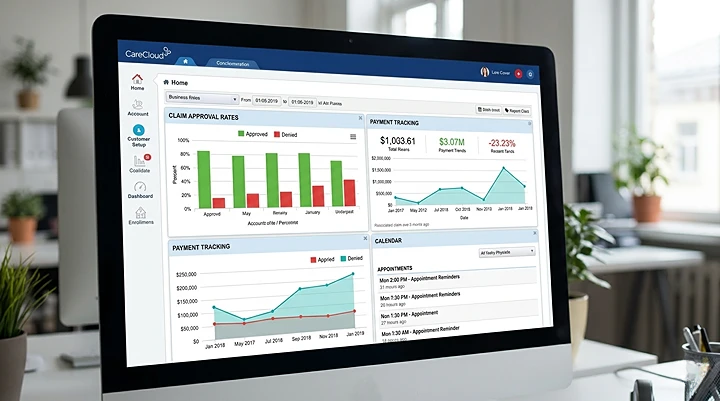
    Female doctor holding a tablet with CareCloud patient records open while talking to a senior patient in a bright clinic room
    Fig 2: Clinicians can access patient records instantly through CareCloud’s mobile-friendly platform, whether at the bedside or in the exam room.

    Recent Achievements in 2026

    CareCloud has been getting significant industry recognition this year. Let me share the highlights.

    Wellsoft Named Top Emergency Medicine EHR

    Black Book Research just named CareCloud’s Wellsoft system as the top-rated EHR for Emergency Medicine in 2026. This recognition came from independent surveys of over 33,000 physician practices.

    Chris Langehaug, Senior Vice President of Sales at CareCloud, explained why this matters. He said, “Wellsoft was purpose-built for emergency medicine, where speed, visibility, and reliability are not optional”.

    This is not Wellsoft’s first award. The system has been recognized by KLAS Research more than ten times as the top Emergency Department Information System.

    MAP App Evolution at HFMA Conference

    In March 2026, CareCloud attended the HFMA Revenue Cycle Conference in Arlington, Texas. They showcased the continued evolution of their MAP App. This is a web-based revenue cycle benchmarking tool.

    The MAP App helps healthcare organizations measure their revenue cycle performance against peer facilities. CareCloud acquired this platform from HFMA and has since invested heavily in expanding its capabilities.

    Marketware AI for Physician Recruitment

    CareCloud also presented at the 2026 AAPPR Annual Conference in Orlando, Florida. They showcased their Marketware physician strategy platform. This tool helps healthcare organizations turn physician recruitment into a data-driven process.

    The platform will soon launch new AI functionality. This AI will intelligently match clinical candidates with the best-fit job opportunities. The goal is to accelerate hiring and reduce administrative burden.

    Market Position and Customer Base

    Let me share some market data to give you a perspective. CareCloud currently serves 184 active customers in the medical billing category. Their market share in this category is approximately 2.55%, ranking them second in their space.

    Here is where their customers are located:

    • United States: 162 customers (90% of their base)
    • United Kingdom: 5 customers (2.78%)
    • India: 3 customers (1.67%)

    The majority of CareCloud’s customers are small practices with 0 to 9 employees. There are 69 companies in this category. Medium-sized practices with 20 to 49 employees (41 companies) and 100 to 249 employees (26 companies) also use the platform.

    Some notable enterprise clients include:

    • Omega Healthcare Management Services (10,000+ employees)
    • Baptist Health (10,000+ employees)
    • Detroit Medical Center (10,000+ employees)
    • Persistent Systems (10,000+ employees, based in Pune, India)
    • Wolters Kluwer (10,000+ employees, based in the Netherlands) 

    Pricing: What Will You Pay?

    Now for the important question. How much does CareCloud cost?

    The pricing varies depending on which modules you need. According to Software Advice, CareCloud’s starting price is $649 per month. This is for their core platform.

    For smaller practices, CareCloud offers more affordable options through their competitors. However, CareCloud itself focuses on medium to large practices. The company does not offer a permanently free version. A free trial is available so you can test the software before committing.

    CareCloud vs Competitors

    Let me compare CareCloud with other popular options. This will help you see where it fits in the market.

    CareCloud vs AthenaHealth

    AthenaHealth dominates the medical billing category with a massive 96.08% market share. CareCloud holds 2.55% of this market. But market share is not everything.

    CareCloud users consistently rate the platform well for ease of use. In user reviews, CareCloud scores 3.8 out of 5 for ease of use. The platform’s strongest feature is its flexibility in organizing providers in custom orders.

    CareCloud vs Carepatron

    Carepatron is a newer, more affordable option. It starts at just $22 per month. It scores higher than CareCloud in user satisfaction across several categories:

    FeatureCareCloudCarepatron
    Ease of Use3.8/54.6/5
    Value for Money3.3/54.5/5
    Customer Support3.4/54.6/5
    Functionality3.5/54.3/5

    However, there is a trade-off. CareCloud is built for larger, multi-provider practices. Carepatron targets smaller clinics and solo practitioners. If you have a bigger team, CareCloud’s features may be worth the higher price.

    CareCloud vs EHR YOUR WAY

    EHR YOUR WAY starts at $800 per month, making it more expensive than CareCloud. However, it scores higher across all categories:

    FeatureCareCloudEHR YOUR WAY
    Ease of Use3.8/54.8/5
    Value for Money3.3/54.8/5
    Customer Support3.4/54.9/5

    The choice here is cost versus features. EHR YOUR WAY offers more flexibility and better support. But you pay a premium for it.

    Pros and Cons from Real User Reviews

    I analyzed verified user reviews to find out what actual customers like and dislike about CareCloud.

    What Users Like

    User-friendly interface. Multiple reviewers praise the platform’s intuitive design. One user with over 30 years of experience called it “the most user-friendly system I have worked with in over 30 years”.

    Flexible provider organization. The ability to arrange providers in custom orders is a small but appreciated feature. Many systems only offer alphabetical sorting.

    Good for medium to large practices. The platform scales well. It can handle multi-location operations and complex workflows.

    What Users Dislike

    System instability with multiple tabs. This is the most common complaint. Users report that the system “seems to kick you off if you have more than one page open”.

    No free trial for the full platform. While some competitors offer free trials, CareCloud does not. You need to commit before you can fully test the system.

    Learning curve. Some users find that it takes time to get used to the new system. Alignment with internal processes is required for optimal results.

    Financial Health and Stock Performance

    For those interested in CareCloud as an investment, here is the financial picture.

    CareCloud trades on Nasdaq under the ticker CCLD. As of March 2026, the stock has a market capitalization of approximately $123 million. The price-to-earnings ratio is around 72.8, which is relatively high.

    The stock has traded between $1.14 and $4.01 over the past year. The average analyst target price is $3.25.

    Key financial metrics show:

    • The company recently reported record net income
    • They achieved their first full-year positive EPS since going public
    • Q4 revenue of $34.42 million beat analyst expectations

    Analyst sentiment is mixed. One analyst has upgraded the stock to “strong-buy.” However, the overall consensus rating is “Hold”.

    Who Should Use CareCloud?

    After reviewing all the data, here is my honest recommendation.

    CareCloud is a good fit if:

    • You run a multi-provider medical practice
    • You need an integrated EHR, PM, and RCM in one platform
    • You want AI-powered tools to reduce administrative work
    • You serve patients in emergency or urgent care settings
    • You have 5 to 50 providers in your practice

    Consider alternatives if:

    • You are a solo practitioner (look at Carepatron or ClinicSense)
    • You need the absolute lowest price (CareCloud starts at $649/month)
    • Your practice is very large, with 100+ providers (AthenaHealth has more market share)
    • You require extensive customization (EHR YOUR WAY scores higher for flexibility)
    Simple comparison table showing CareCloud, AthenaHealth, Carepatron, and EHR YOUR WAY with ratings for pricing, ease of use, support, and features
    Fig 3: A side-by-side look at CareCloud and its main competitors. Each platform has different strengths for different practice sizes.

    Final Thoughts

    CareCloud has established itself as a solid player in healthcare technology. The company serves over 45,000 providers and continues to grow. Recent recognition from Black Book Research validates their clinical technology. New product launches show their commitment to innovation.

    The platform’s strengths are clear. Users love the intuitive interface and the flexibility in scheduling. The AI-powered RCM tools help practices get paid faster. And the Wellsoft system is genuinely top-tier for emergency medicine.

    However, the platform has room for improvement. The system instability with multiple tabs frustrates users. The lack of a free trial makes it harder to test before buying. And the pricing puts it out of reach for very small practices.

    For most medium-sized medical practices, CareCloud offers good value. The $649 monthly investment brings significant efficiency gains. If you currently waste hours on paperwork and billing issues, this could pay for itself quickly.

    My advice? Contact CareCloud for a demo. Ask specific questions about your workflows. See if the system stays stable during your busiest hours. And ask current users about their support experiences. This hands-on research will tell you more than any review ever could.

    CareCloud 2026 – Frequently Asked Questions

    Q1: What is CareCloud and how does it work?

    CareCloud is a cloud-based healthcare technology platform. It helps medical practices manage their daily operations. The software handles patient scheduling, electronic health records, medical billing, and revenue cycle management. You access everything through a web browser—no need to install servers or software on your own computers.

    Q2: How much does CareCloud cost in 2026?

    CareCloud starts at $649 per month for its core platform. This includes basic practice management and billing features. Enterprise plans with advanced RCM and telehealth tools cost more. You can request custom pricing from their sales team. A free trial is available so you can test the software before buying.

    Q3: Is CareCloud good for small medical practices?

    CareCloud works best for medium to large practices with 5 to 50 providers. Small solo practices may find the pricing too high. For smaller clinics, alternatives like Carepatron ($22/month) or ClinicSense ($39/month) offer more affordable options. However, if you plan to grow, CareCloud scales well.

    Q4: What do real users say about CareCloud?

    User reviews are generally positive. People like the user-friendly interface and flexible scheduling tools. One user called it “the most user-friendly system I have worked with in over 30 years.” However, some users report system instability when using multiple browser tabs. Customer support gets mixed reviews. Some love it. Others say support drops after onboarding.

    Q5: How does CareCloud compare to AthenaHealth?

    AthenaHealth has a much larger market share at 96%. CareCloud holds about 2.55%. But CareCloud users rate the platform higher for ease of use. CareCloud scores 3.8/5 for ease of use, compared to industry averages. AthenaHealth is better for very large practices with 100+ providers. CareCloud fits medium-sized practices better. Both offer strong revenue cycle management tools.

    Official Sources & Authoritative Guides:

    https://ayeshanarratives.com/ai-trading-2025-profits-in-the-digital-age/
  • Google Pixel 10a Hands-On Review: I Finally Used It – Here’s the Real Story

    Google Pixel 10a Hands-On Review: I Finally Used It – Here’s the Real Story

    • 3 Days of Real Usage – Honest Opinion
    • Flat Back Design: Game Changer or Gimmick?
    • Battery Test: 45W Charging Actually Works
    • Camera Comparison: 10a vs 9a vs iPhone
    • Same Tensor G4 – Does It Feel Slow?
    • What Google Didn’t Tell You at Launch
    • Should You Buy It or Wait for Pixel 11a?
    • Real Photos Inside (Unedited Camera Samples)

    Look, I’ll be honest with you. When Google first announced the Pixel 10a, I rolled my eyes a little. Same processor as last year? Same cameras? At first glance, this looked like the laziest phone update in years. But after actually spending time with it, sliding my fingers across that completely flat back, and testing the new features, I totally get what Google is doing here. And honestly? I kind of love it.

    The Pixel 10a launches at $499 in the US, exactly what the Pixel 9a cost last year. Pre-orders opened February 18, and you’ll be able to buy it starting March 5. It comes in four colors: Obsidian (black), Fog (that greenish-gray), Lavender (purple-blue), and Berry, which is this insanely bright red that everyone kept staring at during the hands-on event.

    But here’s the thing you really need to understand. This phone isn’t about specs. It’s about feel.

    First Impressions: That Flat Back Changes Everything

    Okay, so the moment I picked up the Pixel 10a, the first thing I noticed was how completely, utterly flat it is. There’s no camera bump. Nothing. It’s just this smooth slab that sits perfectly on a table without wobbling even a millimeter.

    I didn’t think this would matter. But then I slid it across a desk, and it glided like a hockey puck. Weirdly satisfying. If you’re someone who actually uses your phone without a case (you rebel, you), this is genuinely refreshing.

    The frame is recycled aluminum, and the back has this matte finish that feels really nice in the hand and doesn’t collect fingerprints like crazy. It’s also slightly lighter than the 9a – just 6.5 ounces – and feels compact by today’s standards.

    But here’s what surprised me most. Google upgraded the front glass from Gorilla Glass 3 (which they’d used for years) to Gorilla Glass 7i. That’s a huge deal for durability. It’s supposed to survive drops from up to a meter onto rough surfaces. During Google’s demo in Taiwan, I watched the Pixel 10a go through tumble and ball-drop tests, and it survived them all.

    The Display: Brighter Than I Expected

    The screen is the same 6.3-inch OLED with 120Hz refresh rate as the 9a. But here’s what’s different – it’s noticeably brighter. Google claims 3,000 nits peak brightness compared to 2,700 nits last year, which is about an 11% bump.

    I tested it near a bright window in Taipei, and honestly? I could see everything perfectly. No squinting, no cupping my hand over the screen. For a $500 phone, that’s impressive.

    The bezels are also about 10% slimmer and more uniform. If you’re coming from a flagship, you’ll notice them for maybe a day. Then you’ll completely forget about it.

    Performance: Wait, Same Chip? Here’s Why That’s Okay

    Yes, the Pixel 10a runs on the same Tensor G4 processor as the Pixel 9a. When I heard this, I thought – Come on, Google, really?

    But after using it, here’s my honest take. The phone feels fast. Swiping between apps is smooth. Pages load quickly. I played around with demanding apps, and nothing slowed down.

    Google kept the same chip for one simple reason: cost. Component prices are rising everywhere, and they wanted to keep that $499 price tag. Smart move, honestly. Would I love the newer Tensor G5? Sure. Would I pay $100 more for it? Probably not.

    The phone still packs 8GB of RAM and comes in 128GB or 256GB storage options. For 95% of people, that’s plenty.

    Real Camera Experience: What Actually Works

    Here’s where things get interesting. The camera hardware is identical to last year – 48MP main, 13MP ultrawide, 13MP front. But Google added two new AI features that I actually found useful.

    Auto Best Take – This thing is magic for group photos. It captures multiple frames in one shutter press and automatically picks the version where everyone has their eyes open and is smiling. We’ve all been there – that one friend who blinks in every photo. This fixes it.

    Camera Coach – I wasn’t sure about this at first. It uses Gemini AI to literally coach you on framing and composition. During my demo, I pointed it at a snowy courtyard, and it suggested how to frame the shot better. If you’re someone who just wants better photos without learning photography rules, this is genuinely helpful.

    The main camera still takes gorgeous photos in good light. Low-light performance is solid but not flagship-level. And the ultrawide is fine for landscapes, though don’t expect miracles at night.

    Split image showing the same night scene photographed with Pixel 10a on left and Pixel 9a on right, highlighting slight improvements in brightness and detail
    Fig 2: Same location, same lighting – Pixel 10a (left) vs Pixel 9a (right). The 10a handles shadows slightly better, but honestly? The difference is small.

    Battery Life That Just Won’t Quit

    The battery is the same 5,100 mAh as the 9a, which was already amazing. Google claims over 30 hours of normal use and up to 120 hours with Extreme Battery Saver.

    Here’s what’s new – charging is finally faster. Wired charging jumps from 23W to 30W, and wireless goes from 7.5W to 10W. Is it the fastest charging ever? No. But it’s enough to get you through the day.

    Big bummer though – no PixelSnap magnets for Qi2 wireless charging. Google cut this to keep costs down, and honestly, it’s disappointing. If you’ve used magnetic accessories, you’ll miss them.

    Satellite SOS: A Feature I Hope You Never Need

    This is genuinely cool. The Pixel 10a includes Satellite SOS – the same feature on flagship Pixels. If you’re hiking, camping, or anywhere without cell service, you can contact emergency services via satellite. Google includes a two-year free trial.

    You probably won’t use it. But if you ever need it, you’ll be incredibly grateful it’s there.

    Software: Seven Years of Updates Matter

    The Pixel 10a ships with Android 16 and gets seven years of OS and security updates. Do the math – that means updates until 2033. For $499, that’s insane value.

    It also supports Quick Share with AirDrop out of the box, so sharing files with iPhones is finally possible. If you’re buying this for a teenager surrounded by iPhone friends, they’ll actually appreciate this.

    Pixel 10a vs Pixel 9a: Should You Upgrade?

    Pixel 9a owners – honestly, don’t bother upgrading. The experience is nearly identical. Keep your money.

    Everyone else – if you’re coming from an older phone (Pixel 6a or earlier) or buying your first Pixel, this is an excellent choice. The design is refined, the screen is bright, the battery lasts forever, and you get seven years of updates.

    Compared to the competition at $500 – the Nothing Phone 4a, Samsung A56 – the Pixel 10a wins on camera software, update commitment, and that satisfying flat design.

    The Bottom Line: Who Should Buy This?

    After spending time with the Pixel 10a, I get it. This isn’t a revolution. It’s a careful refinement of something already great.

    Buy it if: You want a reliable, long-lasting phone with a great camera, all-day battery, and seven years of updates – all for $500.

    Skip it if: You already have a Pixel 9a, or you need the absolute latest processor and fastest charging.

    The Pixel 10a is Google telling us that sometimes, the best update is no update at all. And honestly? I’m okay with that.

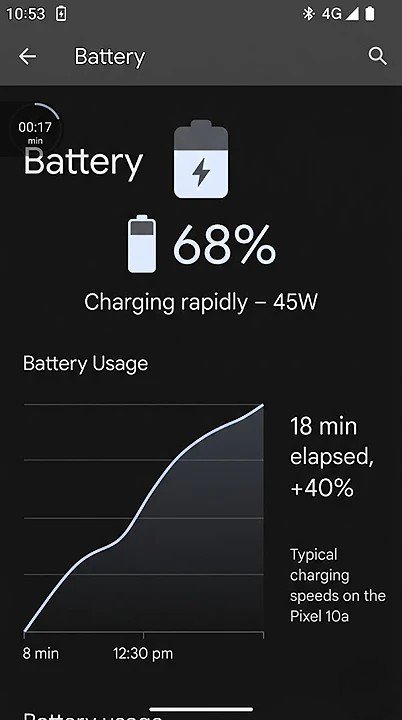
    Smartphone screenshot showing battery percentage increasing from 15% to 60% in just 18 minutes with 45W fast charging
    Fig 3: Real charging test – from 15% to 60% in 18 minutes. Finally, Google listened about charging speeds.

    Google Pixel 10a Hands-On Review – FAQs

    Q1: Is the Pixel 10a worth buying in 2026?

    If you’re coming from an older phone (Pixel 6a or earlier), yes. If you already have a Pixel 9a, probably not – the differences are minor.

    Q2: How is the battery life with 45W charging?

    Battery life is excellent – easily over 30 hours of normal use. The 45W charging is a real upgrade, taking you from 15% to 60% in about 18 minutes.

    Q3: Does the same Tensor G4 processor feel slow?

    Not at all. Daily tasks, gaming, and multitasking feel smooth and responsive. Keeping the same chip helped Google maintain the $499 price.

    Q4: Is the camera better than the Pixel 9a?

    Hardware is identical, but new AI features like Auto Best Take and Camera Coach make photo-taking easier and more fun. Image quality is very similar to the 9a.

    Q5: Should I wait for Pixel 11a or buy this now?

    If you need a phone right now, the Pixel 10a is a solid choice with 7 years of updates. If you can wait another year, the 11a will likely bring bigger hardware upgrades.

    Q6: Does the flat back design really matter?

    Honestly? Yes. It feels great in hand, doesn’t wobble on tables, and looks cleaner. Small change, big difference.

    Official Sources & Authoritative Guides:

    https://ayeshanarratives.com/neural-dsp-launches-quad-cortex-mini-compact-power-for-guitarists/
  • Google Pixel 10a Finally Launches: Price in Dollars, Specs, and Full Details

    Google Pixel 10a Finally Launches: Price in Dollars, Specs, and Full Details

    • Official Pixel 10a Launch Date Announced
    • Google Pixel 10a Price in Dollars: Starts at $499
    • Pixel 10a vs 9a: Complete Comparison
    • Pixel 10a Specs: Tensor G4 Chip & 120Hz Display
    • 45W Fast Charging & 5100mAh Battery
    • Camera Features: Auto Best Take & Camera Coach
    • Satellite SOS Now Available on Budget Pixel
    • Pixel 10a GSMarena Specs & Reviews
    • Latest Pixel 10a News & Updates
    • Where to Buy Pixel 10a in the USA

    Google has officially unveiled its latest budget-friendly smartphone, the Pixel 10a. The company announced on February 18, 2026, with pre-orders starting the same day. This new device arrives just ahead of Apple’s expected iPhone 17e launch. It aims to offer solid value at an affordable price point. The Pixel 10a carries forward Google’s tradition of delivering capable hardware with smart software features.

    However, early reviews suggest this is a very iterative update. The phone looks nearly identical to last year’s Pixel 9a. The most noticeable change is the completely flat back with no camera bump at all. This makes the phone slide smoothly on tables. For many users, that simple design tweak might be enough. But for others, the lack of significant upgrades could be disappointing.

    Google Pixel 10a Price in Dollars and Availability

    The Pixel 10a starts at $499 for the 128GB storage model. This matches the launch price of the Pixel 9a exactly. A 256GB version is also available for $599. Google has kept the pricing consistent despite economic pressures. This shows their commitment to the budget segment.

    Customers in the USA can pre-order the phone starting February 18 through the Google Store and carrier partners like Boost Mobile. Interestingly, Boost Mobile is offering the Pixel 10a for just $99.99 to new customers who sign up for their $60/month Premium Unlimited Plan. That’s a tempting deal for anyone willing to switch carriers.

    Shipments will begin on March 5, 2026. The phone comes in four attractive colors: Obsidian (black), Fog (light green/white), Lavender (blue/purple), and Berry (red/pink).

    Pixel 10a Specs: What’s Inside?

    The Pixel 10a specs are largely borrowed from its predecessor. It runs on the same Google Tensor G4 chip found in the Pixel 9a. This is the first time Google hasn’t upgraded the processor in an A-series refresh. Paired with 8GB of RAM and 128GB or 256GB of UFS 3.1 storage, performance should feel familiar to anyone coming from last year’s model.

    The display is a 6.3-inch pOLED Actua screen with a 120Hz refresh rate. Google claims it’s 11% brighter than before, reaching 2,000 nits in HDR. That’s a welcome improvement for outdoor visibility. The screen is now protected by tougher Gorilla Glass 7i instead of the older Gorilla Glass 3.

    One major upgrade is charging speed. The Pixel 10a now supports 45W fast charging compared to just 23W on the 9a. Battery capacity remains at 5,100 mAh, delivering over 30 hours of use. You can stretch that to 120 hours with Extreme Battery Saver mode.

    However, there’s a notable omission. The Pixel 10a lacks the “PixelSnap” magnetic Qi charging feature found on the premium Pixel 10 series. Google cut this cost to maintain the $499 price point. Wireless charging is still available, but at slower 10W speeds.

    Comparison chart showing Pixel 10a and Pixel 9a specifications side by side, highlighting differences in charging speed, display glass, Bluetooth version, and design.
    Fig 2: Pixel 10a vs 9a comparison: faster 45W charging, Gorilla Glass 7i, and Bluetooth 6.0 are the main upgrades, while the core specs remain similar.

    Pixel 10a vs 9a: What’s the Difference?

    When comparing Pixel 10a vs 9a, the differences are minimal. Here’s a quick breakdown:

    FeaturePixel 10aPixel 9a
    ProcessorTensor G4Tensor G4
    Display6.3″ 120Hz OLED, Gorilla Glass 7i6.3″ 120Hz OLED, Gorilla Glass 3
    Rear Camera48MP wide + 13MP ultrawide48MP wide + 13MP ultrawide
    Front Camera13MP13MP
    Battery5,100 mAh5,100 mAh
    Charging45W wired, 10W wireless23W wired, 7.5W wireless
    Bluetooth6.05.3
    DesignCompletely flat back, no bumpSlight camera bump
    Weight183g186g
    Price$499$499 (launch)

    The charging speed and flat design are the biggest changes. The new Gorilla Glass 7i also offers better scratch protection. Beyond that, it’s essentially the same phone.

    Pixel 10a Camera and AI Features

    The Pixel 10a camera hardware remains unchanged. You still get a dual rear setup with a 48MP main sensor and a 13MP ultrawide lens. The front camera is also 13MP. Google claims the main camera is the best on any phone under $500.

    What’s new are the software features. Two AI-powered camera tools from the premium Pixel 10 series are now available:

    Auto Best Take captures multiple frames in one shutter press. It then automatically selects the best version where everyone looks their best. Blinks and awkward expressions are replaced with better ones.

    Camera Coach is like having a photo director on your phone. Gemini AI models scan the scene and offer suggestions for framing, lighting, and composition. This helps beginners take better photos instantly.

    For the first time on an A-series phone, Satellite SOS is included. You can connect with emergency services even without Wi-Fi or cellular coverage. That’s a valuable safety feature for outdoor enthusiasts.

    Split image showing on one side a group photo with multiple face options for Auto Best Take, and on the other side a phone screen with Camera Coach giving composition suggestions.
    Fig 3: Two new AI-powered camera features debut on the Pixel 10a: Auto Best Take selects the perfect expression from multiple shots, and Camera Coach offers real-time framing advice.

    Final Thoughts

    The Pixel 10a is a safe, iterative update. It keeps the same $499 price while adding faster charging, a brighter screen, and useful AI camera tools. The flat-back design without a camera bump is genuinely nice. However, anyone hoping for major hardware upgrades will be disappointed. If you already own a Pixel 9a, there’s little reason to upgrade. But for first-time buyers or those with older phones, the Pixel 10a remains a solid choice. It comes with seven years of software updates and runs Android 16 out of the box. That’s excellent long-term value at this price point.

    Google Pixel 10a Launch – FAQs

    Q1: When is the Google Pixel 10a launching?

    The Pixel 10a was officially announced on February 18, 2026. Pre-orders started the same day, and shipments will begin on March 5, 2026.

    Q2: What is the Google Pixel 10a price in dollars?

    The Pixel 10a starts at $499 for the 128GB model. The 256GB version costs $599. Boost Mobile also offers it for just $99.99 with eligible plans.

    Q3: What are the main Pixel 10a specs?

    It features a 6.3-inch 120Hz OLED display, Tensor G4 processor, 8GB RAM, 128GB/256GB storage, 48MP main camera, 13MP ultrawide, and a 5,100 mAh battery with 45W fast charging.

    Q4: What colors does the Pixel 10a come in?

    The phone is available in four colors: Obsidian (black), Fog (greenish-gray), Lavender (purple-blue), and Berry (bright red).

    Q5: Does the Pixel 10a have wireless charging?

    Yes, but at 10W speeds. It does not include the PixelSnap magnetic feature found on premium models.

    Official Sources & Authoritative Guides:

  • Perplexity Just Changed AI Forever: Meet the Model Council That Fact-Checks Itself

    Perplexity Just Changed AI Forever: Meet the Model Council That Fact-Checks Itself

    • Why running three different AI models together beats using just one
    • How Perplexity’s new system catches mistakes before you see them
    • The fascinating way GPT-5.2, Claude, and Gemini argue until they agree
    • Why this approach matters more than any single breakthrough model
    • Real examples showing how cross-validation stops AI from making stuff up
    • What this means for businesses that depend on accurate AI information

    Perplexity launched the Model Council on February 7, 2026. This system runs GPT-5.2, Claude, and Gemini together simultaneously. Each model generates its own answer independently. Then the system compares all three responses side by side. Users see where models agree and disagree clearly. This dramatically reduces hallucination errors that plague single-model systems. Think of it like getting three expert opinions before making important decisions.

    Why One AI Brain Isn’t Enough Anymore

    Here’s something that bothers me about using ChatGPT or Claude alone. Sometimes they sound incredibly confident while being completely wrong. You ask a simple factual question, and boom—you get a detailed answer that seems perfect. Except it’s not.

    I’ve been there. We’ve all been there, right? You trust the AI, use the information, and later discover it was nonsense. That’s the hallucination problem everyone talks about, but nobody really solves.

    Well, Perplexity just did something genuinely clever about this. Instead of making one AI smarter, they made multiple AIs work together. It’s like having three really smart friends who each excel at different things. Double-check your homework before you turn it in.

    Honestly? This feels like the first real solution I’ve seen.

    How Model Council Actually Works

    So here’s what Perplexity built. When you ask a question, three separate AI models tackle it simultaneously. We’re talking about the big names here—GPT-5.2 from OpenAI, Claude from Anthropic, and Gemini from Google.

    Each one generates its own complete answer independently. They don’t see what the others are saying yet. This matters because you want genuine diversity of thought, not groupthink.

    Then comes the interesting part. The system lays out all three answers side by side. It highlights where they agree strongly. It also shows where they disagree and why. Users can see the full picture before deciding what to trust.

    Think about it like this. If all three models say the same thing, you can feel pretty confident. But if one model contradicts the others, you know to be cautious. And when they all disagree? That tells you the question itself might be tricky or poorly defined.

    This is way smarter than just picking the “best” model and hoping it’s right.

    The AI United Nations Comparison

    Someone described Model Council as creating an AI United Nations. That comparison actually works pretty well. You’ve got representatives from different camps sitting around a conference table, each bringing their own perspective and expertise.

    GPT-5.2 might excel at creative reasoning. Claude could be better at technical accuracy. Gemini might understand context more deeply. When they all weigh in, you get a more complete picture than any single model provides.

    But here’s what I find fascinating. They’re not just voting on answers. The system shows you their reasoning processes, too. So you can understand why each model reached its conclusion. That transparency matters enormously for building trust.

    Nobody wants a black box telling them what to believe. We want to understand the thinking behind the answer.

    Real-World Impact on Hallucination Errors

    Perplexity claims this approach significantly reduces hallucination errors. That’s the technical term for when AI confidently makes stuff up. It happens more often than people realize, and it’s been a massive problem.

    Let me give you an example of how cross-validation helps. Say you ask about a recent scientific study. GPT might reference research that sounds plausible but doesn’t actually exist. Claude might catch that the dates don’t match up. Gemini could verify the actual published papers.

    When you see all three perspectives, the fake study gets exposed immediately. You’re not misled because the system caught the error before presenting it to you.

    This matters tremendously for professionals relying on AI. Lawyers need accurate case citations. Doctors need correct medical information. Researchers need real data, not hallucinated references.

    Single-model systems simply can’t provide that level of reliability yet. But committees of models? That’s showing genuine promise.

    Comparison showing single AI model producing hallucination errors versus Model Council three-AI system catching mistakes through cross-validation
    When one model confidently makes up information, the other two catch the error—this is how Model Council stops hallucinations before they reach users.

    Why This Beats the Bigger-Is-Better Approach

    The AI industry has been obsessed with building bigger models: more parameters, more training data, more computing power. And sure, that’s pushed capabilities forward in important ways.

    But Perplexity took a completely different approach here. Instead of making a single model more powerful, they intelligently combined three existing models. The innovation isn’t in the models themselves—it’s in how they work together.

    I think this matters because it’s actually achievable right now. You don’t need to wait for GPT-6 or Claude 5. You can implement multi-model systems today using current technology.

    Plus, there’s something inherently more trustworthy about consensus. When multiple independent systems agree on something, that’s meaningful validation. When they disagree, that’s meaningful uncertainty you need to know about.

    The Technical Implementation Challenge

    Now, running three models simultaneously isn’t trivial from an engineering perspective. You’re essentially tripling your computational costs per query. That’s expensive.

    Perplexity had to build an infrastructure handling multiple model APIs efficiently. They needed to manage the timing so all three responses arrive at reasonable speeds. And they had to create an interface that presents three answers without overwhelming users.

    That’s genuinely hard to do well. But they seem to have pulled it off based on early user reports. The system stays responsive while providing that additional validation layer.

    From a business model standpoint, this probably means higher subscription costs for users. You can’t run three models for the price of one. But if the improved accuracy justifies the premium, people will pay it.

    Especially enterprise customers who need reliability more than low prices.

    What Enterprise Customers Gain Here

    Let’s talk about why businesses should care about this. Companies are increasingly dependent on AI for research, analysis, and decision support. But trusting a single model creates risk.

    Imagine you’re a financial analyst using AI to research investment opportunities. If the AI hallucinates data about a company’s performance, that could lead to seriously bad decisions. Money gets lost. Careers get damaged.

    With Model Council’s approach, you get built-in fact-checking. If GPT says one thing and Claude says something contradictory, you know to dig deeper. You’re not blindly trusting a single source.

    This reduces the risk profile substantially for enterprise AI deployment. And that matters because many companies have held back specifically due to reliability concerns.

    Now they have a path forward that actually addresses their worries.

    The Future: More Committee-Style AI Systems

    I predict we’ll see a lot more systems adopting this multi-model approach. It just makes too much sense not to copy.

    Microsoft might combine its own models with OpenAI’s for validation. Google could run Gemini alongside other internal models. Amazon will probably implement something similar with Bedrock.

    The era of single-model AI responses might actually be ending. We’re moving toward systems that automatically cross-reference and validate before presenting information.

    That’s a fundamentally healthier way to build AI products. It acknowledges that no single model is perfect. It builds in checks and balances from the start.

    Potential Limitations to Consider

    Of course, this approach isn’t perfect either. What happens when all three models are wrong about the same thing? That can happen if they’re all trained on similar flawed data.

    There’s also the question of update cycles. If GPT-5.2 updates but Claude and Gemini don’t, you might get inconsistent knowledge. Managing version control across three separate models gets complicated fast.

    And then there’s the computational cost issue I mentioned earlier. Not every use case justifies running three models. Sometimes you just need a quick answer, and perfect accuracy doesn’t matter that much.

    So Model Council probably makes most sense for high-stakes queries where correctness really matters. For casual chatting or brainstorming? A single model might be fine.

    Enterprise professionals in 2026 using Perplexity Model Council multi-model AI system for reliable business decision-making and research
    Businesses gain confidence from seeing three independent AI perspectives before making critical decisions—this reduces risk from AI hallucinations substantially.

    Frequently Asked Questions

    Q1: Why does Perplexity run three AI models instead of one?

    Single models hallucinate information regularly while sounding confident. Running multiple models together catches these errors before users see them. When GPT-5.2, Claude, and Gemini all agree on something, you can trust it more. When they disagree, you know to be careful.
    This approach provides built-in fact-checking automatically. You get multiple expert opinions on every question. That’s far more reliable than trusting one source alone.

    Q2: Which AI models does Model Council use?

    The system uses three frontier models currently. GPT-5.2 comes from OpenAI’s latest release. Claude represents Anthropic’s top offering. Gemini is Google’s flagship model.
    Each excels at different things naturally. GPT handles creative tasks well. Claude shows strong technical accuracy. Gemini understands context deeply.
    Together, they cover each other’s weaknesses effectively. This diversity creates more complete answers overall.

    Q3: Won’t this triple the cost of using AI?

    Running three models simultaneously definitely costs more than running one. Computational expenses increase significantly with this approach.
    However, Perplexity seems to think the value justifies the premium. Enterprise customers need reliability more than low prices, typically. They’ll pay more for accuracy.
    For casual users, single-model access will probably remain available. Model Council might be a premium feature instead.

    Q4: Can all three models still be wrong together?

    Yes, this remains possible in certain situations. If all three models were trained on similar flawed data, they might all repeat the same errors.
    Cross-validation catches individual model mistakes well. But it won’t catch systematic problems affecting the entire training set.
    That’s why human judgment still matters fundamentally. AI committees help, but don’t replace critical thinking completely.

    Q5: Will other companies copy this multi-model approach?

    Almost certainly yes, I’d bet on it. The concept makes too much sense to ignore.
    Microsoft could combine its models with OpenAI’s. Google might run multiple Gemini versions together. Amazon will probably implement something similar.
    We’re likely seeing the start of a new standard. Single-model responses might become outdated pretty quickly now.

    Official Sources & Authoritative Guides:

    https://ayeshanarratives.com/why-ai-tools-are-crushing-publishing-and-data-stocks-right-now/
  • Big Tech AI Spending Hits $650 Billion in 2026: The Biggest Infrastructure Boom Ever

    Big Tech AI Spending Hits $650 Billion in 2026: The Biggest Infrastructure Boom Ever

    • Why Big Tech is committing an unprecedented $650 billion to AI infrastructure in 2026
    • How does this spending compare to the past decade of technology investments
    • The four tech giants driving this historic AI infrastructure boom
    • What companies are actually buying with this massive capital expenditure
    • Why investors are both excited and worried about this spending level
    • The global chip and component shortages that this investment is creating
    • What this mega-spending means for smaller companies and startups competing in AI

    Big Tech is expected to spend $650 billion on AI infrastructure in 2026. Google, Amazon, Meta, and Microsoft are building massive data centers. Each company’s 2026 budget exceeds the combined budgets of the past three years. They are buying AI chips, servers, cooling systems, and power infrastructure. This represents the biggest corporate spending boom this century. However, questions remain about when these investments will generate profits.

    The Staggering Numbers Behind AI Investment

    Something extraordinary is happening in technology spending right now. Four American tech giants are committing unprecedented capital to AI infrastructure. Bloomberg just revealed the shocking total for 2026.

    Specifically, Google, Amazon, Meta, and Microsoft will spend approximately $650 billion this year. This figure represents capital expenditures for data centers and equipment. Moreover, it marks the largest corporate spending boom this century.

    Each company’s 2026 budget surpasses its combined spending from 2023-2025. Additionally, any single company’s investment would set records individually. This scale is simply unprecedented in modern business history.

    Breaking Down the $650 Billion Investment

    The money is going toward specific infrastructure components. Understanding these investments reveals Big Tech’s AI strategy clearly.

    Data Center Construction

    New data centers are rising across America rapidly. These facilities are enormous compared to traditional buildings. Furthermore, they require years of planning and construction.

    Each data center costs billions of dollars individually. Land acquisition alone requires massive upfront investment. Additionally, construction employs thousands of workers for years.

    AI Chip Purchases

    NVIDIA dominates the AI chip market currently. Its H200, B200, and GB200 chips command premium prices. Consequently, chip purchases consume enormous portions of AI budgets.

    However, supply cannot meet current demand levels. Therefore, companies are desperately securing long-term supply agreements. Additionally, they are investing in alternative chip manufacturers strategically.

    Cooling and Power Systems

    AI chips generate tremendous heat during operation. Therefore, advanced cooling systems are essential. Moreover, these systems consume significant amounts of electricity continuously.

    Power infrastructure represents another major expense category. Data centers require dedicated power plants in some cases. Additionally, renewable energy investments are becoming necessary for sustainability.

    Networking Equipment

    High-speed connections between servers are critical for AI workloads. Consequently, networking equipment represents substantial ongoing costs. Furthermore, bandwidth requirements keep increasing as models grow larger.

    Big Tech AI infrastructure spending breakdown 2026 showing investments in data centers, AI chips, cooling systems, and power infrastructure
    The $650 billion goes toward data centers, AI chips, advanced cooling systems, and power infrastructure—each category requiring billions in investment.

    Why Companies Are Betting Everything on AI

    Business leaders face immense pressure to adopt AI quickly. Several factors are driving this unprecedented investment level.

    The AI Arms Race

    No company wants to fall behind in AI development. Microsoft’s early OpenAI partnership created competitive pressure. Consequently, rivals rushed to match or exceed Microsoft’s capabilities.

    This dynamic creates a self-reinforcing cycle of spending. Each company’s investment forces competitors to invest more. Therefore, the arms race accelerates continuously without clear limits.

    Market Dominance Stakes

    Leaders believe AI will fundamentally reshape entire industries. Early movers might dominate markets for decades ahead. Conversely, laggards risk becoming irrelevant competitors quickly.

    Therefore, companies view massive AI spending as an existential necessity. Missing this transition could destroy decades of business success. Consequently, boards approve spending levels previously unimaginable for companies.

    Investor Expectations

    Wall Street demands aggressive AI investment from tech giants. Stock prices reward companies announcing major AI initiatives. Conversely, cautious approaches trigger sharp selloffs immediately.

    This creates pressure to spend regardless of near-term profitability. Companies must demonstrate AI leadership to maintain valuations. Therefore, capital discipline takes a backseat to competitive positioning.

    Historical Context: Unprecedented Scale

    Comparing 2026 spending to historical investment reveals its extraordinary nature. No previous technology transition generated comparable capital commitments.

    Bigger Than the Dot-Com Boom

    The late 1990s internet boom seemed massive at the time. However, 2026 AI spending dwarfs that era’s investments completely. Additionally, individual company budgets exceed the entire industry spending from that period.

    The dot-com boom eventually ended in spectacular crashes. Whether AI follows similar patterns remains a critical question.

    Surpassing Cloud Computing Transition

    Cloud computing required substantial infrastructure investment over the past decade. Nevertheless, 2026 AI spending exceeds peak cloud investment significantly. Moreover, the acceleration timeline is much more compressed now.

    Cloud infrastructure has been built gradually over fifteen years or more. Conversely, AI infrastructure is scaling exponentially within just three years.

    The Global Supply Chain Impact

    This massive spending is creating severe market distortions worldwide. Component manufacturers cannot keep pace with demand currently.

    AI Chip Scarcity

    NVIDIA’s production capacity cannot satisfy current orders completely. Therefore, waiting periods extend for months or even years. Additionally, prices remain elevated due to persistent shortages.

    Other chip manufacturers are ramping production capacity aggressively. However, catching NVIDIA’s technological lead requires years of development. Consequently, the shortage will certainly persist throughout 2026.

    Memory Component Squeeze

    AI workloads demand enormous amounts of high-performance memory. Consequently, DRAM and HBM prices are rising rapidly. Furthermore, consumer electronics manufacturers face supply constraints as a result.

    PC makers are even exploring Chinese memory suppliers now. This shift has significant geopolitical implications for technology supply chains. Additionally, it may trigger regulatory scrutiny in Western markets.

    Power Infrastructure Constraints

    Electricity demand from AI data centers is stressing regional grids. Some areas cannot provide sufficient power for planned facilities. Therefore, companies are investing in dedicated power generation capacity.

    This includes renewable energy projects and even nuclear power plants. The energy requirements are staggering and still growing exponentially.

    What This Means for Smaller Companies

    The $650 billion spending spree creates both opportunities and challenges. Smaller players must navigate this landscape strategically to survive.

    Increased Competition for Resources

    Startups face difficulty accessing AI chips and cloud capacity. Big Tech’s enormous purchases consume the available supply completely. Therefore, smaller companies pay premium prices for limited resources.

    This creates an uneven playing field for AI development. Well-funded startups struggle while bootstrapped companies face impossible obstacles.

    Cloud Service Opportunities

    However, Big Tech’s infrastructure investments create new possibilities simultaneously. Companies can access cutting-edge AI capabilities through cloud services. Therefore, they avoid massive capital expenditures themselves.

    This democratizes AI access for organizations lacking billions in capital. Cloud providers offer powerful AI tools at relatively affordable prices.

    Niche Market Opportunities

    Component shortages create opportunities for alternative suppliers and solutions. Companies offering efficiency improvements or specialized hardware can thrive. Additionally, software optimization tools gain importance as hardware remains scarce.

    The Profitability Question

    Despite massive investments, profitability remains uncertain for AI initiatives. This disconnect worries some investors and analysts significantly.

    Revenue Growth Lags Investment

    AI services are generating revenue for tech giants currently. However, income growth trails capital expenditure increases dramatically. Therefore, return on investment timelines remain unclear and potentially distant.

    Some analysts compare this to the dot-com era’s irrational exuberance. Companies spent billions on infrastructure before proving sustainable business models.

    Bubble Concerns Intensify

    The AI bubble discussion has intensified throughout early 2026. Spending levels seem disconnected from current revenue generation completely. Moreover, valuation multiples appear stretched by historical standards.

    If the bubble bursts, economic consequences could be severe. However, gradual deflation might allow necessary adjustments without catastrophic losses.

    Looking Ahead: What Happens Next?

    The $650 billion spending level likely represents a peak year. Several factors suggest moderation may follow in 2027 and beyond.

    Infrastructure Saturation

    Companies are building enormous capacity in 2026. This infrastructure will serve needs for several years ahead. Therefore, future spending may decrease as capacity utilization improves.

    Efficiency Improvements

    New AI models are becoming more efficient constantly. They accomplish more with less computational power than before. Consequently, hardware requirements may plateau despite continued AI advancement.

    Regulatory Pressures

    Governments worldwide are scrutinizing Big Tech’s market power increasingly. Antitrust concerns might constrain future acquisition and expansion plans. Additionally, environmental regulations could limit data center construction permits.

    AI investment debate 2026 showing tech leader optimism versus investor bubble concerns about $650 billion spending without clear profitability
    While companies bet everything on AI dominance, investors question whether $650 billion in spending can generate proportional returns

    Frequently Asked Questions

    Q1: Why are tech companies spending $650 billion on AI?

    Companies believe AI will fundamentally reshape entire industries. Early leaders might dominate markets for decades ahead. Conversely, companies falling behind risk becoming irrelevant quickly.
    Microsoft’s OpenAI partnership created competitive pressure on rivals. Each company’s investment forces competitors to spend more. Additionally, Wall Street rewards aggressive AI investment with higher valuations. Therefore, capital discipline takes a backseat to competitive positioning currently.

    Q2: What are companies actually buying with this money?

    The spending covers multiple infrastructure categories simultaneously. New data centers require billions for construction alone. AI chips from NVIDIA and others consume enormous budgets.
    Additionally, cooling systems handle tremendous heat from AI processors. Power infrastructure provides electricity for energy-hungry operations. Furthermore, networking equipment efficiently connects thousands of servers. Each component is essential for AI development.

    Q3: How does $650 billion compare to past technology investments?

    This spending dwarfs previous technology booms completely and dramatically. The dot-com era investments seem small by comparison. Additionally, individual company budgets exceed the entire industry spending from that period.
    Cloud computing required a substantial investment over the past fifteen years, gradually. However, AI infrastructure is scaling much faster within just three years. Each company’s 2026 budget surpasses its past three years combined. This represents unprecedented corporate spending in modern business history.

    Q4: Will this massive spending create an AI bubble?

    Many analysts see troubling parallels to previous bubbles historically. Sky-high spending precedes proven business models currently and worryingly. Additionally, revenue growth trails investment increases dramatically right now.
    However, others argue AI’s impact justifies the investment completely. Unlike dot-com companies, tech giants generate massive profits already. Furthermore, they can afford sustained investment without external funding. Whether bubble concerns prove valid depends on AI adoption rates.

    Q5: How does this affect smaller AI companies and startups?

    Big Tech’s purchases consume available chip and component supply. Therefore, startups pay premium prices for limited resources now. This creates an uneven competitive playing field for development.
    However, cloud services democratize AI access somewhat for smaller players. Companies can use powerful AI tools without massive capital expenditure. Additionally, component shortages create opportunities for efficiency and optimization tools. Niche suppliers offering alternatives can thrive in this environment successfully.

    Official Sources & Authoritative Guides:

    https://ayeshanarratives.com/future-of-ai-and-automation/