Whales are among the largest and most remarkable animals on Earth. These marine mammals live in oceans around the world, from warm tropical waters to the cold seas surrounding the poles.
Life Beneath the Surface
Although whales spend their lives in water, they breathe air through blowholes located on top of their heads. They must regularly return to the surface to breathe before diving again in search of food or traveling through the ocean.
Whales are warm-blooded, give birth to live young, and nurse their calves with milk. A thick layer of fat called blubber helps protect them from cold water and stores energy during long migrations.
Two Main Groups
Whales are generally divided into baleen whales and toothed whales. Baleen whales filter small animals from the water using flexible plates inside their mouths. This group includes blue whales, humpback whales, and gray whales.
Toothed whales use teeth to catch fish, squid, and other prey. Many of them also use echolocation, producing sounds and listening for returning echoes to understand their surroundings. Sperm whales, belugas, and orcas belong to this group.
The Blue Whale
The blue whale is the largest known animal to have ever lived. An adult can grow longer than a city bus and weigh well over one hundred tonnes. Despite its enormous size, it feeds mainly on tiny crustaceans called krill.
Communication and Migration
Whales communicate using clicks, whistles, pulses, and complex songs. Some sounds can travel across great distances underwater. Humpback whales are especially famous for their long, patterned songs.
Many species migrate thousands of kilometres each year. They often feed in cold, nutrient-rich waters before traveling to warmer regions where they mate and give birth.
Protecting Whales
Commercial hunting once caused severe declines in many whale populations. Today, whales also face threats from fishing gear, ship collisions, underwater noise, pollution, and changes to ocean ecosystems.
Conservation programs, safer fishing practices, protected habitats, and international cooperation can help whale populations recover. Protecting whales also supports healthier oceans because these animals play an important role in marine food webs and nutrient cycles.
AEO (Answer Engine Optimization) is the practice of structuring content so it can be lifted directly into a featured snippet, a knowledge panel, or an AI-generated answer box, without the reader ever needing to click through.
GEO (Generative Engine Optimization) is the broader practice of getting your brand named inside a generative AI response—ChatGPT, Perplexity, Gemini, Claude—even when there’s no traditional search results page involved at all.
The distinction matters less than people think. Both are downstream of the same core discipline: content that’s factually accurate, clearly structured, and backed by real expertise.
What Google’s Own Guide Actually Says (Most Articles Skip This)
In May 2026, Google published an official reference document on Search Central titled “Optimizing your website for generative AI features on Google Search.” It’s the most direct statement Google has made on this topic, and its central claim cuts against a lot of what’s been sold as “AI SEO”:
AEO and GEO are not a separate discipline from SEO. They’re an extension of it. The same E-E-A-T signals that drive your organic Google rankings are what determine whether your content gets surfaced in AI Overviews.
More specifically, Google’s guide names several popular tactics as unnecessary for its own systems:
llms.txt files aren’t required. Google says it doesn’t need a special machine-readable file to understand your site—its crawlers already parse HTML content directly.
Content “chunking” isn’t required. There’s no need to artificially break your article into small, isolated blocks for AI systems to parse. Google’s documentation states its systems can already identify the relevant section of a longer page and surface just that part.
Special AI-specific schema markup isn’t required. Standard structured data (the same schema you’d use for regular SEO) is sufficient.
This matters because a large share of “AEO/GEO agencies” are currently selling llms.txt generation and content-chunking services as if they’re mandatory. According to Google’s own documentation, they aren’t—at least not for Google’s systems specifically. (Other engines like ChatGPT Search and Perplexity may have different retrieval mechanics, which is where GEO practices still diverge somewhat from pure Google SEO.)
Why This Shift Is Happening
Search behavior is genuinely changing, even if some of the specific statistics floating around the industry are more marketing than measurement. A few things are broadly agreed on across serious analysis:
AI Overviews now appear across a meaningful share of Google searches, particularly for informational queries.
Zero-click search behavior—where a searcher gets their answer without visiting any website—has been rising steadily for years and continues to grow with AI-generated summaries.
Tools like ChatGPT and Perplexity have become genuine discovery channels in their own right, not just novelty chatbots.
Be skeptical of any article citing an ultra-precise percentage (like “70% of searches will be zero-click by December”) without a named, checkable source—a lot of these figures get repeated blog-to-blog without anyone tracing them back to real data. The direction of the trend is clear even where the exact numbers aren’t.
How to Actually Optimize for AEO and GEO
Here’s what holds up across Google’s own guidance and credible independent analysis:
1. Answer the question in the first 2–3 sentences
AI systems and featured snippets favor content that states the direct answer immediately, then elaborates. Don’t bury the answer under three paragraphs of scene-setting.
2. Use real structure—H2s and H3s that mirror actual questions
Headings phrased as questions (“What is X?”, “How does Y work?”) map naturally onto how people query AI systems and how those systems extract answers.
3. Build genuine E-E-A-T signals
This means: named authors with real credentials, transparent sourcing, accurate and current information, and a site that demonstrates actual expertise rather than templated content. Google has said repeatedly that this is the same signal driving both organic rankings and AI Overview inclusion—it isn’t a separate “AI trick.”
4. Use standard schema markup
FAQPage, Article, Organization, and BreadcrumbList schema—implemented correctly—help every system (Google, and increasingly others) understand your content’s structure. You don’t need anything exotic beyond this.
5. Keep facts current and correct
Generative engines are increasingly cautious about citing sources with outdated or inconsistent information, since a wrong citation reflects on the engine itself. Update older content rather than only publishing new posts.
6. Allow AI crawlers in robots.txt
If you block bots like OAI-SearchBot, ChatGPT-User, PerplexityBot, or Google-Extended, you’re opting out of GEO visibility on those platforms entirely—regardless of how well-optimized your content is otherwise.
7. Write for topical completeness, not keyword density
Cover a topic’s full scope—related questions, edge cases, common follow-ups—rather than optimizing narrowly around one exact-match phrase. This is what “semantic SEO” actually means in practice.
What to Deprioritize
Based on Google’s own guidance and the gap between hype and substance in this space:
Don’t pay for “guaranteed AI citation” services—no legitimate vendor can guarantee inclusion in a generative response, since none of them control the model’s retrieval logic.
Don’t obsess over generating an llms.txt file as your top priority—it’s optional infrastructure, not a ranking lever, per Google’s own documentation.
Don’t over-fragment long-form content into disconnected chunks—Google has explicitly said this isn’t necessary for its systems.
Quick AEO/GEO Audit Checklist
Does the article answer its core question within the first 100 words?
Are headings phrased as real questions a reader would type or ask an AI assistant?
Is there a named author with visible credentials or a bio?
Is FAQPage or Article schema implemented and validated?
Are AI crawlers (Google-Extended, OAI-SearchBot, PerplexityBot) allowed in robots.txt?
Has the content been updated in the last 6–12 months if it references time-sensitive facts?
Does the article cover related sub-questions, not just the primary keyword?
Frequently Asked Questions
Q: Is AEO the same as GEO?
A: No. AEO focuses on being extracted into snippets and answer boxes within traditional search results. GEO focuses on being named inside AI chat responses, which may not involve a search results page at all. They overlap heavily but aren’t identical.
Q: Do I need to create an llms.txt file?
A: Not for Google specifically its May 2026 guidance states this explicitly. It may still offer marginal benefit for some other AI platforms, but it isn’t the priority some vendors claim.
Q: Does AEO/GEO replace traditional SEO?
A: No. Google has stated directly that AEO and GEO are extensions of SEO, not a replacement for it. The same fundamentals—quality content, technical health, E-E-A-T—still apply.
Q: How long does it take to see results from AEO/GEO optimization?
A: There’s no fixed timeline, and be wary of anyone promising one. Since these systems retrieve and re-evaluate content continuously, well-optimized pages can appear in AI answers faster than traditional rankings shift, but consistent, sustained visibility still takes ongoing content quality work.
Q: Should I block AI crawlers to protect my content from being used to train models?
A: That’s a separate decision from GEO visibility, and it’s a real trade-off—blocking training-focused crawlers doesn’t always block retrieval-focused ones, and vice versa. If visibility in AI answers matters to your business, check each crawler’s specific purpose before blocking it wholesale.
Conclusion
AEO and GEO aren’t a new discipline you need to learn from scratch—they’re SEO with a sharper focus on structure, clarity, and answerability. Google’s own May 2026 guidance confirms this directly, and it directly contradicts a lot of the tooling and services being sold as essential right now. Build content that genuinely answers questions, structure it clearly, back it with real expertise, and make sure the right bots can actually reach it. That combination is what’s actually driving visibility in AI search—not a special file format or a fragmented content structure.
Once again, the world is watching the Middle East. Indeed, the Escalation of US-Iran relations has broken into an exposé-level conflict. In fact, events have taken a new turn almost daily since July 8, 2026. So, here’s what you need to know about this rapidly changing situation and why it matters.
Escalation of US-Iran Recent Developments
According to US reports, a large-scale, multi-target strike was carried out by American forces. Specifically, officials say the strike was retaliation for incidents involving commercial vessels in the Strait of Hormuz, a crucial route in the global oil trade. As a result, this latest chapter in the Escalation of US-Iran tensions has drawn attention from governments and markets alike.
Meanwhile, footage and reports from international media outlets surfaced in recent days. Notably, they appear to show disruption at Kharg Island and activity surrounding Bandar Abbas. If accurate, these disruptions could hurt the Iranian economy in the near future.
Recent Context of Escalation of US-Iran
First of all, this isn’t a standalone incident. Rather, it has occurred at the same time as the NATO leaders’ meeting in Ankara, Turkey, for their annual summit. As a result, the overlap has produced two very large, concurrent global news stories, and the Escalation of US-Iran relations sits at the center of one of them.
Previously, an informal agreement kept tensions at a simmering level. However, that fragile equilibrium may not last much longer. Indeed, continued fighting in the region could soon break the fragile status quo entirely.
The Economic Angle: Oil Sanctions
In addition, the US has now restricted Iranian oil sales alongside its military posturing. Consequently, this move costs the Iranian government heavily, since oil sales help fund state operations. Likewise, the US sanctions also threaten other nations tied to Iran’s oil trade. Therefore, global shipping profits tied to that oil may collapse as a direct consequence of the Escalation of US-Iran relations.
In response, Iranian officials have criticized the renewed US oil sanctions strongly. Specifically, they claim the sanctions breach an understanding both countries reached just one month prior. Furthermore, Iran’s Foreign Ministry blames the US for abandoning the agreement’s terms, a claim that adds another layer to the ongoing Escalation of US-Iran dispute.
US-Iran tensions continue to influence global diplomacy, energy markets, and regional security as military developments and economic sanctions reshape the geopolitical landscape.
How Iran Has Responded
For instance, Iranian officials have signaled that a response is imminent. Additionally, they frame this response as a necessary reply to what they call an unprovoked escalation. So far, however, no one in the region has called for de-escalation.
Meanwhile, analysts are now watching Iran’s moves around energy infrastructure closely. Because disruptions to commercial shipping could hit international markets almost immediately, this remains a major concern. That’s why the Strait of Hormuz remains one of the most closely watched waterways in the world amid the ongoing Escalation of US-Iran tensions.
NATO Summit Developments
Overall, the Escalation of US-Iran relations has cast a long shadow over this year’s NATO summit. As a result, it’s shaping conversations well beyond the alliance’s usual agenda.
Day 1: What’s Happening at the President Trump NATO Summit
Currently, President Trump is attending the NATO Summit in Ankara. There, Turkish President Recep Tayyip Erdogan is hosting him. Meanwhile, NATO alliance members reportedly feel uneasy about conditions in both the European and Middle Eastern theaters. Consequently, countries in the alliance are now demanding clearer commitments from the United States as the Escalation of US-Iran situation continues to unfold.
In response, Defense Secretary Pete Hegseth plans to leave the president’s delegation to handle the situation directly. Because of this, the North Atlantic Council has classified this situation as high priority. Now, council meetings treat the Iran situation as a top item on the agenda.
Day 2: What Might Happen After Escalation of US-Iran
On one hand, continued escalation remains a real possibility. This could draw other regional players into the conflict and, in turn, worsen pressure on the global fuel supply. On the other hand, both sides could limit further moves and avoid a wider conflict, thereby easing the Escalation of US-Iran relations before it spreads further.
Over the coming days, you may notice erratic movement in markets and fuel prices. Therefore, consider adjusting travel plans if fuel prices or market shifts start to affect your routes.
Staying Updated
Since this situation evolves day by day, it’s best to rely on multiple credible news sources instead of just one. Meanwhile, both governments continue to release official statements, and more information will emerge as the days go on. So, watch closely, since the Escalation of US-Iran story continues to develop in real time.
Final Thoughts
In summary, recent events show that the Escalation of US-Iran relations has reached a new crisis point, one of growing concern in modern history. Altogether, renewed sanctions, increased military activity, and increasingly aggressive statements from both nations all point to a tense road ahead. Ultimately, we’ll update this page as new, confirmed developments occur in the weeks ahead.
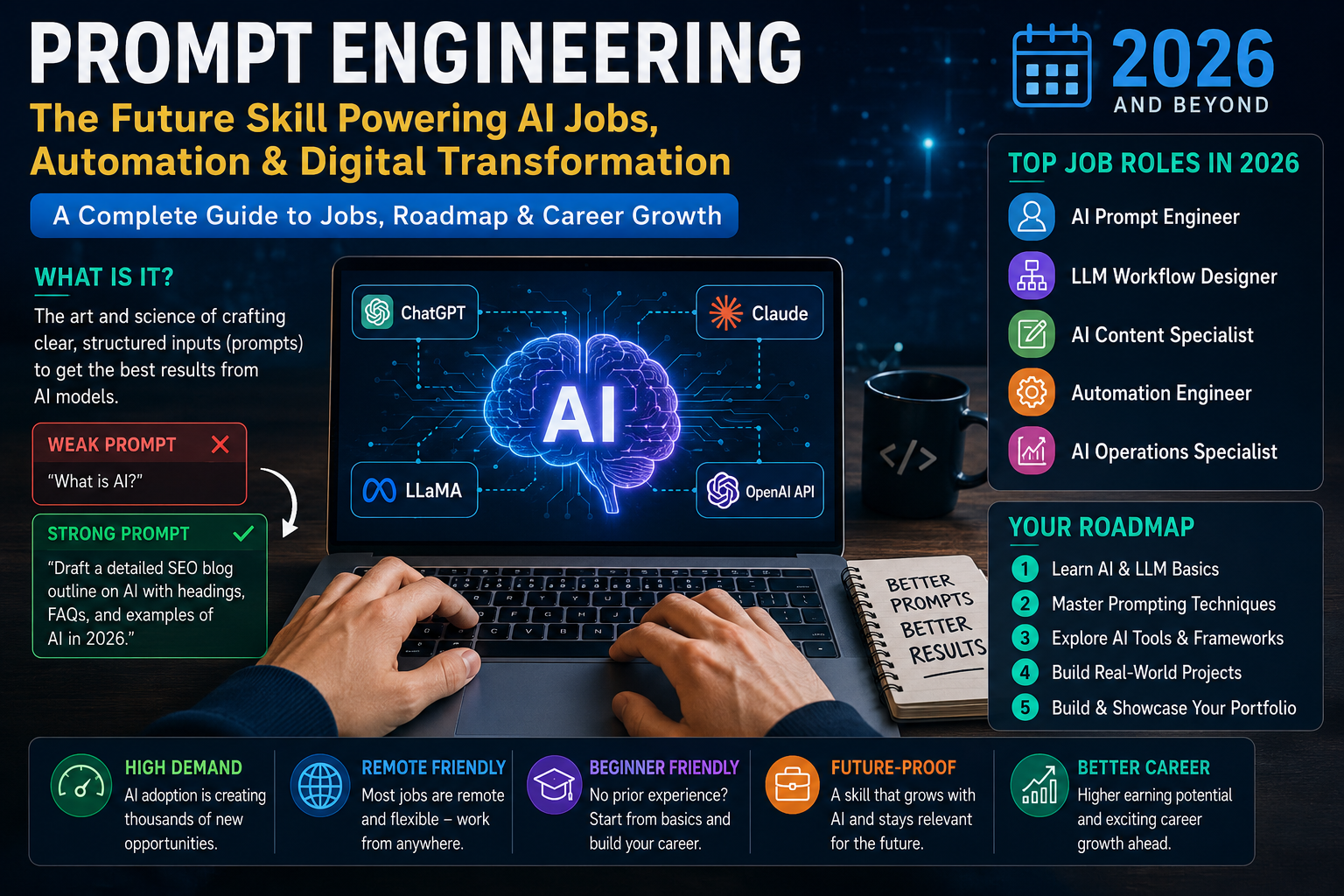
AI is revolutionizing communication, learning, and creativity. A rapidly growing skill during this AI revolution is Prompt Engineering. It allows individuals to interact with complex AI systems like ChatGPT, Claude, and LLaMA, among others. Not including AI systems in your daily business practices will cause you to lose relevance in today’s economy. AI systems have the ability to write, code, and even create art and design. Likewise, the majority of company goals are increasingly centered on the use of AI in order to maximize profit and speed up the delivery of business functions and services to users. AI systems, however, require flawless instructions to reach their full potential. This is the primary reason why the AI systems get the job done successfully. It allows individuals to create intelligent business workflows with instructions that are very clear and to the point. The following sections will attempt to demystify this relatively new and growing career by introducing work and learning opportunities in this field.
What is Prompt Engineering? Frameworks, and AI Instruction Design
Prompt Engineering refers to the skill, craft, and science involved with creating inputs for users that drive AI systems and models toward desired outputs. AI is not self-aware and will only do what the user guides it to do with an input. Bad inputs create bad outputs. A clear, precise, and contextual user input provides AI with the optimal guidance to perform a task best.
Prompt Engineering Career Opportunities for 2026 Moving Forward
The infusion of AI systems and technologies throughout a variety of industry sectors, including marketing, finance, healthcare, and software, will create an unprecedented number of job opportunities specific to the discipline in the marketplace. Examples of job positions that will be posted more frequently will be as follows:
AI Prompt Engineer
LLM Workflow Designer
AI Content Specialist
Automation Engineer
AI Operations Specialist
Remote Work, USA Job Postings, and Entry Level Positions
More AI systems and solutions will necessitate more jobs in this area and create job opportunities for the following positions:
Prompt Engineering remote
Prompt Engineering USA
Prompt Engineering NYC
Prompt Engineering entry level
Prompt Engineering no experience
Prompt Engineering near me
Indeed as all AI solutions are online, the jobs will be remote and most entry level. Prompt Engineering internships and Assistant AI roles are available.
Overview of Job Duties and Responsibilities
In this job, you will create, test, and improve AI workflows. Many will utilize LangChain, the OpenAI API, or other automation resources. However, AI systems will always require human collaboration in order to produce safe and effective solutions. This job will provide the optimal use of AI to meet human requirements.
Prompt Engineering Roadmap: Your Step-by-Step AI Training Plan
Step 1: Understand the Fundamental Concepts of AI and Models
Ultimately, people will need to have an understanding of Large Language Models, including how these systems process and interpret tokens, the role of context in LMs, and how LMs respond to various input and prompts.
Prompt Engineering: The Skill Set That Will Dominate AI and Automation-Enabled Careers of 2026
Step 2: Develop an Understanding of Prompt Engineering
Zero-shot prompting
Few-shot prompting
Role-based prompting
Chain-of-thought prompting
Step 3: Develop a Working Knowledge of the AI Systems, Tools, and Models
Systems such as the following:
ChatGPT
LLaMA
OpenAI API
LangChain
Step 4: Action. Building and Development
Build systems to enhance your experience:
AI Chatbots
Content creation tools
GPTs that generate professional resumes
Custom programs to streamline and automate workflows
Step 5: Build a Prompt Engineering Portfolio
This may be the easiest step. Use your custom prompts to build workflows and publish your projects on GitHub. This will give you a great head start with engagements and learning from prompt engineering courses and boot camps.
Cost and Speed of Prompt Engineering Compared to Fine Tuning
In fine tuning, models are trained on particular datasets. This, however, creates an expensive process as the dataset is custom-built. A more prominent design alteration built on instruction improvement is the prompt method. Most companies prefer prompt methods primarily because they are easier to use, faster and cheaper, and applicable to more use cases. The prompt method is, therefore, the most preferred design modification methods for startups and AI focused companies.
RAG vs Prompt Methods: Context vs Instructions
RAG (Retrieval-Augmented Generation) seeks to refine AI answers by extracting data to be referenced before the generation of the answer, while instructions based systems places more emphasis on the instructions given to the model. Most modern day AIs integrate both systems.
RAG integrates the latest information, while systems built on instructions focus on the model’s output. The powerful combination of the two systems provides the desired level of precision and flexibility to respond to a given use case.
Prompt Engineering for Developers and Software Engineers
The software development life cycle can be fully integrated and automated using various sophisticated AI systems and workflows, making this skill highly in demand. As an example, a developer could issue the following prompt: “You are a senior Python developer. Generate a Flask Rest API for me that includes: authentication, error handling, and separation of concerns with a clean architecture.” Clear and sophisticated prompts greatly cut down the time and cost of software development. There are many Prompt Engineering GitHub repositories, allowing developers to learn more about real-world implementations.
Best Prompt Engineering Courses, Cheat Sheets and Learning Resources
At the onset of a new learning experience, many developers favor structured learning. This includes:
AI courses on Udemy
Courses on Coursera
AI bootcamps
PDF learning guides
Other excellent learning resources include Prompt Engineering cheat sheets, Prompt Engineering PDF and paper texts, and Prompt Engineering book resources. These allow for rapid and rich learning of AI program structures.
AI Workflow Tools, Frameworks and LangChain Libraries
Tools that are commonly used include:
ChatGPT
LLaMA 2
Hugging Face
OpenAI API
LangChain
Automated systems of this type are the fundamental building blocks of AI programs, including chatbots, automated programs and intelligent assistants. Many developers rely on Prompt Engineering and LangChain integrations to build complex workflows within AI programs.
Crafting an AI Resume for Sustained Career Development
Real-life use cases and the design of AI frameworks are critical to developing compelling resumes. Automation of workflows and integration of APIs are equally important. For instance, there are numerous AI career opportunities, including:
Remote AI employment
Entry-level AI employment
Employment that does not require AI knowledge or skills
Employment opportunities in the USA AI sector
AI employment opportunities in New York City
It is essential to note that new developers with robust portfolios also stand a good chance of securing these employment opportunities.
Gaining a Prompt Engineering Internship and Entry-Level AI Employment
An increasing number of firms are rolling out new internship programs. Presently, entry-level employment requires concentrating on:
AI system testing
AI prompt design
Optimization of AI workflows
Evaluation of AI paradigms
These positions are highly suited for students and new entrants to the job market who wish to pursue a career in the AI Industry.
The Development of Autonomous AI Agents and AI Systems
AI agents and autonomous systems are a part of the sophisticated AI tools and systems of the future that are multimodal. Although many of the basic tasks of an AI Industry will be automated, advanced systems and architectures will require constant fine-tuning by AI professionals.
Prompt Engineering FAQ
What is it used for?
The principal aim is to assist AI personnel to refine their communication skills to facilitate engagement with AI systems to obtain clear and optimal answers.
Is It a Career?
Yes. There are numerous career opportunities in just about every industry that is aiming to upscale its AI operations.
Is It Necessary to Know How to Code?
In the majority of cases, the answer is no. However, the ability to code is very advantageous for higher tier developer positions.
Is the field work-from-home friendly?
Yes, all tools are online, making nearly all roles fully remote.
What skills are required?
You will need to be tech-savvy, have advanced critical thinking skills, and be able to think through your ideas and express them in a coherent manner.
Conclusion: Future-Proof Your Career with AI Instruction Skills
At this point in the AI-accelerated economy, AI instruction refinement is one of the top skills to have. It lets workers maximize their efficiency and time and helps them streamline work processes and open up entirely new career courses. Even after this point in time, with the exponential growth of AI, this will be an important skill to have for software developers and automation, for anyone creating any kind of content. For this reason, the best time to learn this skill is now, to have an advantage in the job market for this kind of skill-based work.
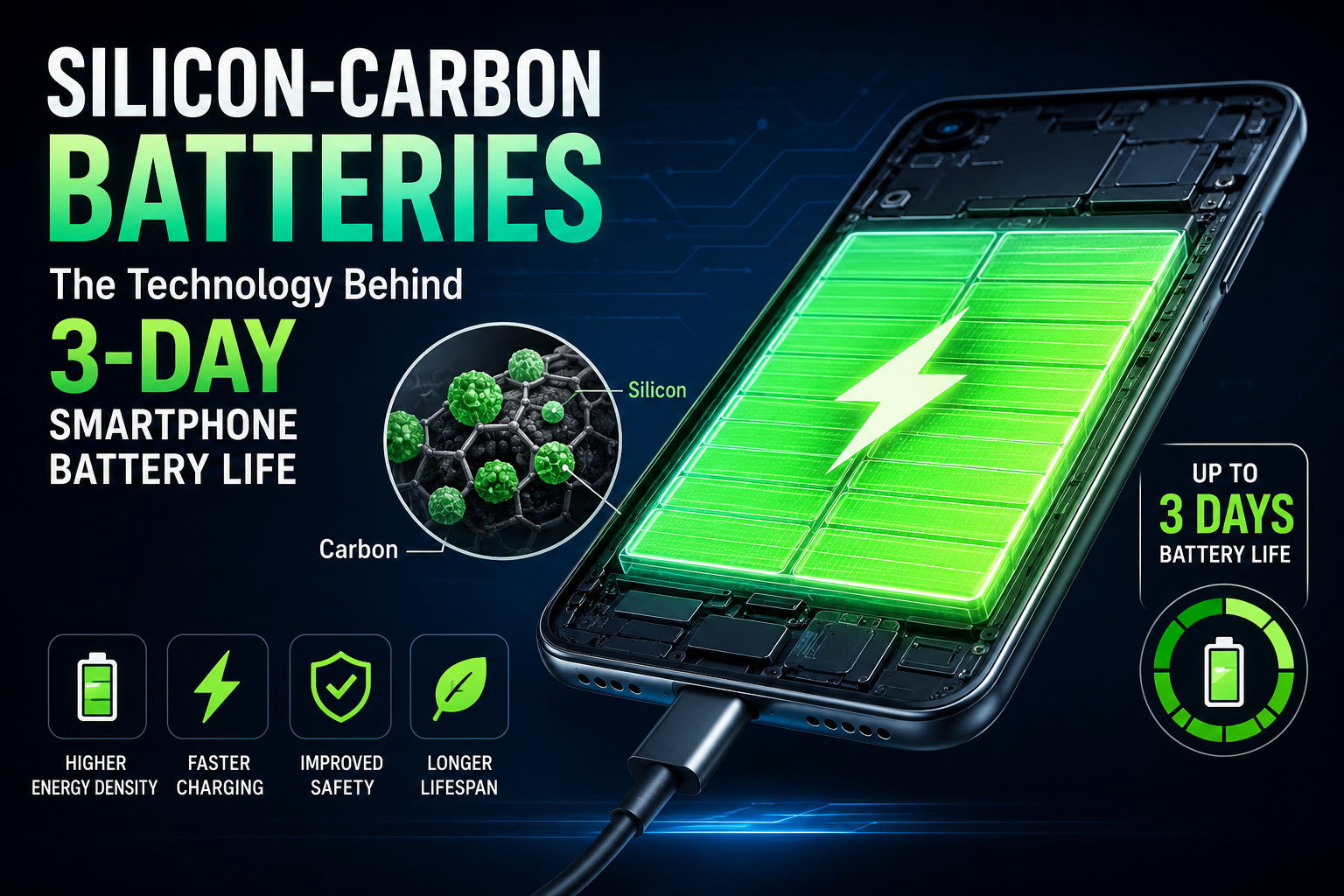
Smartphone battery life has become one of the most important factors for buyers in 2026. Even with faster processors, AI tools, and advanced displays, many phones still need charging before the day ends. This is where Silicon Carbon Batteries are starting to change the game. Instead of making phones thicker, manufacturers now improve how much energy a battery can store inside the same space. That is why users searching for phones with silicon carbon battery are increasing quickly. People now want to know if this is a real upgrade or just another marketing trend.
Why Smartphone Batteries Are Changing in 2026
Smartphones are no longer simple communication devices. People use them for gaming, work, videos, AI tools, and more. Because of this, battery demand has increased a lot. Traditional lithium batteries cannot improve much without increasing size. This is where Silicon Carbon Batteries offer a better solution. They improve energy storage without changing phone design. As a result, users get longer backup without bulky devices. Interest in battery silicone technology is also growing as people try to understand this new shift.
How Silicon Carbon Batteries Work in Simple Terms
The main idea behind Silicon Carbon Batteries is simple. Inside every battery, there is a part called the anode. Old batteries use graphite in this part. Graphite works well but cannot store much energy. Silicon can store much more energy than graphite. The problem is that silicon expands during charging, which can reduce stability. To solve this, manufacturers mix silicon with carbon. This combination keeps the battery stable while increasing energy capacity. Research like carbon coated silicon monooxide as an anode for lithium ion batteries has helped improve this design further.
What Users Notice in Daily Life
The biggest improvement is not technical, it is practical. Phones last longer on a single charge. Charging becomes faster and more efficient. Heavy tasks like gaming and video streaming drain less battery compared to older systems. Many users also reduce their dependency on chargers and power banks. This is why products like silicon carbon power bank, silicon carbon battery power bank, and silicon carbon battery bank are becoming more popular. These improvements make daily smartphone use much easier.
Phones Using Silicon Carbon Battery Technology
The use of phones with silicon carbon battery systems is growing, especially in high-end smartphones. Companies use this technology to increase battery size without making phones thicker. It also supports better performance for gaming and AI-based features. Right now, most devices with this technology are flagship models, but mid-range phones will likely adopt it soon as production costs decrease. Discussions around sci battery innovation show how fast this technology is developing in the smartphone industry.
Silicon Carbon vs Lithium Battery Performance
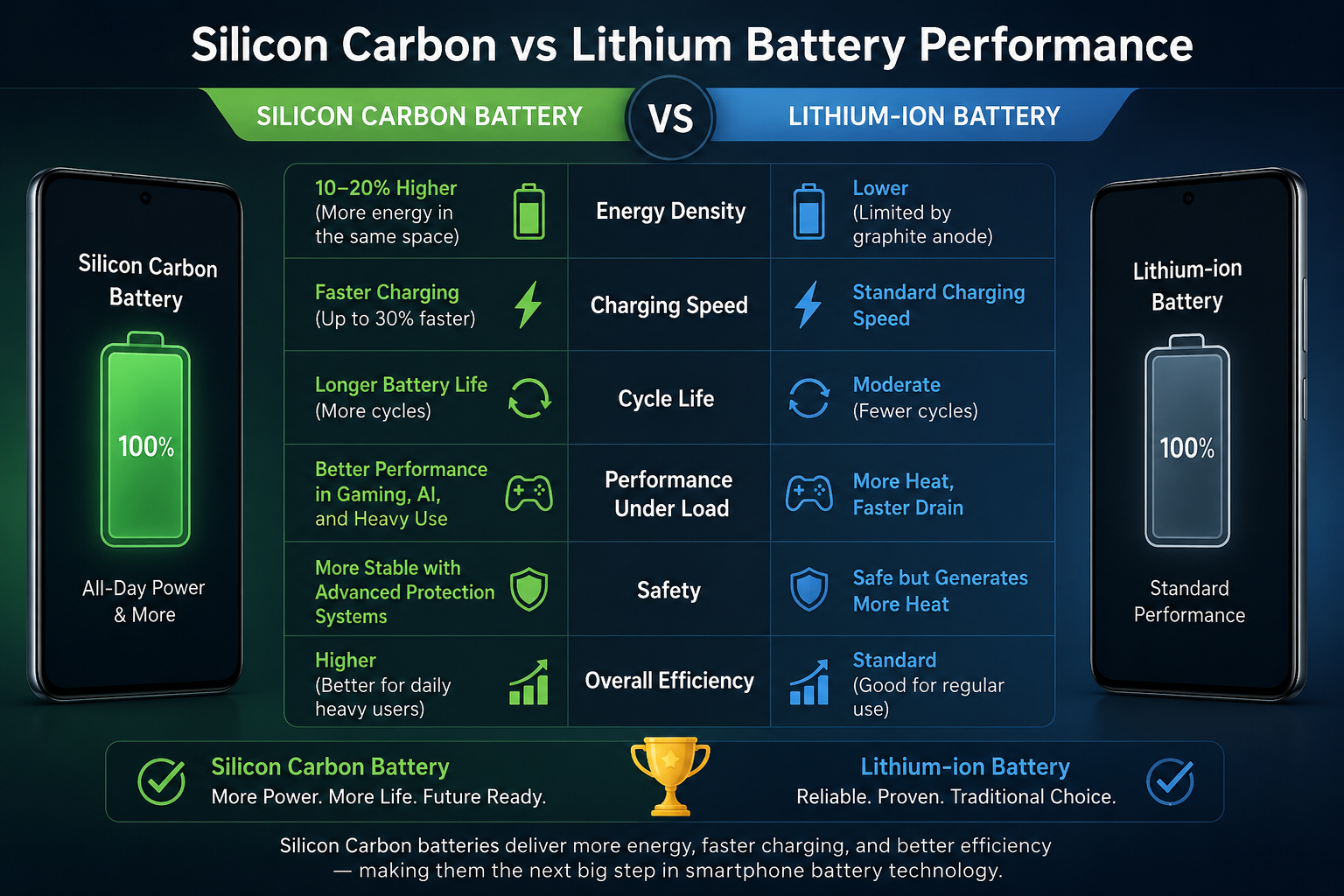
Many users ask whether are silicon carbon batteries better than lithium ion batteries. In real-world use, Carbon Batteries often perform better. Lithium-ion batteries are stable and reliable, but they have limited capacity improvements. Carbon Batteries store more energy and charge faster. This allows phone makers to create slimmer devices with longer battery life. Users also often search are carbon batteries better when comparing new smartphones in 2026.
A clear side-by-side comparison of Silicon Carbon and Lithium-Ion batteries showing differences in energy density, charging speed, cycle life, and efficiency.
Safety and Reliability of Silicon Carbon Batteries
Safety is an important concern for any new battery technology. Modern Silicon Carbon Batteries come with built-in safety systems that control heat, charging speed, and power flow. Many users also ask are carbon batteries safe and whether are silicon batteries safer than lithium batteries. While both technologies are based on lithium chemistry, improved battery management systems make Carbon Batteries safe for everyday use.
Frequently Asked Questions
What are Silicon Carbon Batteries?
Silicon Carbon Batteries are advanced lithium-based batteries that use silicon in the anode to increase energy storage and improve smartphone battery life.
Are silicon carbon batteries better?
Yes, Batteries offer better battery life, faster charging, and improved efficiency compared to traditional lithium-ion batteries.
Are silicon batteries better than lithium ion batteries?
Yes, they provide higher energy capacity and better real-world performance while keeping phone designs slim.
Are silicon batteries safe?
Yes, modern Silicon Batteries include safety systems that manage heat and charging to ensure safe daily use.
Are silicon carbon batteries better for the environment?
They may reduce waste because they last longer and need fewer replacements over time.
What phones use silicon carbon batteries?
Some premium smartphones already use phones with silicon carbon battery technology, and more models are expected in the future.
Conclusion
Silicon Carbon Batteries are becoming one of the most important smartphone upgrades in 2026. Instead of focusing only on performance or design, this technology solves a real user problem—battery life. With better energy storage, faster charging, and slimmer device design, Batteries are shaping the future of mobile devices. As more brands adopt this innovation, it will likely become a standard feature in upcoming smartphones.
Cookie Consent
We use cookies to improve your experience on our site. By using our site, you consent to cookies.
Used to monitor number of Google Analytics server requests
10 minutes
__utmb
Used to distinguish new sessions and visits. This cookie is set when the GA.js javascript library is loaded and there is no existing __utmb cookie. The cookie is updated every time data is sent to the Google Analytics server.
30 minutes after last activity
__utmc
Used only with old Urchin versions of Google Analytics and not with GA.js. Was used to distinguish between new sessions and visits at the end of a session.
End of session (browser)
__utmz
Contains information about the traffic source or campaign that directed user to the website. The cookie is set when the GA.js javascript is loaded and updated when data is sent to the Google Anaytics server
6 months after last activity
__utmv
Contains custom information set by the web developer via the _setCustomVar method in Google Analytics. This cookie is updated every time new data is sent to the Google Analytics server.
2 years after last activity
__utmx
Used to determine whether a user is included in an A / B or Multivariate test.
18 months
_ga
ID used to identify users
2 years
_gali
Used by Google Analytics to determine which links on a page are being clicked
30 seconds
_ga_
ID used to identify users
2 years
_gid
ID used to identify users for 24 hours after last activity
24 hours
_gat
Used to monitor number of Google Analytics server requests when using Google Tag Manager
1 minute
_gac_
Contains information related to marketing campaigns of the user. These are shared with Google AdWords / Google Ads when the Google Ads and Google Analytics accounts are linked together.