
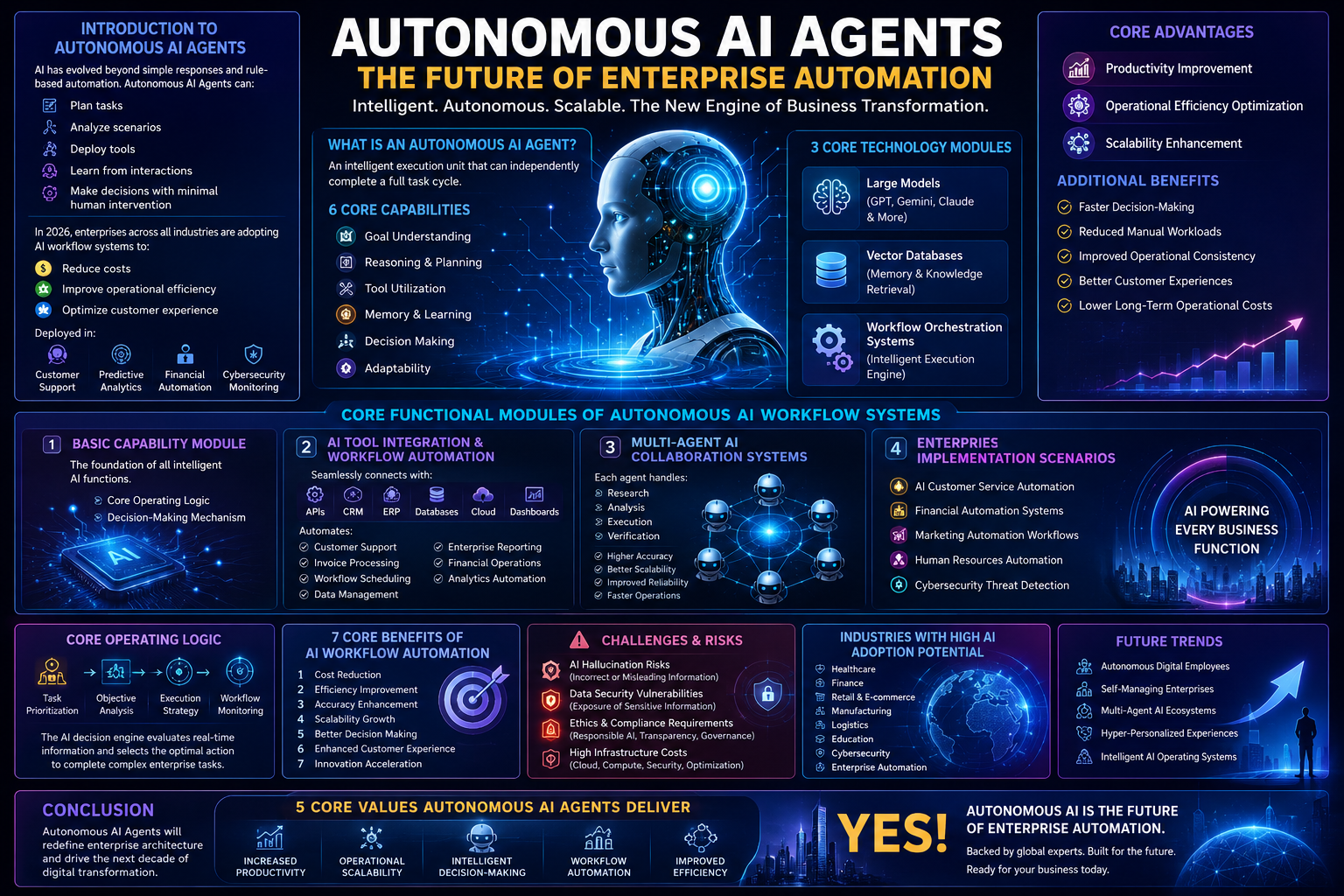
Introduction to Autonomous AI Agents
Artificial intelligence has long surpassed its traditional boundaries, which once limited it to only responding to prompts and following fixed automation rules, and has formally entered a new development stage where it can independently:
- Plan tasks
- Analyze scenarios
- Deploy tools
- Learn from interactions
- Make decisions with minimal human intervention
The core driving force behind this wave of industrial innovation is exactly Autonomous AI Agents.
In 2026, enterprises across all global industries are integrating intelligent AI workflow systems equipped with this technology into their core business operations, aiming to achieve the following goals:
- Reducing costs
- Improving operational efficiency
- Optimizing customer experience
The application scenarios that have already been deployed include:
- Automated customer support
- Predictive analytics
- Financial automation
- Cybersecurity monitoring
Autonomous AI agents have also become a core strategic component driving enterprises’ digital transformation.
Compared with traditional AI chatbots and conventional automation software, autonomous AI agents have several unique advantages:
- Independently complete complex multi-step tasks
- Coordinate operations across software platforms
- Access core database information
- Continuously optimize workflows through memory and reasoning systems
- Dynamically respond to real-time changing business scenarios

Core Definition and Capabilities of Autonomous AI Agents
This paper formally provides a clear definition of autonomous AI agents, which possess six core capabilities.
The three core technology modules that support their real-world implementation include:
- General large models such as GPT, Gemini, and Claude
- Vector databases
- Intelligent workflow orchestration systems
Subsequent sections of this paper will further explore:
- Working principles of autonomous AI agents
- Supporting technologies
- Enterprise implementation use cases
- Deployment benefits
- Existing challenges
- Future development trends of intelligent workflow automation
Core Operating Logic of Autonomous AI Systems
This paper first starts from the core operating logic of autonomous AI agents, clarifying that their prerequisite tasks include:
- Task prioritization
- Objective analysis
- Execution strategy formulation
- Workflow progress monitoring
This set of preliminary actions underpins the operating mechanism of the AI decision engine.
Relying on predefined business objectives and full-link real-time information, the system determines the optimal execution action after multi-dimensional evaluation across different business scenarios.
This capability supports AI systems in independently completing complex enterprise-level operational tasks.
Core Functional Modules of Autonomous AI Workflow Systems
Basic Capability Module
The first module is the basic capability module, whose:
- Core operating logic
- Decision-making mechanism
lay a solid foundation for implementing all intelligent AI functions.
AI Tool Integration and Workflow Automation Module
The second module is the AI tool integration and workflow automation module, which can seamlessly connect with:
- APIs
- CRM platforms
- ERP systems
- Databases
- Cloud applications
- Analytics dashboards
This module enables automation for multiple enterprise operations including:
- Customer support
- Invoice processing
- Workflow scheduling
- Data management
- Enterprise reporting
- Financial operations
- Analytics automation
Its built-in workflow orchestration framework further improves:
- System efficiency
- Operational scalability
- Automation accuracy
Multi-Agent AI Collaboration Systems in 2026
The third module focuses on the 2026 frontier trend of multi-agent AI collaboration systems.
In this architecture, each individual AI agent can independently handle tasks such as:
- Research
- Information analysis
- Workflow execution
- Output verification
This distributed AI architecture provides significant advantages including:
- Higher accuracy
- Better scalability
- Improved reliability
- Faster operational speed
These systems can be implemented in industries such as:
- Healthcare
- Cybersecurity
- Finance
- Logistics
- Enterprise automation
Enterprise Implementation Scenarios of Autonomous AI
The fourth module focuses on vertical enterprise implementation scenarios.
AI Customer Service Automation
AI systems help enterprises by providing:
- 24/7 customer support
- Automated ticket handling
- Real-time information retrieval
- Personalized customer interactions
Financial Automation Systems
Autonomous AI systems support:
- Invoice processing
- Fraud detection
- Expense management
- Financial forecasting
- Accounts payable automation
- Accounts receivable management
Marketing Automation Workflows
AI workflow systems improve:
- Audience segmentation
- Campaign optimization
- Ad targeting
- Predictive analytics
- Conversion tracking
- Content generation
Human Resources Automation
AI-powered HR systems automate:
- Resume screening
- Employee onboarding
- Interview scheduling
- Training management
- Workforce operations
Cybersecurity Threat Detection
Autonomous AI systems monitor:
- Network activity
- Security threats
- Vulnerability patterns
- Suspicious behavior
- Real-time cyber risks
Each implementation scenario is matched with specific AI functions and corresponding cost-reduction and efficiency-improvement benefits.
Core Advantages of Autonomous AI Agents
The fifth module outlines the three core values of autonomous AI agents:
- Productivity improvement
- Operational efficiency optimization
- Scalability enhancement
All technical capabilities are directly mapped to measurable business benefits with no vague or abstract statements.
Additional enterprise advantages include:
- Faster decision-making
- Reduced manual workloads
- Improved operational consistency
- Better customer experiences
- Lower long-term operational costs
Core Value of Autonomous AI Workflow Systems
The core value of autonomous AI workflow systems lies in enabling enterprises to:
- Support full-chain real-time decision-making
- Reduce overall operational costs
- Improve scalability
- Increase automation efficiency
Challenges and Risks of Autonomous AI Systems
The current implementation of autonomous AI systems still faces four major challenges:
- AI hallucination risks
- Data security vulnerabilities
- Ethics and compliance requirements
- High infrastructure investment costs
AI Hallucination Risks
AI systems may occasionally generate inaccurate or misleading information.
Data Security Vulnerabilities
Workflow transmission systems may expose sensitive enterprise information if security measures are insufficient.
Ethics and Compliance Requirements
Organizations must ensure:
- Responsible AI usage
- Transparency
- Regulatory compliance
- Ethical governance
High Infrastructure Costs
Large-scale AI deployments require:
- Advanced cloud infrastructure
- Computing resources
- Ongoing optimization
- Enterprise-grade security systems
Future Trends and Industry Forecasts for Autonomous AI
Industry analysts predict that autonomous AI will become the core supporting technology for global enterprise operations over the next decade.
Enterprises that complete their AI strategy implementation early are expected to build long-term competitive advantages that are difficult to replicate.
This paper also identifies:
- 7 core benefits of AI workflow automation
- 8 industries with rapid AI adoption potential
- Major future technology development directions
Future enterprise AI trends include:
- Autonomous digital employees
- Self-managing enterprises
- Multi-agent AI ecosystems
- Hyper-personalized customer experiences
- Intelligent AI operating systems
FAQ and Foundational Definitions
This paper also clarifies several foundational concepts through an embedded FAQ structure.
What Is an Autonomous AI Agent?
An autonomous AI agent refers to an intelligent execution unit capable of independently completing a full task cycle.
What Is an AI Workflow System?
An AI workflow system is an automated scheduling platform that links multiple intelligent systems together.
Will autonomous AI become the future direction of enterprise automation?
The answer is yes, and this conclusion is strongly supported by industry experts and enterprise technology analysts worldwide.
Conclusion:
The Future of Enterprise Automation
This paper concludes that autonomous AI will reshape enterprise technological architecture from the ground up, creating a foundational layer for the digital transformation of entire industries.
Autonomous AI agents can provide five core values to enterprise automation:
- Increased productivity
- Operational scalability
- Intelligent decision-making
- Workflow automation
- Improved efficiency
