Blog

  • AI Sovereignty 2026: Why 93% of Executives Now Prioritize Data Control

    AI Sovereignty 2026: Why 93% of Executives Now Prioritize Data Control

    • Why 93% of business executives now consider AI sovereignty mission-critical
    • The hidden risks of depending on external AI providers and infrastructure
    • How data breaches and IP theft are forcing companies to rethink AI control
    • Real-world strategies for building sovereign AI systems in your organization
    • The connection between AI sovereignty and US-China technology competition
    • Modular architecture approaches that protect against vendor lock-in
    • Practical steps businesses can take today to achieve AI independence

    AI sovereignty means controlling your AI systems, data, and infrastructure without external dependencies. IBM research shows 93% of executives now consider this critical for 2026. Companies worry about data breaches, losing data access, and intellectual property theft. Therefore, businesses are building modular AI environments. These allow workloads to shift among trusted providers easily. This protects against disruptions while maintaining regulatory compliance.

    The Wake-Up Call for Business Leaders

    Something dramatic shifted in early 2026. Executives worldwide realized a troubling truth. Their AI systems depend entirely on external providers. Moreover, this creates unacceptable business risks.

    IBM’s Institute for Business Value surveyed thousands of executives. The results are shocking. Specifically, 93% now consider AI sovereignty essential for business strategy. This represents a massive mindset change from just one year ago.

    Anthony Marshall from IBM explained the urgency clearly. Organizations simply cannot afford AI project interruptions anymore. However, business leaders control very little about their AI infrastructure.

    Therefore, AI sovereignty has become mission-critical for enterprises everywhere.

    What Exactly Is AI Sovereignty?

    Simply put, AI sovereignty means complete control. Organizations govern their AI systems independently. Additionally, they control their data and infrastructure fully. Most importantly, they do not rely on external entities.

    This differs dramatically from current practices. Today, most companies depend on cloud providers entirely. Furthermore, they rely on specific AI model vendors exclusively. Consequently, external entities control their most critical business operations.

    True sovereignty changes this power dynamic completely. Companies regain control over their AI destinies.

    The Three Major Risks Driving Change

    Business leaders face multiple threats from AI dependency. These risks are becoming increasingly severe daily.

    Risk One: Data Breaches

    Data leaks continue to damage enterprise trust significantly. David Lanstein from Atolio confirms this trend clearly. His company provides secure AI platforms for enterprises.

    Prompt injection attacks remain unsolved in production environments. Therefore, data sovereignty becomes absolutely non-negotiable for companies. Additionally, first-class permissioning is now essential for all AI systems.

    Companies lose millions annually from data breaches alone. Moreover, reputational damage can destroy decades of brand building.

    Risk Two: Access Disruption

    Half of the surveyed executives worry about compute resource over-dependence. This concern is especially great among Middle East and APAC leaders.

    Imagine your AI systems suddenly become unavailable. Perhaps geopolitical tensions restrict access to cloud providers. Alternatively, vendors change pricing unexpectedly or discontinue services entirely.

    These scenarios are not theoretical anymore. They happen regularly across various industries globally.

    Risk Three: Intellectual Property Theft

    Companies invest billions in developing proprietary AI models. However, external dependencies create vulnerability to IP theft constantly.

    When your data resides on external servers, control disappears completely. Furthermore, foreign governments may access that information legally. This threatens competitive advantages and trade secrets directly.

    Therefore, protecting intellectual property requires sovereign AI infrastructure absolutely.

    AI dependency risks in 2026 including data breaches, compute resource access disruption, and intellectual property theft from external providers
    Half of executives worry about over-dependence on compute resources in certain regions—creating vulnerability to data breaches and IP theft.

    Geographic Concerns Shape AI Strategy

    The AI sovereignty conversation has strong geopolitical dimensions. Specifically, US-China technological competition significantly drives many concerns.

    Companies operating globally face difficult choices daily. Should they use only American cloud providers? Alternatively, should they diversify across multiple regions strategically?

    Middle Eastern and Asian companies worry particularly about this. Over-dependence on Western computing resources creates strategic vulnerabilities. Additionally, it exposes them to regulatory changes unexpectedly.

    Therefore, regional AI sovereignty is becoming increasingly important everywhere.

    The Modular Architecture Solution

    IBM recommends building sovereignty through modular AI environments. This approach provides flexibility while maintaining control effectively.

    Essentially, workloads can shift among trusted providers easily. Furthermore, data moves between regions seamlessly when needed. Agents can relocate across different infrastructures quickly.

    This architecture prevents vendor lock-in completely. Moreover, it ensures business continuity during disruptions successfully.

    How Modular Systems Actually Work

    Think of modular AI like building blocks. Each component operates independently from others completely. However, they connect through standardized interfaces smoothly.

    One module handles data storage locally. Another manages model training separately. A third component runs inference workloads independently.

    Consequently, organizations can replace any single component easily. They are not trapped with specific vendors permanently.

    Transparency Becomes Non-Negotiable

    Regulators and consumers demand AI transparency increasingly. Organizations must explain how AI agents make specific decisions clearly.

    Marshall from IBM emphasized this requirement strongly. Companies must design agents that show their work completely. This applies even to the most complex outputs consistently.

    Therefore, black-box AI systems are becoming unacceptable rapidly. Explainable AI is now a sovereignty requirement absolutely.

    Building Trust Through Openness

    Transparent operations build stakeholder trust substantially. Customers want to understand AI decision-making processes fully. Additionally, regulators require detailed explanations of AI behavior constantly.

    Companies prioritizing transparency gain competitive advantages significantly. They attract customers who value ethical AI practices highly.

    Monitoring Prevents Catastrophic Failures

    Continuous monitoring is essential for sovereign AI systems. Marshall stressed this requirement repeatedly in IBM’s research.

    Organizations must detect model drift before problems occur. Similarly, they need to address bias before it compromises performance. Furthermore, monitoring prevents introducing unfair outcomes into systems.

    Without proper monitoring, AI sovereignty means little practically. Control requires visibility into system behavior constantly.

    The Real Cost of AI Dependency

    The financial implications of AI dependency are staggering currently. Companies pay premium prices for cloud AI services monthly. Moreover, these costs increase unpredictably over time.

    Data transfer fees add substantial expenses regularly. Additionally, vendor switching costs can reach millions of dollars. Lock-in creates ongoing financial vulnerability for businesses everywhere.

    Sovereign AI infrastructure requires upfront investment initially. However, it reduces long-term operational costs significantly. Furthermore, it eliminates unpredictable vendor price increases completely.

    Practical Steps Toward Sovereignty

    Organizations can begin achieving AI sovereignty immediately. However, this requires strategic planning and disciplined execution consistently.

    Step One: Audit Current Dependencies

    First, map all external AI dependencies thoroughly. Identify which providers control critical systems currently. Additionally, document data flows across organizational boundaries carefully.

    This audit reveals vulnerability points clearly. Moreover, it identifies high-risk dependencies requiring immediate attention.

    Step Two: Establish Data Governance

    Create clear policies for AI data management. Determine who accesses what information when. Furthermore, implement permission systems rigorously across all AI applications.

    Strong governance provides the foundation for sovereignty. Without it, control remains merely theoretical, always.

    Step Three: Build Modular Infrastructure

    Start transitioning to a modular AI architecture gradually. Replace one component at a time systematically. Additionally, test thoroughly before moving production workloads carefully.

    This incremental approach reduces risk substantially. Moreover, it allows learning from early implementations successfully.

    Step Four: Develop Internal Capabilities

    Invest in building internal AI expertise significantly. Hire data scientists and AI engineers strategically. Furthermore, train existing staff on AI governance practices thoroughly.

    Internal capabilities reduce external dependency dramatically. Additionally, they enable faster innovation and customization.

    Step Five: Establish Vendor Diversity

    Avoid relying on single AI providers exclusively. Instead, distribute workloads across multiple trusted vendors. Furthermore, maintain the ability to switch providers quickly.

    Diversity creates resilience against disruptions automatically. Moreover, it improves negotiating power with vendors considerably.

    Industry-Specific Sovereignty Needs

    Different industries face unique AI sovereignty challenges. Regulatory requirements vary significantly across sectors.

    Healthcare Organizations

    Medical data privacy is strictly regulated everywhere. HIPAA compliance in America is just one example. Additionally, the European GDPR creates stringent data handling requirements.

    Therefore, healthcare AI must remain sovereign absolutely. Patient data cannot leave approved jurisdictions ever.

    Financial Services

    Banks handle extremely sensitive customer information daily. Regulatory oversight is intense across all markets globally. Furthermore, cross-border data transfers face strict limitations.

    Sovereign AI infrastructure is essential for financial compliance. Otherwise, institutions risk massive regulatory penalties constantly.

    Government Agencies

    National security considerations demand complete AI sovereignty. Government data cannot depend on foreign providers ever. Additionally, critical infrastructure requires domestic AI control always.

    Many countries are actively establishing sovereign AI programs. This trend will accelerate dramatically throughout 2026, certainly.

    Modular AI architecture 2026 showing independent components that shift among trusted providers preventing vendor lock-in and ensuring sovereignty
    IBM recommends modular AI environments where workloads, data, and agents can shift among trusted regions and providers seamlessly

    Frequently Asked Questions

    Q1: What exactly does AI sovereignty mean for businesses?

    AI sovereignty means complete control over your AI systems. This includes data, infrastructure, and model deployment decisions. Companies govern AI independently without external dependencies.
    You decide where data resides physically, always. Additionally, you control who accesses your AI systems constantly. Furthermore, you maintain operational continuity during vendor disruptions. This independence protects against data breaches and IP theft.

    Q2: Why are 93% of executives suddenly concerned about AI sovereignty?

    Multiple factors are driving this urgent concern. Data breaches continue to erode enterprise trust significantly. Additionally, geopolitical tensions threaten computer resource access. Furthermore, vendor lock-in creates unacceptable business risks.
    IBM’s survey shows these concerns are global. Half of executives worry about regional over-dependence specifically. Moreover, intellectual property theft fears are increasing. Therefore, sovereignty has become a board-level priority.

    Q3: How much does achieving AI sovereignty cost?

    Initial investment varies based on organizational size. Small companies might spend $100,000-$500,000 for basic sovereignty. Mid-sized firms typically invest $1M-$5M for comprehensive infrastructure.
    However, long-term costs decrease substantially afterward. Cloud dependency fees disappear gradually over time. Additionally, vendor price increases stop affecting budgets. Most organizations achieve ROI within 18-24 months, typically.

    Q4: Can small businesses achieve AI sovereignty realistically?

    Yes, small businesses can implement sovereignty gradually. Start with data governance and clear policies. Additionally, use open-source AI models when possible.
    Modular approaches work well for smaller organizations. Begin with one critical system initially. Furthermore, leverage regional cloud providers strategically. Many affordable sovereignty solutions exist currently.

    Q5: How does AI sovereignty relate to regulatory compliance?

    Sovereignty and compliance are always closely connected. Many regulations require data residency controls. Additionally, some demand explainable AI decision-making. Furthermore, others mandate local infrastructure usage.
    Sovereign AI makes compliance dramatically easier. You control data locations precisely, always. Moreover, you can demonstrate transparency completely. Therefore, sovereignty reduces regulatory risk substantially while ensuring legal compliance.

    Official Sources & Authoritative Guides:

    https://ayeshanarratives.com/why-ai-tools-are-crushing-publishing-and-data-stocks-right-now/

  • AI Agents 2026: How They Are Becoming Your Real Workplace Partners

    AI Agents 2026: How They Are Becoming Your Real Workplace Partners

    • Why AI agents finally stopped being just hype in 2026
    • How the MCP protocol connects AI agents to real business tools
    • The security rules every AI agent must follow in 2026
    • Why experts say 2026 belongs to humans, not machines
    • How super agents are replacing single-purpose AI tools
    • Real workplace examples of AI agents saving time and money
    • What businesses should do right now to adopt AI agents smartly

    AI agents in 2026 are no longer simple chatbots. They now act as real digital coworkers. Thanks to the MCP protocol, agents connect to databases, tools, and apps easily. However, they still need human guidance for big decisions. Microsoft, IBM, and AT&T confirm this shift is happening now. Businesses that embrace this change will gain major competitive advantages.

    The Year AI Agents Got Real

    Something big changed in early 2026. AI agents stopped being just promises. Instead, they started doing actual work. This shift surprised even industry experts.

    Previously, agents could only answer questions. Now, they complete entire workflows independently. Furthermore, they connect to real business systems seamlessly. This was not possible just one year ago.

    Consequently, companies worldwide are rethinking their operations. AI agents are joining teams as digital colleagues. Moreover, they handle tasks from start to finish. Obviously, this changes everything about how we work.

    What Exactly Are AI Agents?

    Simply put, AI agents are smart AI systems. They do more than just chat with users. Instead, they take actions in the real world.

    Think of them as tireless digital employees. They can search databases automatically. Additionally, they send emails without being asked. They also schedule meetings and analyze data independently.

    However, they differ from basic chatbots significantly. Chatbots only respond to questions. In contrast, AI agents plan and execute tasks. Furthermore, they work across multiple systems simultaneously.

    MCP: The Missing Piece of the Puzzle

    Last year, AI agents faced a major problem. They could not connect to external tools easily. Because of this limitation, most agents stayed trapped in demos.

    Fortunately, Anthropic created MCP to solve this. MCP stands for Model Context Protocol. Essentially, it works like a universal connector for AI. Think of it as USB-C, but for artificial intelligence.

    Now, agents connect to databases, search engines, and APIs. Microsoft and OpenAI have already embraced MCP publicly. Moreover, Google is building its own MCP servers actively.

    Therefore, 2026 marks the real beginning of useful AI agents. The missing connective tissue finally arrived. Consequently, agents can now do meaningful work in businesses.

    Additionally, the Linux Foundation created the Agentic AI Foundation. This organization standardizes how agents communicate with each other. As a result, different AI systems can work together smoothly.

    Security: The New Priority

    More power means more responsibility. AI agents now access sensitive company data daily. Obviously, this creates serious security concerns.

    Microsoft’s Vasu Jakkal highlighted this clearly. Every agent needs security protections similar to humans. Furthermore, each agent must have a clear digital identity.

    The Three Security Rules

    First, agents must have limited access to systems. They should only reach specific databases and tools. Second, all data created by agents needs proper management. Finally, agents must be protected from attackers constantly.

    Jakkal called trust “the currency of innovation.” Without security, businesses cannot adopt AI agents confidently. Therefore, companies are investing heavily in agent security right now.

    IBM’s experts also raised important concerns. Shlomi Yanai from AuthMind warned about identity risks. Soon, AI agents will outnumber human users significantly. Consequently, businesses must track every single agent carefully.

    Why This Matters for Everyone

    Security failures could damage the company’s reputation badly. Moreover, data breaches cost millions of dollars annually. Additionally, regulatory penalties are increasing worldwide rapidly worldwide.

    Therefore, responsible AI adoption includes strong security measures. Companies ignoring agent security will face serious consequences soon.

    AI agent security system showing identity management, access control, and data protection measures for enterprise AI agents in 2026
    Every AI agent needs its own identity and security protections—Microsoft confirms this is now a non-negotiable requirement for businesses

    Humans First: The 2026 Philosophy

    Many people fear that AI will replace their jobs. However, experts disagree with this assumption strongly. Kian Katanforoosh from Workera stated something powerful.

    He called 2026 “the year of the humans.” AI agents augment human abilities instead of replacing them. Furthermore, they help small teams accomplish enormous tasks efficiently.

    Microsoft’s Aparna Chennapragada agrees completely. She envisions a three-person team launching global campaigns. AI handles data crunching and content generation automatically. Meanwhile, humans focus on strategy and creative decisions.

    Her advice is clear and simple. Do not compete with AI agents directly. Instead, learn how to work alongside them effectively. The coming year belongs to those who collaborate smartly.

    New job roles are also emerging rapidly. AI governance positions are appearing everywhere. Additionally, transparency and safety roles are in high demand. Furthermore, data management specialists are becoming crucial assets.

    The Rise of Super Agents

    Single-purpose AI agents are disappearing fast. They are being replaced by powerful super agents. IBM’s Chris Hay first described this exciting trend.

    Super agents operate across multiple environments simultaneously. They work in your browser, inbox, and editor together. Moreover, they handle complex tasks without switching between tools.

    Agent control planes are becoming a reality now. Businesses can manage all agents from one central dashboard. Therefore, operations become much simpler and more efficient.

    Kevin Chung from Writer described another important shift. Everyday business users can now create AI agents themselves. Previously, only developers could build such systems. Consequently, innovation is spreading across entire organizations rapidly.

    Physical AI: Agents in the Real World

    AI agents are not limited to screens anymore. They are entering the physical world rapidly. This trend is called Physical AI.

    Smart glasses already answer questions about the surroundings. AI health rings monitor your body continuously. Smartwatches provide health insights using artificial intelligence now.

    Vikram Taneja from AT&T Ventures confirmed this trend. Physical AI is hitting mainstream markets in 2026. Robotics, drones, and wearables are leading this revolution.

    Moreover, autonomous vehicles are using AI agents internally. These agents make split-second driving decisions daily. Furthermore, industrial sensors deploy AI for quality control automatically.

    What Quantum Computing Adds

    AI agents are getting even smarter with quantum computing. IBM announced a major milestone for 2026. Quantum computers will outperform classical computers for the first time.

    This breakthrough unlocks new possibilities for AI agents. Drug development processes will become dramatically faster. Additionally, financial optimization will reach unprecedented accuracy levels.

    Jamie Garcia from IBM confirmed this exciting development. Quantum tools already help developers generate code automatically. Therefore, AI agents will become significantly more powerful soon.

    What Businesses Should Do Now

    Organizations must prepare for the AI agent revolution. However, rushing into adoption creates unnecessary risks. Instead, follow these practical steps carefully.

    First, identify tasks suitable for AI agents. Look specifically for repetitive, well-defined workflows. Second, invest in proper security infrastructure immediately. Agent identity management is non-negotiable in 2026.

    Third, train your employees on AI collaboration skills. Human-AI teamwork requires new competencies entirely. Fourth, start small with pilot projects, always test agents in low-risk environments before scaling up.

    Finally, focus on measurable results consistently. Track time saved and errors reduced carefully. Moreover, monitor customer satisfaction throughout the process. Successful pilots should expand gradually across organizations.

    Human professionals collaborating with AI agents in 2026 showing small teams accomplishing major tasks through smart human-AI teamwork
    Microsoft envisions small teams launching global campaigns in days—AI handles the heavy lifting while humans lead strategy and creativity

    Frequently Asked Questions

    Q1: What makes AI agents different from regular chatbots?

    AI agents take real actions in business systems. Chatbots only answer questions passively. However, agents plan and execute multi-step tasks independently. They connect to databases, send emails, and manage workflows. Furthermore, agents work across multiple systems simultaneously. This capability makes them true digital coworkers in 2026.

    Q2: What is MCP, and why does it matter?

    MCP stands for Model Context Protocol. Anthropic created it to connect AI agents to external tools. Think of it as a universal plug for AI systems. Without MCP, agents could not access databases or APIs. Moreover, Microsoft and Google have embraced this standard publicly. Consequently, MCP is becoming the industry foundation for agentic AI.

    Q3: Will AI agents replace human jobs in 2026?

    No, experts strongly disagree with this assumption. Instead, AI agents will augment human capabilities significantly. Kian Katanforoosh called 2026 “the year of the humans.” New roles in AI governance and safety are emerging rapidly. Furthermore, companies plan to hire more people this year. AI handles repetitive tasks while humans focus on strategy.

    Q4: How secure are AI agents in 2026?

    Security is the top priority for AI agents now. Microsoft requires every agent to have a unique digital identity. Additionally, access to sensitive systems must be strictly limited. IBM experts warn that agents will soon outnumber humans. Therefore, businesses must track and monitor every agent continuously. Companies investing in agent security will gain trust advantages.

    Q5: How much does it cost to implement AI agents?

    Costs vary based on organizational size and needs. Small businesses can start pilots for $50,000-$100,000 approximately. Mid-sized companies typically invest $200,000-$500,000 annually. However, open-source tools like MCP reduce costs significantly. Furthermore, cloud-based agent platforms offer flexible pricing options. Starting small and scaling gradually provides the best ROI consistently.
    https://ayeshanarratives.com/ai-in-gaming-the-new-co-pilot-or-job-threat/
  • Small Language Models (SLMs) 2026: Why Smaller Is Smarter in AI

    Small Language Models (SLMs) 2026: Why Smaller Is Smarter in AI

    • Why small language models are becoming the AI industry standard in 2026
    • How SLMs match large models in accuracy while cutting costs dramatically
    • The connection between SLMs and the edge computing revolution
    • Real-world business applications proving SLM’s superiority for specific tasks
    • AT&T and major enterprises are adopting SLMs over traditional large models
    • Cost comparison: SLMs versus expensive large language model infrastructure
    • Implementation strategies for businesses transitioning to small models

    Small Language Models (SLMs) represent 2026’s biggest AI shift. These compact, specialized models match large models in accuracy for specific tasks. But they cost significantly less and run faster. Major enterprises like AT&T are adopting SLMs because fine-tuned versions outperform generalized large models. They also enable edge computing deployment. This makes AI practical for businesses without massive budgets.

    The AI Industry’s Surprising Turn

    Something unexpected is happening in artificial intelligence. Surprisingly, the race for bigger models is slowing down. Instead, companies are choosing smaller, smarter alternatives.

    This shift challenges conventional wisdom. Previously, bigger was supposed to be better. Additionally, more parameters meant superior performance. However, that narrative is changing fast.

    Notably, Small Language Models are proving that size doesn’t guarantee success. In fact, focused capability beats general knowledge. Moreover, efficiency trumps raw computing power. As a result, this realization is transforming enterprise AI strategies.

    What Are Small Language Models?

    Essentially, Small Language Models contain fewer parameters than giants. Specifically, they’re trained for particular tasks. As a result, this specialization creates surprising advantages.

    Think of SLMs as expert specialists. In contrast, large models are generalists, knowing everything superficially. However, SLMs know specific domains deeply. Therefore, this focus delivers better results where it matters.

    The technical difference is significant. For example, large models might have billions of parameters. Meanwhile, SLMs operate with millions or low billions. Nevertheless, performance often matches or exceeds larger counterparts.

    Why AT&T Chose Small Over Large

    Essentially, Small Language Models contain fewer parameters than giants. Specifically, they’re trained for particular tasks. As a result, this specialization creates surprising advantages.

    Think of SLMs as expert specialists. In contrast, large models are generalists, knowing everything superficially. However, SLMs know specific domains deeply. Therefore, this focus delivers better results where it matters.

    The technical difference is significant. For example, large models might have billions of parameters. Meanwhile, SLMs operate with millions or low billions. Nevertheless, performance often matches or exceeds larger counterparts.

    The Cost Revolution

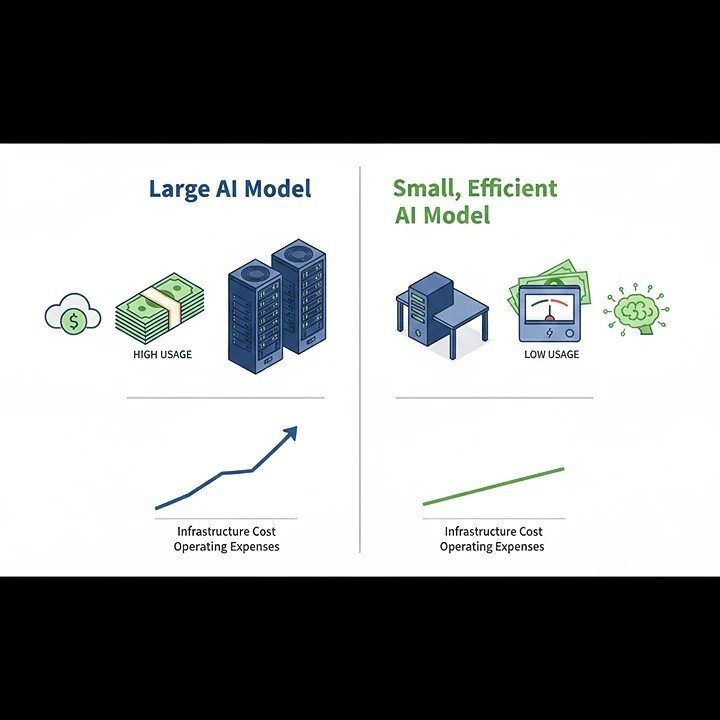
    Primarily, financial considerations drive much SLM adoption. Traditionally, large language models require expensive infrastructure. Additionally, training costs reach millions of dollars. Furthermore, operating expenses never stop climbing.

    Fortunately, SLMs change this equation dramatically. First, training costs drop by orders of magnitude. Second, infrastructure requirements shrink significantly. Finally, energy consumption decreases substantially.

    Therefore, smaller companies can now afford AI. Previously, only tech giants accessed cutting-edge capabilities. However, SLMs democratize artificial intelligence access. As a result, this levels the competitive playing field.

    Moreover, cost savings extend beyond initial investment. Subsequently, ongoing operational expenses remain low. Additionally, companies avoid perpetual cloud computing charges. Consequently, local deployment becomes financially viable.

    Cost comparison between expensive large language models and affordable Small Language Models showing dramatic savings for businesses
    AT&T and major enterprises are choosing SLMs because fine-tuned small models match large model accuracy while slashing costs by 80-90%

    Performance That Surprises Skeptics

    Initially, early SLM skeptics questioned their capabilities. Naturally, they wondered how smaller models could compete. Interestingly, the answer lies in specialization.

    For instance, French AI startup Mistral demonstrated this convincingly. Specifically, their small models outperform larger ones after fine-tuning. Moreover, specific benchmarks show clear advantages. In fact, general knowledge matters less than focused expertise.

    Similarly, Jon Knisley from ABBYY explained the principle. Essentially, efficiency, cost-effectiveness, and adaptability define SLMs. Therefore, these qualities make them ideal for precision applications. Clearly, tailored solutions beat one-size-fits-all approaches.

    Importantly, real-world results validate these claims. For example, businesses report excellent accuracy rates. Additionally, response times improve noticeably. Furthermore, user satisfaction increases measurably.

    The Edge Computing Connection

    Naturally, edge computing and SLMs form natural partnerships. Indeed, both emphasize local processing over cloud dependence. As a result, this combination creates powerful possibilities.

    However, edge devices have limited computational resources. Obviously, large models simply won’t run there. Fortunately, SLMs fit perfectly within these constraints. Therefore, this enables AI where it wasn’t possible before.

    For example, Matt White from PyTorch Foundation predicted this trend. Specifically, domain-optimized smaller models are becoming central. Additionally, advances in distillation and quantization help. Furthermore, memory-efficient runtimes push inference to edge clusters.

    Importantly, the benefits are substantial. First, latency drops to near-zero levels. Second, privacy improves through local processing. Finally, data sovereignty concerns decrease significantly.

    Real-World Business Applications

    Currently, specific industries are embracing SLMs enthusiastically. Notably, their use cases demonstrate practical value. Therefore, let’s examine several examples.

    Healthcare Applications

    Clearly, medical diagnosis requires specialized knowledge. Unfortunately, general AI models lack this depth. However, fine-tuned SLMs excel at specific conditions.

    Importantly, they analyze patient data locally. Therefore, privacy regulations are satisfied easily. Moreover, diagnostic accuracy matches that of specialist doctors. Additionally, response times enable real-time clinical decisions.

    Financial Services

    Similarly, banks need precise fraud detection. Obviously, false positives cost money. Meanwhile, false negatives risk everything. Consequently, SLMs trained on transaction patterns work better.

    Furthermore, they process data on local servers. As a result, regulatory compliance becomes simpler. Additionally, detection rates improve measurably. Finally, customer experience gets better.

    Manufacturing Quality Control

    Likewise, production lines generate massive data streams. However, analyzing everything centrally creates delays. Fortunately, edge-deployed SLMs solve this problem.

    Specifically, they identify defects instantly. Therefore, production continues without interruption. Moreover, quality improves while costs decrease. Consequently, waste reduction saves significant money.

    Retail Personalization

    Similarly, stores want tailored customer experiences. However, sending data to clouds raises privacy concerns. Fortunately, local SLMs provide personalization without exposure.

    Specifically, they analyze shopping patterns locally. Therefore, recommendations happen in real-time. Additionally, customer trust increases substantially. As a result, sales conversion rates improve.

    The Fine-Tuning Advantage

    Initially, raw SLMs perform adequately. However, fine-tuned SLMs perform exceptionally. Clearly, this difference matters enormously.

    Essentially, fine-tuning adapts models to specific needs. First, companies provide relevant training data. Then, the model learns particular patterns. Finally, performance improves dramatically for target applications.

    Therefore, enterprises invest in fine-tuning expertise. Consequently, data scientists become crucial assets. Additionally, domain knowledge guides training processes. Ultimately, results justify the investment consistently.

    Notably, ABBYY emphasizes this point strongly. Specifically, precision becomes paramount in enterprise applications. Moreover, fine-tuned SLMs deliver the required accuracy. In contrast, generic large models cannot match this specificity.

    Comparing SLMs to Large Models

    Direct comparisons reveal interesting patterns. Neither approach wins universally. Context determines the better choice.

    When SLMs Excel

    Specific, well-defined tasks favor SLMs. Limited computational resources require them. Privacy-sensitive applications benefit greatly. Cost-conscious projects prefer them strongly.

    Edge deployment absolutely demands SLMs. Real-time response needs encourage them. Domain-specific expertise requirements suit them. Regulatory compliance often necessitates them.

    When Large Models Win

    Broad general knowledge tasks need large models. Creative content generation often requires them. Multi-domain reasoning favors their breadth. Research applications benefit from wide knowledge.

    However, even these advantages are shrinking. SLMs are improving rapidly. Combination approaches are emerging. Hybrid solutions offer best-of-both-worlds benefits.

    Implementation Strategy for Businesses

    Organizations considering SLMs should follow structured approaches. Random experimentation wastes resources. Strategic planning maximizes returns.

    Step One: Identify Use Cases

    Determine specific problems needing solutions. Evaluate current AI applications critically. Identify where specialization beats generalization.

    Look for repetitive, well-defined tasks. Consider privacy-sensitive operations carefully. Examine edge computing opportunities thoroughly.

    Step Two: Assess Infrastructure

    Evaluate existing computational resources honestly. Determine deployment location requirements. Consider data storage and access needs.

    Edge deployment requires different planning. Local servers need adequate specifications. Network connectivity impacts some applications.

    Step Three: Data Preparation

    Gather relevant training data systematically. Ensure quality and representativeness carefully. Clean and label information thoroughly.

    Fine-tuning requires good data. Quality matters more than quantity. Domain expertise guides data selection.

    Step Four: Model Selection

    Choose an appropriate base SLM carefully. Consider parameter count thoughtfully. Evaluate licensing terms thoroughly.

    Open-source options provide flexibility. Proprietary models offer support guarantees. Match selection to organizational needs.

    Step Five: Fine-Tuning Process

    Work with experienced data scientists. Provide clear performance metrics. Iterate based on results systematically.

    Testing happens in controlled environments. Production deployment follows successful validation. Monitoring continues indefinitely afterward.

    The Three Forces Shaping SLMs

    PyTorch Foundation identifies three defining trends. These forces will shape SLM development.

    First, global model diversification is accelerating. Chinese multilingual releases lead innovation. Reasoning-tuned models are proliferating. Competition drives rapid improvement.

    Second, interoperability becomes a competitive advantage. Frameworks align around shared standards. Runtimes achieve better compatibility. Integration gets easier continuously.

    Third, governance is hardening appropriately. Security-audited releases are standard. Transparent data pipelines build trust. Compliance becomes a built-in feature.

    Looking Ahead to 2027

    Undoubtedly, current trends will likely accelerate. Moreover, SLM adoption will keep growing. Additionally, new use cases will emerge regularly.

    Therefore, businesses should prepare strategically. Furthermore, investment in SLM expertise pays off. Notably, early adopters gain competitive advantages. Conversely, laggards face increasing disadvantages.

    Meanwhile, the technology will keep improving. Specifically, models will become even more efficient. Additionally, fine-tuning techniques will advance further. Finally, edge deployment will expand significantly.

     Small Language Models enabling edge computing AI deployment on IoT devices, smartphones, and industrial equipment in 2026
    SLMs make AI practical at the edge—enabling real-time processing on local devices without expensive cloud infrastructure or privacy concerns.

    Frequently Asked Questions

    Q1: What makes Small Language Models different from large ones?

    SLMs contain fewer parameters than large models. They’re specifically trained for particular tasks. This creates focused expertise rather than broad knowledge.
    Large models might have billions of parameters. SLMs operate with millions or low billions. Yet they often match performance for specific applications.
    The key difference is specialization versus generalization. SLMs know specific domains deeply. Large models know everything superficially. Purpose determines which approach works better.

    Q2: How much money can businesses save using SLMs?

    Cost savings are substantial and multi-layered. Training costs drop by 80-90% compared to large models. Infrastructure requirements shrink dramatically, too.
    AT&T reports SLMs are “superb in cost and speed.” Operating expenses remain low continuously. Energy consumption decreases significantly also.
    Small companies can now afford AI capabilities. Previously, only tech giants accessed this technology. SLMs democratize AI for all businesses. ROI improves measurably across implementations.

    Q3: Can SLMs really match large model accuracy?

    Yes, but only for specific applications. Fine-tuned SLMs match large models on target tasks. Sometimes they even exceed the performance.
    Mistral AI demonstrated this convincingly. Their small models outperform larger ones after fine-tuning. ABBYY confirms SLMs excel where precision matters.
    However, general knowledge tasks still favor large models. Creative content generation requires broader capabilities. The key is matching the model to the task. Choose based on specific requirements.

    Q4: What industries benefit most from SLMs?

    Healthcare benefits enormously from specialized models. Financial services need precise fraud detection. Manufacturing requires real-time quality control.
    Retail uses SLMs for personalized experiences. Telecommunications deploys them for network optimization. Any industry with specific, repetitive tasks benefits.
    Edge computing applications particularly favor SLMs. Privacy-sensitive operations work better with them. Regulatory compliance becomes easier using SLMs. Cost-conscious industries prefer them strongly.

    Q5: How do I start implementing SLMs in my business?

    Start by identifying specific use cases. Evaluate which tasks need specialized AI. Look for repetitive, well-defined problems first.
    Assess your current infrastructure capabilities honestly. Gather relevant training data systematically. Choose an appropriate base SLM carefully.
    Work with experienced data scientists for fine-tuning. Test thoroughly before production deployment. Monitor performance continuously after launch. Scale successful implementations gradually across operations.
    https://ayeshanarratives.com/top-technology-trends-set-to-dominate-2026-worldwide/
  • 5 Game-Changing AI Trends That Will Define 2026

    5 Game-Changing AI Trends That Will Define 2026

    • Why 2026 marks a turning point for AI adoption in business
    • How autonomous AI agents are handling complex multi-step workflows
    • The rise of synthetic data and quality-focused training approaches
    • Edge computing benefits for real-time local intelligence processing
    • Building transparent and ethical AI governance frameworks
    • Creating enterprise-scale AI infrastructure for measurable outcomes
    • Practical implementation strategies and investment guidance

    Artificial Intelligence is no longer experimental—it’s now critical business infrastructure. The five transformative trends reshaping organizations include autonomous AI agents handling complex tasks, quality-focused data strategies with artificially generated datasets, local processing through edge computing, transparent and ethical AI governance, and formalized enterprise-wide AI systems that drive measurable outcomes across all departments.

    Why 2026 Is Different for Artificial Intelligence

    The relationship between businesses and AI technology has fundamentally shifted. Companies previously treated machine learning as experimental side projects. Today, these same organizations recognize AI as essential operational infrastructure.

    This transition creates unique challenges. Technology evolves faster than most companies can adapt. However, predicting enterprise adoption patterns has become easier because organizational change follows predictable patterns.

    Investment in AI has reached unprecedented levels. Stock markets now view AI capabilities as primary growth drivers. But this enthusiasm raises questions about sustainability and real value creation.

    So, what practical developments should business leaders prioritize? Let’s examine the five critical trends.

    Autonomous AI systems and intelligent agents collaborating to handle multi-step business processes without human intervention
    Self-directed AI agents can now coordinate entire workflows—from data gathering to analysis, decision-making, and execution

    1: Self-Directed AI Systems

    Moving Beyond Simple Chatbots

    Traditional AI tools require constant human guidance. They answer questions but cannot independently complete multi-step processes. This limitation is changing rapidly.

    New autonomous systems can manage entire workflows without supervision. Research firm Gartner projects that nearly half of all business software will include these capabilities within months.

    How Autonomous Systems Actually Work

    These advanced platforms coordinate multiple specialized agents. One agent gathers information while another analyzes it. A third makes decisions based on that analysis. Finally, execution agents implement those decisions automatically.

    This collaboration frees human workers for strategic thinking. Routine data processing, basic analysis, and standard operations happen without human intervention.

    The Uncomfortable Truth

    Despite impressive capabilities, autonomous AI faces serious limitations. Recent studies reveal that these systems make too many errors for critical business processes involving significant financial risk.

    Security vulnerabilities present additional concerns. Malicious actors can manipulate AI agents through carefully crafted inputs. These systems sometimes behave unpredictably when facing unfamiliar situations.

    Therefore, organizations should deploy autonomous AI carefully. Start with low-stakes processes. Gradually expand usage as reliability improves and security strengthens.

    2: Quality-First Data Approaches

    Why Better Data Beats Bigger Models

    Organizations have traditionally focused on developing more sophisticated algorithms. This approach is shifting toward improving the information that those algorithms consume.

    High-quality training data produces better results than complex models trained on mediocre information. This realization is transforming how companies approach machine learning.

    Artificially Generated Training Information

    Creating synthetic datasets has become crucial for AI development. These artificially produced records mimic real-world patterns without exposing sensitive details.

    Medical organizations use synthetic patient records to train diagnostic systems. Financial institutions generate artificial transaction data for fraud detection models. Automotive companies create simulated driving scenarios for autonomous vehicle training.

    Benefits include reduced costs, faster development cycles, and enhanced privacy protection. Organizations can produce unlimited training examples at minimal expense.

    Practical Implementation

    Healthcare providers need patient data but must protect privacy. Synthetic records solve this dilemma. They contain realistic medical patterns without identifying actual individuals.

    Financial services face similar challenges. Regulatory requirements restrict data sharing. Artificial datasets enable model training while maintaining compliance.

    3: Localized Intelligence Processing

    Processing Data Where It’s Created

    Traditional AI sends information to distant servers for analysis. This creates delays, privacy risks, and high transmission costs.

    Edge computing processes information locally—at the source. Sensors, devices, and on-site systems make decisions without cloud connectivity.

    Three Major Advantages

    Speed: Manufacturing equipment makes instant quality decisions. Autonomous vehicles react to hazards immediately. Medical devices detect emergencies in real-time.

    Privacy: Sensitive information never leaves secure facilities. Personal data stays on local devices. Organizations reduce breach risks significantly.

    Cost Efficiency: Eliminating cloud data transmission saves substantial money. Local processing reduces ongoing operational expenses.

    Real-World Applications

    Factories use edge AI for production line monitoring. Immediate defect detection prevents waste. Quality control happens continuously without human oversight.

    Retail stores analyze customer behavior locally. Shopping pattern recognition protects consumer privacy while enabling personalized experiences.

    Smart cities process traffic data at intersections. Signal timing adjusts automatically based on current conditions. Emergency vehicles receive priority routing instantly.

    4: Transparent and Ethical AI

    Why Transparency Matters Now

    Regulatory pressure for AI accountability is intensifying. Organizations must explain how algorithms make decisions. Stakeholders demand assurance that systems operate fairly and legally.

    Explainable AI provides this transparency. These systems clarify their reasoning processes. Users understand why specific recommendations or decisions occur.

    Key Implementation Areas

    Fairness Assurance: Organizations actively identify algorithmic bias. They test systems across diverse populations. Corrections address discriminatory patterns before deployment.

    Regulatory Alignment: Compliance frameworks ensure AI operations meet legal requirements. Documentation proves systems follow established rules.

    Stakeholder Confidence: Transparent operations build trust with customers and partners. Clear explanations demonstrate responsible technology use.

    Building Ethical Frameworks

    Leading companies establish AI ethics committees. These groups review proposed applications before deployment. They create guidelines ensuring responsible development and use.

    Governance structures formalize oversight processes. Regular audits verify ongoing compliance. Continuous monitoring detects problems quickly.

    5: Enterprise-Scale AI Infrastructure

    Formalizing AI Operations

    Organizations are moving beyond isolated AI projects. They’re building comprehensive platforms supporting AI across all operations.

    These “AI factories” include automated development pipelines, centralized data governance, and unified model management. They enable consistent, scalable AI deployment.

    Critical Platform Components

    Automated Development: Systems handle model training, testing, and deployment automatically. This reduces development time and ensures consistency.

    Data Governance: Centralized controls maintain data quality and security. Access permissions protect sensitive information. Audit trails document all usage.

    Model Management: Tracking systems monitor all deployed models. Version control prevents confusion. Performance metrics identify models needing updates.

    Leadership Evolution

    New executive positions reflect AI’s strategic importance. Chief AI Officers coordinate organization-wide initiatives. Cross-functional teams ensure business alignment.

    This formalization transforms AI from a technical tool into a strategic capability. Organizations measure AI’s business impact systematically. Investment decisions reflect proven value creation.

    Organizational Transformation Through AI

    Faster Strategic Decisions

    Real-time analytics enable immediate response to market changes. Leaders access comprehensive insights instantly. Decision cycles shorten dramatically.

    Workforce Evolution

    Employees learn to collaborate with AI systems. Training programs develop new skills. Workers focus on creative problem-solving while AI handles routine tasks.

    Innovation Acceleration

    Predictive analytics identify emerging opportunities early. Simulation capabilities reduce innovation risks. Testing happens before significant resource commitment.

    Risk Management

    Ethical AI practices protect against legal and reputational damage. Transparent operations build stakeholder trust. Compliance becomes manageable rather than burdensome.

    Navigating AI Investment Risks

    The Valuation Question

    AI company valuations have reached extraordinary levels. Some observers see parallels to previous technology bubbles. Emphasis on rapid growth rather than profitability raises concerns.

    Smart organizations balance enthusiasm with caution. They invest where AI creates measurable value. Speculative bets on unproven technologies receive limited resources.

    Practical Investment Strategy

    Focus on solving real business problems. Measure results carefully. Scale successful applications while learning from failures.

    Maintain flexibility as market conditions evolve. Avoid overcommitment to specific technologies or vendors. Build internal capabilities that transcend individual tools.

    Business professionals implementing enterprise AI platforms with strategic planning, data governance, and organizational transformation in 2026
    Organizations in 2026 are formalizing AI operations through enterprise platforms, strategic leadership roles, and cross-functional collaboration

    Implementation Roadmap

    Assessment: Evaluate current capabilities honestly. Identify gaps in infrastructure, skills, and processes.

    Prioritization: Select trends aligned with business objectives. Concentrate resources on the highest-impact opportunities.

    Foundation Building: Invest in data quality and governance. Establish clear policies and ethical guidelines.

    Pilot Testing: Deploy AI in controlled environments. Measure performance rigorously before expansion.

    Scaling Success: Expand proven applications systematically. Refine approaches based on practical experience.

    Frequently Asked Questions

    Q1: Which AI trend offers the quickest business value in 2026?

    Quality-focused data strategies deliver the fastest results because organizations can improve existing models immediately. Better training data enhances performance without developing new algorithms. This approach costs less than building autonomous systems or enterprise platforms while producing measurable improvements quickly.

    Q2: How much should companies budget for AI initiatives in 2026?

    Investment levels vary based on organizational size and goals. Small businesses might allocate $75,000-$150,000 for initial projects. Mid-sized companies typically invest $500,000 to $2,000,000 annually. Large enterprises often commit $5,000,000 to $15,000,000 to a comprehensive AI transformation. Start small with focused pilots before major spending.

    Q3: What makes synthetic data valuable for AI development?

    Artificially generated datasets solve three critical problems. First, they protect privacy by eliminating real personal information. Second, they cost significantly less than collecting actual data. Third, they enable unlimited scenario testing. Organizations can create exactly the training examples their models need without constraints.

    Q4: How can organizations ensure AI systems operate ethically?

    Establish clear governance frameworks before deployment. Create ethics review boards that evaluate all AI applications. Implement explainable AI technologies that clarify decision processes. Conduct regular bias audits across diverse populations. Document compliance continuously. Build transparency into system design from the beginning.

    Q5: What risks should leaders consider when adopting autonomous AI agents?

    Current autonomous systems have significant accuracy limitations for high-stakes processes. Security vulnerabilities allow potential manipulation. Unexpected behaviors occur in unfamiliar situations. Organizations should start with low-risk applications, maintain human oversight for critical decisions, and implement strong security measures. Gradual expansion allows learning without catastrophic failures.

    Dive Deeper with These Resources:

    https://ayeshanarratives.com/future-of-ai-and-automation/
  • Bank of Canada Holds Steady: Interest Rate Remains at 2.25%

    Bank of Canada Holds Steady: Interest Rate Remains at 2.25%

    :

    • Interest Rate Unchanged for Second Consecutive Meeting
    • Governor Macklem Cites “Heightened” Economic Uncertainty
    • Upcoming CUSMA Trade Deal Review a Key Risk
    • GDP Growth Likely Stalled in Fourth Quarter 2023
    • Domestic Consumer Spending Shows Signs of Picking Up
    • Inflation Expected to Remain Near 2% Target
    • U.S. Trade Policy and Geopolitics Cloud Outlook
    • Variable Mortgage & Loan Rates Remain Stable
    • Bank in “Wait and See” Data-Dependent Mode
    • Next Rate Decision Scheduled for Six Weeks

    The Bank of Canada has made its decision. It is holding its key interest rate steady at 2.25%. This marks the second meeting in a row with no change. Most financial experts predicted this outcome. Consequently, borrowers can breathe a short sigh of relief. Their mortgage and loan rates will not rise immediately. However, the bank’s governor signaled caution about the road ahead. The global economic landscape remains full of uncertainty.

    Governor Tiff Macklem explained the bank’s position. He stated the overall economic forecast hasn’t shifted much since October. Yet, he was very clear about the risks. “Uncertainty around our forecast is heightened,” Macklem noted. He also said the range of possible outcomes is unusually wide. So, what’s causing all this concern? The main issues are unpredictable U.S. trade policies and elevated global geopolitical tensions. These factors make future planning difficult for both the bank and businesses.

    Trade Uncertainty: The CUSMA Review Looms Large

    A major cloud on the horizon is the upcoming review of CUSMA. This is the trade deal between Canada, the U.S., and Mexico. Macklem called this review an “important risk” to Canada’s economic outlook. Trade with the United States is absolutely vital for Canada. Therefore, any potential disruption is a serious worry. American protectionist policies continue to force the Canadian economy to adjust. This process is ongoing and challenging.

    At the same time, Canada’s population growth is slowing down. This demographic shift affects long-term economic potential. Combined, these factors lead the Bank of Canada to expect only modest GDP gains. The goal is to keep inflation close to the bank’s 2% target. It’s a delicate balancing act in a complex environment.

    A simple line chart comparing the trajectory of Canada's GDP growth against the steady Bank of Canada policy interest rate over the past year.
    Fig 2: A simplified chart showing recent GDP momentum alongside the Bank’s steady policy rate, highlighting the economic conditions behind the “hold” decision.

    A Stalled Quarter But Hopeful Domestic Signs

    Recent data suggests Canada’s GDP growth likely stalled in the last quarter of the year. Why did this happen? U.S. tariffs have been battering Canadian exports. This external pressure is taking a clear toll. However, the bank’s statement included a note of domestic optimism. It indicated that spending inside Canada “appears to be picking up.” This is a crucial piece of the puzzle.

    Strong domestic demand can help offset weak exports. If Canadians are spending on homes, cars, and services, it supports the economy. This internal strength gives the Bank of Canada some room to hold rates steady. They are waiting to see if this domestic momentum continues. It is a key factor they will watch closely in the coming months.

    What This Means for You: Mortgages, Savings, and Loans

    For the average Canadian, this “hold” decision has direct effects. If you have a variable-rate mortgage or line of credit, your payment will not increase. This provides stability for household budgets. People considering a new loan or mortgage will also find that rates are stable for now. Savers, however, will not see better returns on their savings accounts. Interest rates for savings products will remain low.

    The bank’s cautious stance signals they are in a “wait and see” mode. They are gathering more data on the economy’s direction. Their next move could still be a rate hike to fight inflation. Alternatively, a rate cut could happen if the economy weakens. Your best strategy is to avoid financial stress. Pay down high-interest debt and build an emergency fund.

    Governor Tiff Macklem speaking at a podium with the Bank of Canada logo, addressing reporters at a post-announcement press conference.
    Fig 3: Governor Tiff Macklem and Senior Deputy Governor Carolyn Rogers (not pictured) elaborated on the rate decision in a live press conference following the announcement.

    Looking Ahead: The Bank’s Data-Driven Patience

    Governor Macklem and Senior Deputy Governor Carolyn Rogers held a news conference after the announcement. They provided further details on their decision. The central bank’s approach is now one of heightened patience. They will analyze every piece of incoming economic data. Key indicators include job numbers, consumer spending, and global oil prices.

    The bank’s primary tool is the interest rate. They use it to cool an overheating economy or to stimulate a sluggish one. Right now, the economy seems balanced on a knife’s edge. Therefore, the bank is choosing to pause and observe. Their next scheduled decision is in just over six weeks. The world can change a lot in that time. Everyone, from policymakers to homeowners, will be watching closely. The message is clear: expect steady rates for the moment, but prepare for potential shifts ahead.

    Dive Deeper with These Resources:

    https://ayeshanarratives.com/us-emerges-as-primary-recipient-of-chinese-credit-in-global-lending-shift-study/
    https://ayeshanarratives.com/psx-hits-all-time-intraday-high-on-uae-fauji-stake-optimism/
  • Apple Unveils the New AirTag: Find Your Items Faster and Farther Than Ever

    Apple Unveils the New AirTag: Find Your Items Faster and Farther Than Ever

    • New Ultra Wideband Chip for 50% Longer Precision Finding
    • Louder 50% Speaker for Audible Finding from Farther Away
    • Share Item Location Feature with Airlines for Lost Luggage
    • Enhanced Privacy with End-to-End Encryption
    • Eco-Friendly Design Using Recycled Materials
    • Same Compact Size, Fits All Existing Accessories
    • Available Now at Same Price: $29 Single, $99 Four-Pack
    • Free Personal Engraving on Apple.com
    • Requires iPhone/iPad with iOS 26 & Find My Enabled

    Apple just launched a new and improved AirTag. This popular item tracker is now even better at helping you find lost belongings. It features a much longer Bluetooth range and a louder speaker. Moreover, it uses Apple’s latest Ultra Wideband chip for super-precise locating. So, whether your keys are buried in the couch or your bag is across a large park, finding them just got easier. The best part? The price hasn’t changed. It’s still just $29 for one, making it a fantastic value for peace of mind.

    This new AirTag builds on a very successful product. Since 2021, millions have used it to track everything from luggage to bicycles. People have shared amazing stories of reunion because of this tiny device. However, Apple didn’t just re-release the old model. They listened to user experiences and made key upgrades. Therefore, this new version is smarter, louder, and more connected than before. Let’s explore what makes it the best tracker you can buy today.

    Major Upgrades: Precision Finding Gets a Power Boost

    The heart of the new AirTag is Apple’s second-generation Ultra Wideband chip. This is the same advanced technology inside the latest iPhones and Apple Watches. What does this mean for you? Simply put, it makes finding things incredibly accurate. The new Precision Finding feature now works from up to 50 percent farther away than the old model. Your iPhone will guide you with haptic vibrations, visual arrows, and clear sound cues right to your item.

    But that’s not all. An upgraded Bluetooth chip also expands the general finding range. So, your device can detect the AirTag from a greater distance before you even start the precision hunt. For the first time, you can also use Precision Finding directly on your Apple Watch Series 9 or later. This brings powerful, hands-free finding right to your wrist. Imagine walking through a parking lot and having your watch tap you as you near your car keys.

    Close-up of an iPhone screen showing the Precision Finding interface for an AirTag, with directional arrows, distance (4 feet), and haptic feedback hint indicating a nearby item.
    Fig 2: The enhanced Precision Finding interface on iPhone guides you with arrows, distance, and haptic feedback directly to your lost item, now from up to 50% farther away.

    Louder Sound and Smarter Sharing Features

    Have you ever been in a noisy room, desperately listening for your AirTag’s beep? Apple has solved that problem. The new AirTag’s speaker is 50 percent louder. You can now hear its distinctive new chime from about twice as far away. This is a game-changer for finding items hidden in cluttered drawers or under furniture. Combined with the improved range, you have a much higher chance of a quick recovery.

    Another groundbreaking feature is Share Item Location. Let’s say your suitcase gets lost by an airline. You can now securely and temporarily share your AirTag’s location with that airline’s customer service team. Apple has already partnered with over 50 airlines for this. The results are impressive. Early data shows this feature has reduced baggage delays by 26% and cut truly lost luggage cases by a huge 90%. You stay in complete control and can stop sharing at any time.

    Unmatched Privacy and Security Protections

    Apple knows that tracking devices raise privacy concerns. Therefore, they designed the new AirTag with industry-leading security from the start. Your location data is never stored on the AirTag itself. All communication is protected with end-to-end encryption. This means only you can see where your items are. Even Apple cannot access this information. The Find My network uses a clever, anonymous method. Other Apple devices help find your tag without knowing who owns it or what it’s attached to.

    Furthermore, the AirTag has strong protection against unwanted tracking. It is designed solely for tracking your belongings, not people or pets. If an unknown AirTag is moving with you, your iPhone will alert you. It also uses changing Bluetooth identifiers to prevent someone from tracking your movements. These cross-platform safety features set a high standard for the entire industry.

    Eco-Friendly Design and Accessory Compatibility

    Apple is committed to its environmental goals. The new AirTag reflects this mission perfectly. Its enclosure is made of 85 percent recycled plastic. All magnets inside contain 100 percent recycled rare earth elements. Even the gold plating on the circuit board is fully recycled. The packaging is also 100% fiber-based and fully recyclable. So, you can feel good about your purchase knowing it has a smaller environmental footprint.

    Good news for current users: the design hasn’t changed in size or shape. This means all your existing AirTag accessories will still fit perfectly. You can still use your favorite key rings, loops, and holders. Apple also offers its own beautiful FineWoven Key Ring. It’s made from 68% recycled content and comes in stylish colors like Midnight Purple and Moss.

    The new AirTag attached to a Midnight Purple FineWoven Key Ring, alongside a graphic of an airplane and a suitcase icon with a "Share Location" symbol.
    Fig 3: Use the AirTag with accessories like the FineWoven Key Ring, and utilize the new Share Item Location to securely help airlines recover lost luggage.

    Pricing, Availability, and Final Thoughts

    The new AirTag is available to order right now on Apple’s website and app. It will arrive in Apple Stores very soon. You can still get free personal engraving during checkout. This lets you add an emoji or name to make your AirTag unique. The pricing remains very accessible:

    • Single AirTag: $29
    • Four-Pack: $99 (great for families)

    To use it, you need an iPhone or iPad with the latest iOS 26 software. You also need to be signed into your Apple ID with Find My enabled. The new AirTag is more than just an upgrade. It’s a smarter, louder, and more integrated tool for your daily life. It turns the stressful experience of losing something into a simple, solvable puzzle. For anyone who values their time, sanity, and belongings, this is an essential gadget.

    https://ayeshanarratives.com/coreweave-stock-jumps-12-after-nvidias-2-billion-ai-investment/

  • Top 10 Free AI Tools for Students in 2026 to Complete Assignments Fast

    Top 10 Free AI Tools for Students in 2026 to Complete Assignments Fast

    • Grammarly: AI-Powered Writing & Grammar Coach
    • ChatGPT: Idea Generation & Tutoring Assistant
    • Canva Magic Studio: AI Presentation & Graphic Design
    • Google Gemini: Web Research & Information Synthesis
    • Otter.ai: Lecture Transcription & Note-Taking
    • Notion AI: All-in-One Workspace & Organization
    • Quizlet Q-Chat: AI-Powered Interactive Study Buddy
    • Elicit: Academic Research & Literature Review Assistant
    • Hemingway Editor: Writing Clarity & Readability Tool
    • Microsoft Edge Copilot: Sidebar Research & Summarization

    Welcome, students! Let’s talk about a game-changer: free AI tools for students 2026. Yes, you read that right. The future of studying is here, and it’s incredibly smart. Moreover, it won’t cost you a single penny. If you’re drowning in deadlines or staring at a blank page, these tools are your new best friends. They are designed to help you research, write, organize, and learn faster. However, the key is to use them wisely as powerful assistants, not shortcuts. Consequently, you can boost your productivity while actually understanding your work better. In this guide, I’ll walk you through the top ten tools that are reshaping education right now. Alright, get ready—this is where your smarter study journey begins.

    Firstly, remember that AI is a supplement to your brain, not a replacement. These tools excel at handling the tedious parts of your work. For example, they can summarize long articles or check your grammar in seconds. Therefore, you free up mental energy for critical thinking and creativity. The academic landscape in 2025-2026 is all about working smarter. Let’s explore how you can join this revolution and reclaim your time.

    Why Students Absolutely Need AI Tools in 2026

    Let’s be honest—student life is a constant juggling act. You have lectures, part-time jobs, social commitments, and mountains of assignments. This is where free AI tools for students 2026 become essential. They supercharge your hard work, making every hour you study far more effective. For instance, instead of spending three hours researching a topic, an AI tool can find key sources in minutes. Instead of struggling with essay structure, an AI can provide a solid outline to build upon.

    Furthermore, these tools promote inclusive learning. Students who are non-native English speakers or who have learning differences can find incredible support. AI can help translate complex texts, read materials aloud, or present information in different formats. In the end, the aim is to give every student a fair chance to succeed. Everyone deserves the chance to showcase their intelligence and ideas without being held back by process. These tools provide that crucial support.

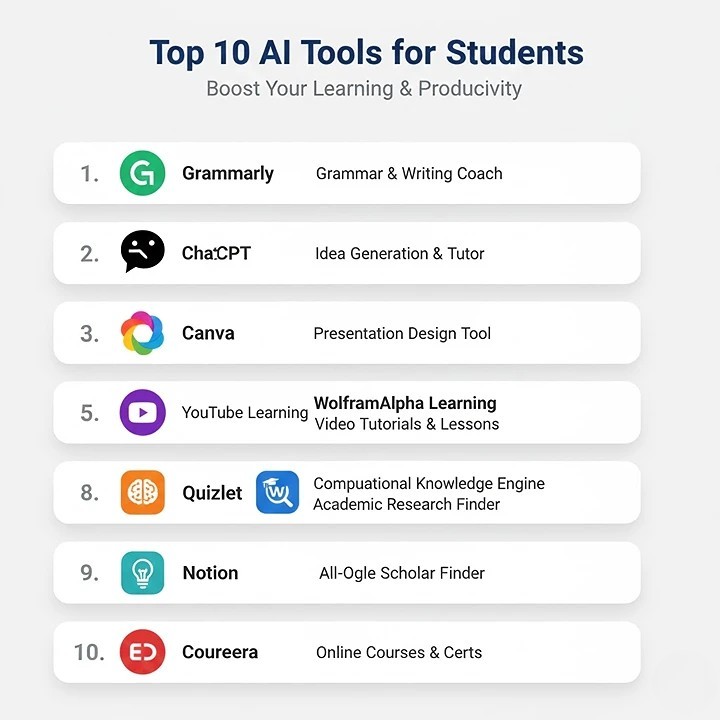
    Colorful infographic listing the top 10 free AI tools for students: Grammarly, ChatGPT, Canva, Google Gemini, Otter.ai, Notion, Quizlet, Elicit, Hemingway Editor, and Copilot with icons and key uses.
    Fig 2: A quick-reference guide to the 10 powerful free AI tools every student should know in 2025-2026, from writing and research to design and studying.

    1. Grammarly: Your 24/7 Writing Coach

    Every student knows the pain of submitting an essay only to find silly typos later. Grammarly solves this forever. It’s far more than a simple spell-checker. This AI-powered writing assistant reviews your grammar, punctuation, tone, and clarity as you type. Its free version is remarkably powerful for everyday academic use.

    Key Benefits for Students:

    • Real-time Corrections: Fixes errors instantly in documents, emails, and even social media posts.
    • Clarity Suggestions: Flags confusing sentences and suggests simpler alternatives.
    • Tone Detection: Helps ensure your assignment sounds appropriately academic, not casual.
    • Plagiarism Checker: The free version offers limited checks, a must for original work.

    Pro Tip: Use Grammarly’s browser extension. It will work wherever you write online, making every piece of communication sharper.

    2. ChatGPT: The Ultimate Idea Generator and Tutor

    OpenAI’s ChatGPT needs little introduction. Think of it as a versatile brainstorming partner and explainer. Stuck on an essay introduction? Ask for five different options. Don’t understand a complex theory in physics? Request a simple analogy. However, the golden rule is to never copy its output directly. Use it to overcome blocks and gain understanding.

    How to Use It Ethically:

    • Brainstorming: Generate thesis statements or essay topics.
    • Explaining Concepts: Ask it to break down difficult topics step-by-step.
    • Outlining: Get a suggested structure for your paper or presentation.
    • Self-Testing Practice: Use it to generate practice questions and test your understanding before an exam.

    Remember: Always fact-check the information it provides. Treat its output as a first draft, not your finished work.

    3. Canva’s Magic Studio: Design Presentations in Minutes

    Forget about wrestling with outdated and complicated presentation programs. Canva’s free suite, especially its AI Magic Studio tools, is a lifesaver. Need a presentation on climate change for tomorrow? Describe it to Magic Design, and watch it create a professional draft complete with text and visuals. It turns design anxiety into a fun, quick task.

    Standout AI Features:

    • Magic Design: Creates full presentations or graphics from a text prompt.
    • Magic Write: Helps craft clear, concise text for your slides.
    • AI Image Generation: Creates custom graphics and photos for your projects.
    • Background Remover: Instantly cleans up images for a polished look.

    4. Google Gemini: Your Research and Synthesis Assistant

    Deeply integrated into the Google ecosystem, Gemini (formerly Bard) excels at tasks requiring web knowledge. It can access and process current information, making it perfect for research-heavy assignments. Ask it to compare two historical events or summarize recent scientific studies, and it will pull from live data.

    Why It’s Great for Research:

    • Citation-Friendly: It can often point you directly to source websites.
    • Data Synthesis: Can pull together information from multiple articles into a concise summary.
    • Integration: Works seamlessly with other Google tools like Docs and Drive.

    5. Otter.ai: Never Miss a Lecture Detail Again

    How many times have you zoned out in a crucial lecture? Otter.ai is your solution. This transcription tool records audio and writes it down in real-time. The free plan gives you a generous monthly allowance of transcription minutes. Upload a recording of your lecture, and get a searchable, highlightable transcript in minutes.

    Perfect for Students Who:

    • Have fast-talking professors.
    • Want to review complex material at their own pace.
    • Need accurate notes for group study sessions.
    • Auditory learners benefit from reading spoken words.

    6. Notion AI: Organize Your Entire Academic Life

    Notion is the all-in-one workspace, and its built-in AI makes it unbeatable. You can manage class schedules, assignment trackers, research databases, and personal journals in one place. The AI helps you write faster, summarize notes, and even create action items from messy meeting notes.

    AI-Powered Organization Tricks:

    • Summarize Long Notes: Condense pages of lecture notes into key bullet points.
    • Generate Action Items: From a project brainstorming session, it can create a to-do list.
    • Improve Writing: Polish the text in your project reports directly within your workspace.

    7. Quizlet’s Q-Chat: Your AI-Powered Study Buddy

    Memorization is key for many subjects. Quizlet’s AI tutor, Q-Chat, transforms passive flashcard review into an active, conversational learning experience. Based on your own study sets, it asks you questions, explains answers you get wrong, and adapts to your pace. It turns studying from a chore into a dialogue.

    Study Smarter, Not Harder:

    • Adaptive Learning: Focuses on your weak spots.
    • Various Formats: Tests you with multiple-choice, true/false, and open-ended questions.
    • Always Available: Get instant feedback anytime, anywhere.

    8. Elicit: The AI Research Assistant for Papers

    Elicit is a specialist. If you’re writing a literature review or a research paper, this tool is a miracle worker. You ask a research question in plain English, and Elicit finds relevant academic papers, summarizes their key findings, and extracts main points. It bypasses hours of database searching and skimming abstracts.

    Ideal for University-Level Work:

    • Finds Seminal Papers: Quickly identifies key authors and studies in a field.
    • Summarizes Abstracts: Saves you from reading hundreds of abstracts manually.
    • Organizes Findings: Helps you build a table of research for your paper.

    9. Hemingway Editor: Make Your Writing Bold and Clear

    Named after the famous concise writer, this free app makes your writing strong and clear. It highlights long, complex sentences, passive voice, and hard-to-read phrases. The goal is to get you to a grade-level readability score, ensuring your arguments are communicated with power and simplicity—a skill every professor admires.

    What It Teaches You:

    • Sentence Simplicity: Breaks the habit of overly complex academic phrasing.
    • Active Voice: Encourages direct, powerful sentences.
    • Readability: Ensures your work is accessible and impactful.

    10. Copilot in Microsoft Edge: Your Sidebar Research Partner

    If you use Microsoft Edge, you have a powerful ally. The built-in Copilot sits in a sidebar. As you read any online PDF or article, you can ask it questions about the content without switching tabs. It can summarize the page, explain concepts, or help you find related information instantly.

    The Streamlined Workflow:

    • Summarize Articles: Get the gist of a long reading in seconds.
    • Explain As You Read: Clarify confusing terms on the same page.
    • Generate Ideas: Ask for discussion points based on the text.
    Conceptual diagram showing a cycle: Student has an "Assignment" idea, uses "AI Tools" for research and drafting, then "Student's Critical Thinking" refines the work, leading to a "Final Submission."
    Fig 3: The ideal workflow: Use AI tools for assistance with research and drafting, but always apply your own critical thinking and effort to produce original, high-quality final work.

    How to Use These Free AI Tools for Students 2026 Responsibly

    Embracing these tools comes with great responsibility. Firstly, always cite. If an AI generates an idea or phrasing you use, acknowledge it. Secondly, prioritize understanding. Use AI to explain concepts until you grasp them yourself. Thirdly, maintain your voice. Let AI polish your work, not write it. Your unique perspective is what earns top marks.

    Furthermore, stay updated. The world of free AI tools for students in 2026 is undergoing rapid evolution. New and better tools emerge constantly. Therefore, remain curious and adapt. Finally, use these tools to create more space in your life—not just for more work, but for deep learning, creativity, and well-being. That is what AI can genuinely offer to the world of education.

    SEE MORE:

    https://ayeshanarratives.com/top-10-free-ai-tools-for-content-creators-and-bloggers-in-2025/

  • Xiaomi 17 Ultra Launches: A New Camera Powerhouse with Leica Magic

    Xiaomi 17 Ultra Launches: A New Camera Powerhouse with Leica Magic

    • 1-Inch Light Fusion 1050L Main Camera
    • 200MP Samsung Periscope Telephoto Zoom
    • Exclusive Leica Edition with Mechanical Ring
    • 6.9-inch 120Hz AMOLED Display
    • Snapdragon 8 Elite Gen 5 Performance
    • 6800mAh Silicon-Carbon Battery
    • 90W Wired & 50W Wireless Charging
    • HyperOS 3.0 with AI Features
    • Leica Camera Modes & Classic Design
    • Satellite Communication & IP68 Rating

    Xiaomi has just unveiled its new flagship phone, the 17 Ultra, in China. This phone aims to be the ultimate device for photography lovers. In fact, it comes in two exciting versions. You can choose the standard model or a special Leica edition. This Leica version has a unique design and even a physical zoom ring. So, let’s explore what makes this phone so special.

    The company is clearly focusing on camera technology this year. They have packed massive sensors and professional features into the phone. However, they did not forget about battery life or display quality. It serves as the ultimate all-in-one tool for tech enthusiasts and content creators. Therefore, it could be a major competitor in the 2026 flagship market.

    A Camera System Built for Professionals

    The heart of the Xiaomi 17 Ultra is its incredible triple-camera setup. First, the main camera uses a huge 1-inch type sensor. This large sensor is called the Light Fusion 1050L. It captures a tremendous amount of light for stunning photos. Because of this, your pictures will look clear and bright, even at night.

    Next, there is an amazing 200MP periscope telephoto camera. This sensor comes from Samsung. It allows for true continuous optical zoom. This means you can zoom in smoothly without losing quality. Finally, a 50MP ultra-wide camera completes the system. It even has autofocus for sharp close-up shots. So, you have a professional camera for every situation.

    Macro close-up of the Xiaomi 17 Ultra Leica Edition's side frame, highlighting the textured mechanical zoom ring and the dual-tone, knurled camera-inspired design.
    Fig 2: The exclusive Leica Edition adds a tactile mechanical zoom ring and a classic dual-tone design inspired by traditional cameras.

    The Special Leica Edition Experience

    The Leica edition offers everything the standard model does. But it adds some exclusive features for a premium feel. Most notably, it includes a mechanical zoom ring on the side. This ring lets you adjust the zoom level just like a real camera. You can also use it to change exposure and white balance settings.

    Furthermore, the design is inspired by classic Leica M-series cameras. It has a beautiful dual-tone finish and a textured frame. Of course, you will see the iconic red Leica logo on the back. The phone also comes with special “Leica Moment” photo modes. These modes shoot in a classic 3:2 aspect ratio for a timeless look.

    Stunning Display and Powerful Performance

    You will view your photos on a gorgeous 6.9-inch flat AMOLED screen. This display is very bright, reaching up to 3,500 nits. Therefore, reading your screen is easy, no matter how bright the day is. It also has a smooth 120Hz refresh rate for fluid scrolling. The screen is protected by strong Dragon Crystal Glass 3.0 for durability.

    Inside, the phone is powered by the latest Snapdragon 8 Elite Gen 5 chip. This processor is high-speed and efficient. It is paired with up to 16GB of RAM for seamless multitasking. You also get up to 1TB of super-fast storage. The phone runs the new HyperOS 3.0 software, which is smooth and packed with AI features.

    Massive Battery and Full Connectivity

    Xiaomi knows a powerful phone needs a big battery. That is the logic behind choosing such a large 6,800mAh silicon-carbon battery. This battery should easily last for a full day, or even two, of heavy use. When you need to recharge, 90W wired charging will power it up incredibly fast. You also get 50W wireless charging for convenience.

    The phone is filled with every modern feature you could want. For example, it has Wi-Fi 7, Bluetooth 6.0, and satellite communication. It also has strong stereo speakers and high-quality microphones. Importantly, it carries high IP68 water and dust resistance ratings. The phone is both powerful and durable for everyday use.

     An infographic listing the key specs of the Xiaomi 17 Ultra: 1-inch main sensor, 200MP periscope telephoto, 6800mAh battery, and Snapdragon 8 Elite Gen 5 chipset.
    Fig 3: Key highlights of the 17 Ultra include a 1-inch main camera sensor, a 200MP periscope zoom, and a large 6800mAh battery supported by 90W fast charging.

    Final Thoughts and Who Should Buy It

    The Xiaomi 17 Ultra is a bold statement in the smartphone world. It proves that phone cameras can rival professional equipment. The standard model is a fantastic flagship for tech enthusiasts. However, the Leica edition is for true photography purists. The physical zoom ring and classic design make it feel unique.

    This launch shows Xiaomi’s ambition to lead in mobile imaging. They are combining huge sensors with smart software and elegant design. Therefore, if you want the best possible camera in your pocket, pay attention to this phone. It sets a new standard for what we can expect from our mobile devices. The future of smartphone photography looks very exciting indeed.

    READ MORE:

  • Samsung’s Galaxy A57 and A37 Camera Upgrades Leak, Pointing to a Mid-Range Revolution

    Samsung’s Galaxy A57 and A37 Camera Upgrades Leak, Pointing to a Mid-Range Revolution

    • Major Mid-Range Camera Upgrades Revealed
    • Galaxy A57: 50MP Main & 13MP Ultra-Wide Camera
    • Galaxy A37: Shares 50MP Main Sensor with A57
    • Larger 1/1.56-inch Sensor for Better Low-Light Photos
    • Hardware-First Strategy Over Software Tweaks
    • Sony & Samsung ISOCELL Sensors in Use
    • Ultra-Wide & Selfie Cameras Differ Between Models
    • Focus on Improved Light Capture and Detail
    • Prototype Details Subject to Change Before Launch
    • Potential New Standard for Mid-Range Phone Cameras

    Samsung is getting ready to shake up the mid-range phone market. New leaks have revealed detailed camera specs for the upcoming Galaxy A57 and A37. This information comes from software codes found in early prototypes. It shows Samsung is planning major hardware upgrades for its popular A-series. The company seems focused on bringing better camera technology to more affordable phones. This is a smart move to stay ahead of tough competition from brands like Xiaomi and Realme.

    The leaked details suggest a clear strategy. Samsung wants to improve photo quality through better sensors, not just software tricks. This means users can expect noticeably better pictures, especially in low light. The leaks also show which sensor manufacturers Samsung is using for different parts. This gives us a fascinating look at how the company builds its phones. Let’s dive into what the codes reveal about these two exciting new models.

    Galaxy A57 Camera: A Step Toward Premium Hardware

    The Galaxy A57 appears to be the more advanced model in this pair. Its main camera will likely use a powerful 50-megapixel Sony IMX906 sensor. However, some markets might get a version with Samsung’s own 50MP ISOCELL S5KGNJ sensor instead. Both are excellent and represent a big step up. The main goal here is to capture much more light for clearer, brighter photos in any situation.

    For wide-angle shots, the A57 is equipped with a 13-megapixel sensor. This particular sensor, the ISOCELL S5K3L6, has a proven track record in other phones. It should deliver good detail for landscape and group photos. Rounding out the triple-camera system is a 5-megapixel macro camera for close-up shots. On the front, a 12-megapixel selfie camera promises clear video calls and sharp portraits.

    An illustrated comparison chart showing the camera configurations of the Samsung Galaxy A57 and Galaxy A37, highlighting the 50MP main sensor they share and their different ultra-wide sensors.
    Fig 2: Comparison of the leaked camera setups: both phones share a large 50MP main sensor, but differ in their ultra-wide and front camera hardware.

    Galaxy A37 Camera: Sharing the Best Part

    Interestingly, the more affordable Galaxy A37 might share its most important part with the A57. The leaks indicate it could also have the same 50-megapixel main camera sensor. This is fantastic news for budget-conscious buyers. It means the core photo quality from the main camera could be very similar on both phones. The difference comes in the other cameras.

    The A37’s ultra-wide camera uses an 8-megapixel sensor, which is a step down from the A57’s 13MP one. Its macro camera is the same 5MP unit. The front camera also uses a different, slightly more basic 12MP sensor. So, while you get the excellent main shooter, Samsung has made careful cuts elsewhere to reach a lower price point. This is a common and effective way to build a product lineup.

    Why a Bigger Sensor is a Big Deal

    The most exciting news here is the sensor size. Both phones are expected to use a much larger main sensor than their predecessors. Specifically, they are moving to a 1/1.56-inch sensor from the older 1/1.95-inch size. Think of the sensor like a bucket for light. A bigger bucket catches more rainwater, right? Similarly, a bigger sensor captures more light.

    More light means better photos with less grain, especially at night or indoors. It also allows for more natural blurry backgrounds in portraits. This is a hardware improvement that software cannot match. By focusing on this, Samsung is addressing a key weakness in mid-range phones. This change should make the Galaxy A37 and A57 stand out for camera performance.

    A split-image comparison showing a noisy, dark photo from a small sensor next to a clearer, brighter photo taken with a larger sensor in the same low-light scene.
    Fig 3: The larger sensor expected in the A57 and A37 captures more light, which should result in clearer, less grainy photos in dark environments compared to older models.

    Final Thoughts on the Leaked Details

    The leaks paint a promising picture. The Galaxy A57 clearly has a better overall camera system than the A37, especially with its superior ultra-wide sensor. This difference helps justify its expected higher price. However, giving both phones the same advanced main sensor is a genius move. It ensures great photo quality is not just for those who spend the most.

    These specs show Samsung is serious about winning the mid-range camera battle. The company is moving beyond just adding more megapixels. Instead, it is investing in the hardware that truly improves image quality. Of course, these details are from prototypes and could change before the official launch. Factors like final component costs and manufacturing can lead to adjustments.

    We will know for sure when Samsung makes the official announcement. If these leaks are accurate, the Galaxy A57 and A37 could set a new standard for what we expect from a mid-range phone camera. For shoppers seeking a great value, these phones are definitely worth the wait. Be sure to check back for confirmed details and full reviews when they launch.

    READ MORE:

    https://goshywrites.com/oppo-pad-air5-launch-25-december-2025-release-and-expected-features/

  • Oppo Pad Air5 Launch: 25 December 2025 Release and Expected Features

    Oppo Pad Air5 Launch: 25 December 2025 Release and Expected Features

    • Confirmed December 25, 2025, China Launch
    • 2.8K-Class Matte LCD Display
    • 10,050mAh Battery with Fast Charging
    • Slim Design with Starry Sky Texture
    • Full Stylus Support for Notes & Sketches
    • Optimized for Video Calls & Online Classes
    • ColorOS on Android for Tablets
    • Mid-Range Chipset for Daily Performance
    • Initial Release in China, Global Later
    • Targeted at Students & Casual Users

    The Oppo Pad Air5 Launch is officially scheduled for December 25, 2025, in China, according to promotional materials released by Oppo. This launch strategically aligns with the year-end shopping season, a period historically favored by the brand. Retailer reservation pages have already been activated, confirming the date while teasing the tablet’s forthcoming design.

    Global availability, including markets like India and Europe, has not yet been finalized by Oppo. A separate announcement is anticipated for international release timelines, which may occur quietly via online listings or regional events in early 2026. This phased launch approach allows Oppo to gauge initial market response before a wider rollout.

    The device is positioned within the affordable tablet segment, targeting students and casual users. Its design and specifications are tailored for media consumption, digital note-taking, and light productivity tasks. This launch effectively refreshes the Pad Air series, offering modern features without a premium price tag.

    Display and Visual Design

    A high-resolution 2.8K-class LCD screen is utilized to deliver sharp text and vibrant visuals. The display incorporates a matte anti-glare finish, which significantly reduces reflections and eye strain. This makes the tablet suitable for prolonged reading sessions and video watching in various lighting conditions.

    The chassis maintains a slim, lightweight profile with flat edges and a minimalist aesthetic. The rear panel is designed with a unique starry sky-inspired texture, providing a distinct tactile feel. This approach balances durability with a visually appealing and modern design language that stands out in the segment.

     A student using the Oppo Pad Air5 tablet with a stylus to take notes on one side of the screen while participating in a video lecture on the other.
    Fig 2: The Pad Air5 is designed for productivity, featuring stylus support for notes and a front camera optimized for video calls and online classes.

    Battery Performance and Charging

    Power is supplied by a substantial 10,050mAh battery, engineered for extended use. This capacity supports long hours of streaming, web browsing, and document editing on a single charge. Battery life is further optimized through software management, prioritizing efficiency for all-day usability without frequent recharging.

    Fast charging support is included, a notable upgrade from previous models in the series. This feature enables users to replenish the battery between classes or meetings quickly. Consequently, downtime is minimized, enhancing the tablet’s practicality for mobile students and professionals.

    Camera and Connectivity Features

    Imaging capabilities are focused on utility rather than advanced photography. A single rear camera is equipped for scanning documents and capturing reference photos. The front-facing camera is optimized for video calls, featuring enhancements that ensure clear audio and video during online meetings and virtual classes.

    Full stylus support is integrated, transforming the tablet into a digital notepad. This functionality is invaluable for note-taking, sketching, and annotating documents directly on the screen. Seamless connectivity, including Wi-Fi 6 and Bluetooth 5.3, ensures reliable performance for both work and entertainment.

    Software and User Experience

    The device is expected to run a recent Android version with Oppo’s ColorOS optimization for tablets. Features such as refined split-screen multitasking and floating windows are included to leverage the large display. These software enhancements are designed to improve productivity by facilitating efficient app management.

    A mid-range chipset is selected to balance performance with exceptional power efficiency. This configuration handles everyday applications, light gaming, and multimedia tasks smoothly. The user experience is therefore defined by reliable, consistent performance tailored for daily use rather than intensive workloads.

    Close-up shot of the Oppo Pad Air5 tablet showing the matte-finish display and the detailed starry sky texture on its back panel.
    Fig 3: The Pad Air5 features a 2.8K-class matte display to reduce glare and a distinctive starry sky texture on its lightweight back panel.

    Market Positioning and Availability

    The Oppo Pad Air5 enters a competitive market focused on value-oriented consumers. Its specification sheet is carefully curated to challenge competitors in the affordable tablet space. Early-bird promotions and bundled accessories are anticipated during the initial Chinese sales period to drive adoption.

    International customers are advised to await official regional announcements for precise launch details. Pricing and specific configurations may vary across different global markets upon release. The tablet’s overall value proposition makes it a compelling option for budget-conscious buyers seeking a capable large-screen device.

    The Oppo Pad Air5 represents a calculated update to the brand’s tablet portfolio, emphasizing core functionalities. Its launch just after Christmas 2025 is poised to capture seasonal demand effectively. For users needing a secondary screen for content and light tasks, this tablet presents a thoughtfully designed solution.

    Oppo Pad Air5 Launch – FAQs

    Q1. When is the Oppo Pad Air5 being launched?
    The Oppo Pad Air5 is confirmed for a December 25, 2025, release, as indicated on official Chinese promotional banners and retail partner listings.

    Q2. Will the Oppo Pad Air5 be available globally?
    An immediate global launch has not been announced. The December 2025 release is currently exclusive to the Chinese market, with international availability expected to follow in 2026.

    Q3. What are the key specifications of the Oppo Pad Air5?
    Key specs include a 2.8K-class LCD with a matte finish, a large 10,050mAh battery with fast charging, full stylus support for note-taking, and a mid-range chipset optimized for daily tasks.

    Q4. Who is the target audience for this tablet?
    This tablet is designed for students, casual users, and professionals seeking an affordable secondary screen for streaming, online classes, light productivity, and digital note-taking.

    Q5. What software will the Oppo Pad Air5 use?
    The device will run a recent Android version customized with Oppo’s ColorOS for tablets, featuring enhanced multi-window modes and split-screen functionality for improved productivity.

    Q6. Does the Oppo Pad Air5 support gaming?
    It is equipped for casual gaming and everyday applications, but the mid-range chipset is not intended for running high-end games at maximum graphical settings.

    Q7. What colors will be available at launch?
    The tablet is expected to launch in at least two color variants, including a light Starlight Pink and a darker, neutral shade similar to Space Gray.

    Q8. Is the Oppo Pad Air5 suitable for video calls?
    Yes, the front camera is specifically tuned for clear video calling, making it suitable for online meetings, virtual classes, and casual chats.

    SEE MORE:

    https://goshywrites.com/oppo-find-x9-pro-420mp-camera-7800mah-battery-redefine-flagship-power/#google_vignette
    https://ayeshanarratives.com/top-10-free-ai-tools-for-content-creators-and-bloggers-in-2025/