Month: June 2026

  • Prompt Engineering Guide 2026: Jobs, Roadmap & Career Growth

    Prompt Engineering Guide 2026: Jobs, Roadmap & Career Growth

    Prompt Engineering: An Overview

    AI is revolutionizing communication, learning, and creativity. A rapidly growing skill during this AI revolution is Prompt Engineering. It allows individuals to interact with complex AI systems like ChatGPT, Claude, and LLaMA, among others. Not including AI systems in your daily business practices will cause you to lose relevance in today’s economy. AI systems have the ability to write, code, and even create art and design. Likewise, the majority of company goals are increasingly centered on the use of AI in order to maximize profit and speed up the delivery of business functions and services to users. AI systems, however, require flawless instructions to reach their full potential. This is the primary reason why the AI systems get the job done successfully. It allows individuals to create intelligent business workflows with instructions that are very clear and to the point. The following sections will attempt to demystify this relatively new and growing career by introducing work and learning opportunities in this field.

    What is Prompt Engineering? Frameworks, and AI Instruction Design

    Prompt Engineering refers to the skill, craft, and science involved with creating inputs for users that drive AI systems and models toward desired outputs. AI is not self-aware and will only do what the user guides it to do with an input. Bad inputs create bad outputs. A clear, precise, and contextual user input provides AI with the optimal guidance to perform a task best.

    Prompt Engineering Career Opportunities for 2026 Moving Forward

    The infusion of AI systems and technologies throughout a variety of industry sectors, including marketing, finance, healthcare, and software, will create an unprecedented number of job opportunities specific to the discipline in the marketplace. Examples of job positions that will be posted more frequently will be as follows:

    • AI Prompt Engineer

    • LLM Workflow Designer

    • AI Content Specialist

    • Automation Engineer

    • AI Operations Specialist

    Remote Work, USA Job Postings, and Entry Level Positions

    More AI systems and solutions will necessitate more jobs in this area and create job opportunities for the following positions:

    • Prompt Engineering remote

    • Prompt Engineering USA

    • Prompt Engineering NYC

    • Prompt Engineering entry level

    • Prompt Engineering no experience

    • Prompt Engineering near me

    Indeed as all AI solutions are online, the jobs will be remote and most entry level. Prompt Engineering internships and Assistant AI roles are available.

    Overview of Job Duties and Responsibilities

    In this job, you will create, test, and improve AI workflows. Many will utilize LangChain, the OpenAI API, or other automation resources. However, AI systems will always require human collaboration in order to produce safe and effective solutions. This job will provide the optimal use of AI to meet human requirements.

    Prompt Engineering Roadmap: Your Step-by-Step AI Training Plan

    Step 1: Understand the Fundamental Concepts of AI and Models

    Ultimately, people will need to have an understanding of Large Language Models, including how these systems process and interpret tokens, the role of context in LMs, and how LMs respond to various input and prompts.

    Prompt Engineering
    Prompt Engineering: The Skill Set That Will Dominate AI and Automation-Enabled Careers of 2026

    Step 2: Develop an Understanding of Prompt Engineering

    • Zero-shot prompting

    • Few-shot prompting

    • Role-based prompting

    • Chain-of-thought prompting

    Step 3: Develop a Working Knowledge of the AI Systems, Tools, and Models

    Systems such as the following:

    • ChatGPT

    • LLaMA

    • OpenAI API

    • LangChain

    Step 4: Action. Building and Development

    Build systems to enhance your experience:

    • AI Chatbots

    • Content creation tools

    • GPTs that generate professional resumes

    • Custom programs to streamline and automate workflows

    Step 5: Build a Prompt Engineering Portfolio

    This may be the easiest step. Use your custom prompts to build workflows and publish your projects on GitHub. This will give you a great head start with engagements and learning from prompt engineering courses and boot camps.

    Cost and Speed of Prompt Engineering Compared to Fine Tuning

    In fine tuning, models are trained on particular datasets. This, however, creates an expensive process as the dataset is custom-built. A more prominent design alteration built on instruction improvement is the prompt method. Most companies prefer prompt methods primarily because they are easier to use, faster and cheaper, and applicable to more use cases. The prompt method is, therefore, the most preferred design modification methods for startups and AI focused companies.

    RAG vs Prompt Methods: Context vs Instructions

    RAG (Retrieval-Augmented Generation) seeks to refine AI answers by extracting data to be referenced before the generation of the answer, while instructions based systems places more emphasis on the instructions given to the model. Most modern day AIs integrate both systems.

    RAG integrates the latest information, while systems built on instructions focus on the model’s output. The powerful combination of the two systems provides the desired level of precision and flexibility to respond to a given use case.

    Prompt Engineering for Developers and Software Engineers

    The software development life cycle can be fully integrated and automated using various sophisticated AI systems and workflows, making this skill highly in demand. As an example, a developer could issue the following prompt: “You are a senior Python developer. Generate a Flask Rest API for me that includes: authentication, error handling, and separation of concerns with a clean architecture.” Clear and sophisticated prompts greatly cut down the time and cost of software development. There are many Prompt Engineering GitHub repositories, allowing developers to learn more about real-world implementations.

    Best Prompt Engineering Courses, Cheat Sheets and Learning Resources

    At the onset of a new learning experience, many developers favor structured learning. This includes:

    • AI courses on Udemy

    • Courses on Coursera

    • AI bootcamps

    • PDF learning guides

    Other excellent learning resources include Prompt Engineering cheat sheets, Prompt Engineering PDF and paper texts, and Prompt Engineering book resources. These allow for rapid and rich learning of AI program structures.

    AI Workflow Tools, Frameworks and LangChain Libraries

    Tools that are commonly used include:

    • ChatGPT

    • LLaMA 2

    • Hugging Face

    • OpenAI API

    • LangChain

    Automated systems of this type are the fundamental building blocks of AI programs, including chatbots, automated programs and intelligent assistants. Many developers rely on Prompt Engineering and LangChain integrations to build complex workflows within AI programs.

    Crafting an AI Resume for Sustained Career Development

    Real-life use cases and the design of AI frameworks are critical to developing compelling resumes. Automation of workflows and integration of APIs are equally important. For instance, there are numerous AI career opportunities, including:

    • Remote AI employment

    • Entry-level AI employment

    • Employment that does not require AI knowledge or skills

    • Employment opportunities in the USA AI sector

    • AI employment opportunities in New York City

    It is essential to note that new developers with robust portfolios also stand a good chance of securing these employment opportunities.

    Gaining a Prompt Engineering Internship and Entry-Level AI Employment

    An increasing number of firms are rolling out new internship programs. Presently, entry-level employment requires concentrating on:

    • AI system testing

    • AI prompt design

    • Optimization of AI workflows

    • Evaluation of AI paradigms

    These positions are highly suited for students and new entrants to the job market who wish to pursue a career in the AI Industry.

    The Development of Autonomous AI Agents and AI Systems

    AI agents and autonomous systems are a part of the sophisticated AI tools and systems of the future that are multimodal. Although many of the basic tasks of an AI Industry will be automated, advanced systems and architectures will require constant fine-tuning by AI professionals.

    Prompt Engineering FAQ

    What is it used for?

    The principal aim is to assist AI personnel to refine their communication skills to facilitate engagement with AI systems to obtain clear and optimal answers.

    Is It a Career?

    Yes. There are numerous career opportunities in just about every industry that is aiming to upscale its AI operations.

    Is It Necessary to Know How to Code?

    In the majority of cases, the answer is no. However, the ability to code is very advantageous for higher tier developer positions.

    Is the field work-from-home friendly?

    Yes, all tools are online, making nearly all roles fully remote.

    What skills are required?

    You will need to be tech-savvy, have advanced critical thinking skills, and be able to think through your ideas and express them in a coherent manner.

    Conclusion: Future-Proof Your Career with AI Instruction Skills

    At this point in the AI-accelerated economy, AI instruction refinement is one of the top skills to have. It lets workers maximize their efficiency and time and helps them streamline work processes and open up entirely new career courses. Even after this point in time, with the exponential growth of AI, this will be an important skill to have for software developers and automation, for anyone creating any kind of content. For this reason, the best time to learn this skill is now, to have an advantage in the job market for this kind of skill-based work.

  • Silicon-Carbon Batteries: The Technology Behind 3-Day Smartphone Battery Life

    Silicon-Carbon Batteries: The Technology Behind 3-Day Smartphone Battery Life


    Introduction

    Smartphone battery life has become one of the most important factors for buyers in 2026. Even with faster processors, AI tools, and advanced displays, many phones still need charging before the day ends. This is where Silicon Carbon Batteries are starting to change the game. Instead of making phones thicker, manufacturers now improve how much energy a battery can store inside the same space. That is why users searching for phones with silicon carbon battery are increasing quickly. People now want to know if this is a real upgrade or just another marketing trend.

    Why Smartphone Batteries Are Changing in 2026

    Smartphones are no longer simple communication devices. People use them for gaming, work, videos, AI tools, and more. Because of this, battery demand has increased a lot. Traditional lithium batteries cannot improve much without increasing size. This is where Silicon Carbon Batteries offer a better solution. They improve energy storage without changing phone design. As a result, users get longer backup without bulky devices. Interest in battery silicone technology is also growing as people try to understand this new shift.

    How Silicon Carbon Batteries Work in Simple Terms

    The main idea behind Silicon Carbon Batteries is simple. Inside every battery, there is a part called the anode. Old batteries use graphite in this part. Graphite works well but cannot store much energy. Silicon can store much more energy than graphite. The problem is that silicon expands during charging, which can reduce stability. To solve this, manufacturers mix silicon with carbon. This combination keeps the battery stable while increasing energy capacity. Research like carbon coated silicon monooxide as an anode for lithium ion batteries has helped improve this design further.

    What Users Notice in Daily Life

    The biggest improvement is not technical, it is practical. Phones last longer on a single charge. Charging becomes faster and more efficient. Heavy tasks like gaming and video streaming drain less battery compared to older systems. Many users also reduce their dependency on chargers and power banks. This is why products like silicon carbon power bank, silicon carbon battery power bank, and silicon carbon battery bank are becoming more popular. These improvements make daily smartphone use much easier.

    Phones Using Silicon Carbon Battery Technology

    The use of phones with silicon carbon battery systems is growing, especially in high-end smartphones. Companies use this technology to increase battery size without making phones thicker. It also supports better performance for gaming and AI-based features. Right now, most devices with this technology are flagship models, but mid-range phones will likely adopt it soon as production costs decrease. Discussions around sci battery innovation show how fast this technology is developing in the smartphone industry.

    Silicon Carbon vs Lithium Battery Performance

    Many users ask whether are silicon carbon batteries better than lithium ion batteries. In real-world use, Carbon Batteries often perform better. Lithium-ion batteries are stable and reliable, but they have limited capacity improvements. Carbon Batteries store more energy and charge faster. This allows phone makers to create slimmer devices with longer battery life. Users also often search are carbon batteries better when comparing new smartphones in 2026.

    Silicon Carbon vs Lithium-Ion Battery Performance Comparison (2026 Guide)
    A clear side-by-side comparison of Silicon Carbon and Lithium-Ion batteries showing differences in energy density, charging speed, cycle life, and efficiency.

    Safety and Reliability of Silicon Carbon Batteries

    Safety is an important concern for any new battery technology. Modern Silicon Carbon Batteries come with built-in safety systems that control heat, charging speed, and power flow. Many users also ask are carbon batteries safe and whether are silicon batteries safer than lithium batteries. While both technologies are based on lithium chemistry, improved battery management systems make Carbon Batteries safe for everyday use.

    Frequently Asked Questions

    What are Silicon Carbon Batteries?

    Silicon Carbon Batteries are advanced lithium-based batteries that use silicon in the anode to increase energy storage and improve smartphone battery life.

    Are silicon carbon batteries better?

    Yes, Batteries offer better battery life, faster charging, and improved efficiency compared to traditional lithium-ion batteries.

    Are silicon batteries better than lithium ion batteries?

    Yes, they provide higher energy capacity and better real-world performance while keeping phone designs slim.

    Are silicon batteries safe?

    Yes, modern Silicon Batteries include safety systems that manage heat and charging to ensure safe daily use.

    Are silicon carbon batteries better for the environment?

    They may reduce waste because they last longer and need fewer replacements over time.

    What phones use silicon carbon batteries?

    Some premium smartphones already use phones with silicon carbon battery technology, and more models are expected in the future.

    Conclusion

    Silicon Carbon Batteries are becoming one of the most important smartphone upgrades in 2026. Instead of focusing only on performance or design, this technology solves a real user problem—battery life. With better energy storage, faster charging, and slimmer device design, Batteries are shaping the future of mobile devices. As more brands adopt this innovation, it will likely become a standard feature in upcoming smartphones.

  • Best Garment Steamers in Pakistan 2026: Top Picks and Buying Guide

    Best Garment Steamers in Pakistan 2026: Top Picks and Buying Guide

    Introduction

    Keeping clothes wrinkle-free has become easier than ever with modern garment steamers. Whether you need perfectly pressed office wear, school uniforms, formal dresses, or everyday clothing, a quality garment steamer can save time while protecting delicate fabrics. In Pakistan, the demand for garment steamers continues to grow as more households seek convenient alternatives to traditional ironing. From powerful stand steamers for families to compact handheld models for travelers, there are many options available in 2026. This guide explores the best garment steamers in Pakistan, compares stand and handheld models, and helps you choose the right steamer based on your budget and household needs.

    Stand Steamers vs Handheld Steamers – Which One Do You Need?

    The first decision buyers face is choosing between a stand steamer and a handheld steamer. Both options remove wrinkles effectively, but they serve different purposes.

    Stand steamers are designed for frequent use and larger loads of clothing. They typically feature larger water tanks, higher steam output, and longer operating times. These models are ideal for families, boutiques, and users who steam multiple garments every week.

    Handheld steamers, on the other hand, focus on portability and convenience. Their compact size makes them perfect for travel, small apartments, and quick touch-ups before meetings or events. While they may not match the power of stand steamers, they offer excellent flexibility for everyday use.

    If you regularly steam several garments at once, a stand steamer is the better investment. If convenience and portability matter most, a handheld model will likely meet your needs.

    Best Garment Steamers in Pakistan 2026

    Several models stand out in the Pakistani market due to their performance, reliability, and value for money.

    The Philips GC482/26 is widely considered the best overall stand steamer. With a powerful 1600W heating system and a 1.4-liter water tank, it provides consistent steam output for efficient wrinkle removal. It works well on cotton, linen, silk, and synthetic fabrics.

    For users seeking premium performance, the Philips STE1030/26 offers an impressive 1800W motor and a large 1.8-liter water tank. Its strong steam production makes it suitable for larger households and users who demand professional-level results.

    The Decora DGS-0271 delivers excellent value by combining 1800W power with a built-in ironing board. This unique feature provides additional convenience and versatility, making it an attractive option for budget-conscious buyers.

    Travelers and professionals will appreciate the Philips GC362, a portable handheld steamer that offers 1300W of power in a lightweight design. It heats quickly and is easy to carry in luggage.

    For those looking for an affordable handheld option, the Decora DHS-0271 offers compact performance and fast steaming capabilities at a budget-friendly price point.

    Compare the best garment steamers in Pakistan for 2026, including powerful stand steamers and portable handheld models designed for every budget and lifestyle.

    Garment Steamer vs Steam Iron – What’s the Real Difference?

    Many buyers wonder whether a garment steamer can completely replace a traditional steam iron. The answer depends on your specific needs.

    A garment steamer uses hot steam to relax fabric fibers and remove wrinkles without direct contact. This makes it safer for delicate materials such as silk, chiffon, velvet, embroidered garments, and suits. Steamers also sanitize fabrics and eliminate odors while refreshing clothing.

    A steam iron relies on a heated metal plate combined with steam pressure. It creates crisp edges and sharp creases, making it ideal for dress shirts, formal trousers, and uniforms. However, irons require more effort and can potentially damage sensitive fabrics if used incorrectly.

    For everyday wrinkle removal and fabric care, a garment steamer offers greater convenience. For achieving perfectly pressed creases and professional finishes, a steam iron remains the preferred choice. Many households benefit from owning both appliances for different purposes.

    Why Philips Dominates the Pakistani Market

    Philips continues to lead the garment steamer market in Pakistan due to its reputation for quality, innovation, and reliability. Consumers trust the brand because its products consistently deliver strong performance and long-term durability.

    One major advantage is Philips’ advanced steam technology, which ensures even steam distribution and efficient wrinkle removal. The company also focuses heavily on user-friendly designs, including adjustable poles, large water tanks, and ergonomic handheld models.

    Another reason for Philips’ popularity is its extensive after-sales support and product availability across Pakistan. Replacement parts, accessories, and warranty services are generally easier to access compared to lesser-known brands.

    Although Philips products often carry a higher price tag, many users consider them a worthwhile investment because of their reliability and long lifespan.

    Buying Guide Based on Your Budget & Family Size

    Choosing the right garment steamer depends largely on your budget and the number of people in your household.

    For single users, students, and travelers, an affordable handheld steamer such as the Decora DHS-0271 provides enough power for occasional use while remaining highly portable.

    Small families with two to four members may find the Philips GC482/26 offers the perfect balance between performance and affordability. Its tank capacity and steam output are sufficient for weekly garment care.

    Larger families that frequently steam multiple outfits should consider the Philips STE1030/26. Its larger water reservoir reduces refill frequency and supports longer steaming sessions.

    Users seeking maximum versatility may prefer the Decora DGS-0271 because its integrated ironing board combines steaming and ironing functionality in one appliance.

    Ultimately, selecting the right model involves balancing your budget, garment volume, storage space, and desired convenience features.

    Frequently Asked Questions

    1. Are garment steamers better than irons?

    Garment steamers are better for delicate fabrics, quick wrinkle removal, and fabric refreshing. Irons remain superior for creating sharp creases and formal finishes.

    2. Which garment steamer is best in Pakistan in 2026?

    The Philips GC482/26 is considered one of the best overall options due to its strong performance, reliability, and value for money.

    3. Can a garment steamer remove wrinkles from all fabrics?

    Most garment steamers work effectively on cotton, polyester, silk, linen, wool, and many delicate materials. Always check garment care labels before steaming.

    4. Is a handheld steamer powerful enough for daily use?

    Yes. Modern handheld steamers such as the Philips GC362 provide sufficient power for daily touch-ups and light household use.

    5. How long does a garment steamer typically last?

    A high-quality garment steamer can last five to ten years or more with proper maintenance, regular cleaning, and correct usage.

    Final Verdict – Which Steamer Should You Buy Today?

    The best garment steamer ultimately depends on your lifestyle and household requirements. The Philips GC482/26 offers the best overall balance of performance and value, while the Philips STE1030/26 is ideal for users seeking premium features. Budget-conscious buyers can confidently choose the Decora DGS-0271 or Decora DHS-0271. For travelers, the Philips GC362 remains one of the most practical handheld options available. By selecting a steamer that matches your budget and garment care needs, you can enjoy faster, safer, and more convenient wrinkle removal throughout 2026.


  • Humanoid Robotics: 15 Powerful Trends Shaping the Future of Intelligent Machines

    Humanoid Robotics: 15 Powerful Trends Shaping the Future of Intelligent Machines

    Introduction

    The field of intelligent machines is undergoing a rapid and historic transformation, and humanoid robotics sits at the center of this global shift. By combining artificial intelligence, machine learning, advanced sensors, robotics engineering, and cognitive computing, engineers design these systems to replicate human movement and decision-making in real-world environments. Unlike traditional automation, these advanced platforms operate in spaces built for humans, which makes them highly adaptable and practical.

    Over the past few years, development updates regarding these systems have gained significant global attention as industries transition from experimental labs to real-world deployment. Rising labor shortages, increasing operational costs, and the demand for higher productivity drive this shift across sectors such as manufacturing, healthcare, logistics, and retail. Consequently, specialized bipedal automation is no longer a future concept but an active part of today’s industrial transformation.

    Growing Importance of Humanoid Robotics in Modern Industries

    Digital transformation and automation are rapidly reshaping modern industries. Businesses face constant pressure to reduce costs while improving efficiency, safety, and output quality. In this environment, human-shaped machines offer increasingly valuable support because they can perform complex tasks that traditionally required human labor.

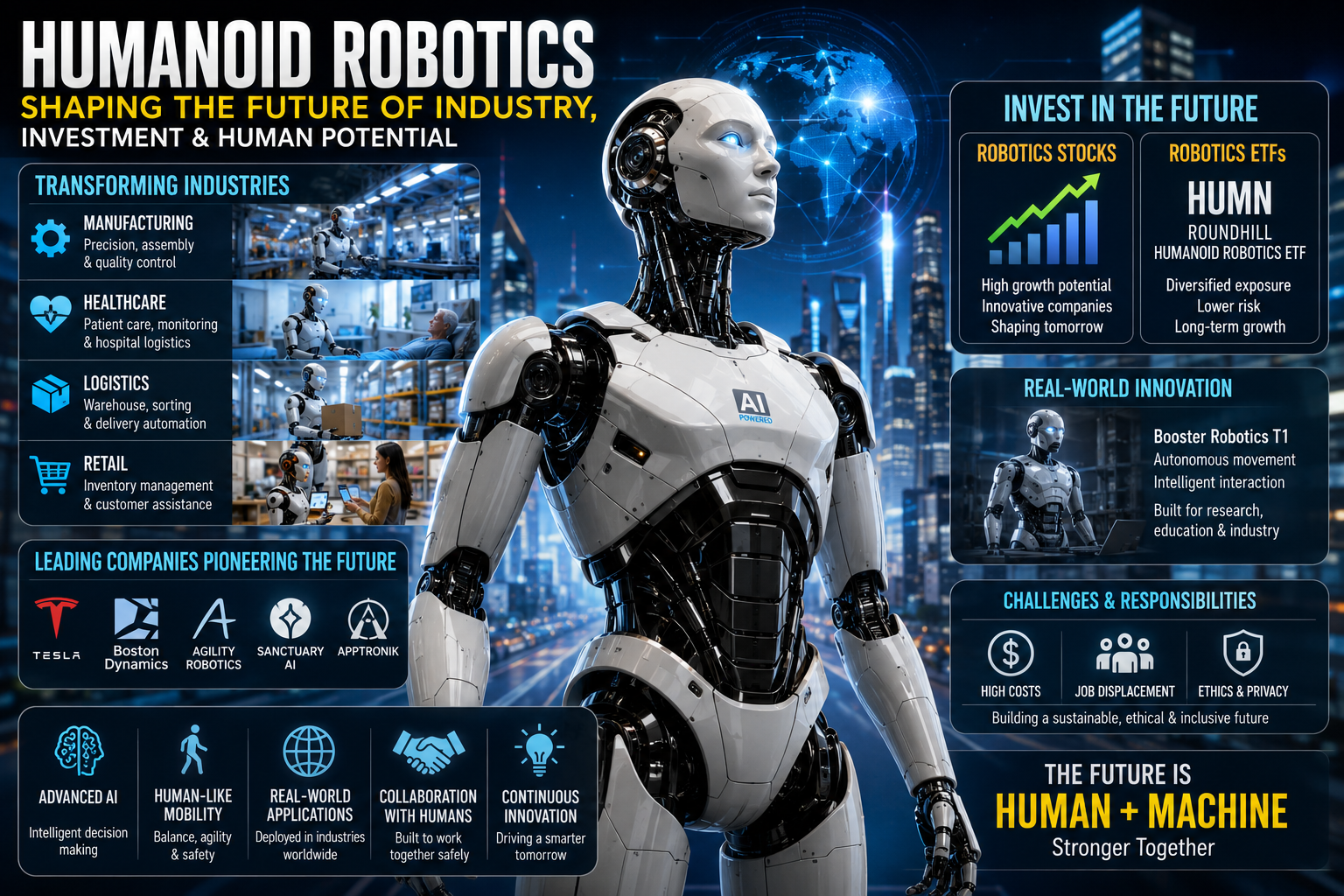
    The surge in current field news reflects how organizations actively adopt these systems for real-world applications. In manufacturing facilities, workers use them for precision-based assembly and repetitive tasks that require absolute consistency. Healthcare professionals rely on them to assist with patient monitoring, the care of older adults, and hospital logistical operations. Meanwhile, retail and logistics companies deploy them for inventory handling, customer assistance, and warehouse automation.

    Unlike traditional industrial machines, anthropomorphic systems function in human-designed environments without requiring expensive infrastructure modifications. This makes scalable humanoid robotics a practical solution for modern businesses.

    Humanoid Robotics

    Technological Advancements Driving Humanoid Robotics Growth

    Rapid progress in artificial intelligence has significantly accelerated the capabilities of human-centric machines. Earlier models relied strictly on repetitive, pre-programmed actions. In contrast, modern intelligent platforms learn from experience, analyze environments, and make autonomous decisions.

    Recent breakthroughs highlight major improvements in machine perception, balance control, and real-time learning systems. Advanced computer vision allows robots to identify objects and people accurately, while natural language processing enables human-like communication. These improvements turn industrial units into interactive assistants rather than simple machinery.

    Similarly, industry reports frequently cover milestones in motion control, energy efficiency, and adaptive intelligence. These developments push the entire sector closer to widespread commercial use, where hardware can work safely alongside humans in dynamic environments.

    Industry Coverage and Global Developments in Automation

    Media coverage of these advanced machines shows how quickly the industry is evolving. Companies continuously release updated prototypes with better agility, longer battery life, and stronger computational capabilities. These innovations represent a massive global race toward advanced automation rather than isolated achievements.

    At the same time, current headlines emphasize real-world deployment over laboratory experiments. Teams are now testing robots in logistics centers, hospitals, airports, and retail environments. This real-world integration demonstrates that research-driven development has officially transitioned to commercial adoption.

    Leading Companies Pioneering Humanoid Robotics

    Several major technology companies drive innovation in this specialized sector:

    • Tesla develops anthropomorphic systems for both industrial and domestic use.

    • Boston Dynamics commands industry respect for its advanced mobility and balance technologies.

    • Agility Robotics focuses on human-friendly navigation.

    • Sanctuary AI builds cognitive robotic intelligence.

    • Apptronik specializes in collaborative industrial robots.

    These top organizations invest heavily in artificial intelligence, mechanical design, and machine learning systems. Their intense competition accelerates innovation, resulting in faster development cycles and improved real-world capabilities. As a result, the technology continues to evolve rapidly, with new advancements emerging each year.

    Financial Market Trends: Humanoid Robotics Stocks

    The financial market shows increasing interest in automation technologies. Sector-specific equities have become a popular topic among investors seeking exposure to high-growth industries. Typically, these listings belong to companies involved in artificial intelligence, hardware manufacturing, and advanced automation systems.

    However, direct equity investments also carry risk due to market volatility and technological uncertainty. While long-term growth potential remains strong, short-term price fluctuations occur frequently. Investors should therefore analyze company fundamentals, technological leadership, and market adoption trends before investing.

    Diverse ETF Opportunities in Robotics

    For investors seeking diversified exposure, exchange-traded funds offer a balanced approach. A sector ETF distributes investment across multiple companies involved in hardware and AI development, reducing risk compared to investing in a single stock.

    One of the most recognized options, the Roundhill Humanoid Robotics ETF (HUMN), tracks companies developing advanced physical technologies. This specific fund focuses on firms involved in next-generation automation and intelligent systems. Similarly, individual fund products are winning over long-term investors due to their built-in diversification benefits.

    These investment vehicles provide direct market exposure without requiring individual stock selection, making them suitable for both beginner and experienced investors.

    Strategic Paths for Investing in Humanoid Robotics Tech

    Understanding how to back this technological wave involves evaluating both direct and indirect strategies. Direct investments in manufacturing companies can yield higher returns, but they expose your portfolio to greater risk from market fluctuations and rapid technological changes.

    Conversely, investing through diversified funds provides a safer, more stable approach. Many financial analysts recommend combining both strategies depending on your personal risk tolerance and investment goals. Because the space is still in a growth phase, long-term investment strategies tend to outperform short-term trading approaches.

    Real-World Innovations and Bipedal Applications

    One of the most significant technological advancements in recent years is the Booster Robotics T1 system. This machine demonstrates exactly how teams can apply advanced mechanics in education, research, and industrial environments. It features autonomous movement, intelligent decision-making, and the ability to interact with humans in structured environments.

    Industry news frequently highlights such innovations, showing that real-world adoption is accelerating. These platforms are no longer theoretical concepts; companies are actively testing and implementing them in various industries worldwide.

    Structural Challenges and Ethical Considerations

    Despite rapid advancements, several challenges remain. High development and production costs still limit widespread adoption, and smaller businesses often struggle to implement these systems due to financial constraints.

    Ethical concerns also demand attention. Discussions in the developer community often focus on job displacement, data privacy, and the responsible use of artificial intelligence. Governments and organizations are working to develop regulatory frameworks to ensure the safe and ethical deployment of automated systems.

    Stakeholders must address these challenges to ensure that humanoid robotics develops in a sustainable, socially responsible manner.

    Frequently Asked Questions

    What is humanoid robotics and why is it important?

    It refers to machines designed to resemble and function like humans. They are important because they improve productivity, reduce operational costs, and enhance efficiency across multiple industries.

    Why is news about human-shaped robots increasing in popularity?

    Interest is surging because of rapid technological advancements in AI, machine learning, and successful real-world deployment across industries.

    Are automation and robotics stocks a good investment?

    These equities offer high-growth opportunities, but they carry risks due to market volatility and emerging technology uncertainty.

    What is a humanoid robotics ETF?

    It is an investment fund that bundles multiple engineering and AI companies together, offering diversified exposure to the entire sector.

    How does the Roundhill fund work?

    The Roundhill fund tracks companies involved in advanced bipedal and intelligent machine development, giving investors an easy way to back the growing automation industry.

    What is the best way to invest in humanoid robotics?

    The best approach depends on your risk tolerance, but many investors prefer a mix of diversified ETFs and selected engineering stocks for balanced exposure.

    Conclusion

    The development of human-centric hardware is reshaping the global technological landscape by bridging the gap between human capabilities and machine intelligence. Its applications expand daily across industries such as healthcare, manufacturing, logistics, and retail.

    With increasing media attention, rising demand for tech stocks, and the growing popularity of fund investments, the sector is positioned for long-term expansion. Continuous innovation in artificial intelligence, mechanical engineering, and autonomous systems will ensure that humanoid robotics becomes an integral part of the global economy.

    As development continues, these systems will play a crucial role in shaping the future of automation, improving efficiency, and redefining human-machine collaboration in the modern world.