
Introduction to AI Workflow Agents and AI Workflow Automation
AI workflow agents are quickly changing how businesses run daily operations across the UK, USA, and Canada. At their core, they are autonomous AI agents designed to handle tasks, make decisions, and optimize processes without constant human control. These systems sit inside modern AI workflow automation environments where they connect apps, analyze data, and execute actions in real time. Unlike traditional tools, they don’t just follow instructions, they think, learn, and adapt as conditions change.
Today, companies rely heavily on AI-powered workflow management because speed and accuracy matter more than ever. Businesses no longer want slow manual processes or rigid systems. Instead, they prefer flexible intelligent workflow systems that can scale easily. For example, a marketing team can use AI productivity tools to automatically schedule campaigns, track engagement, and adjust targeting without manual input. This shift marks a major step in digital workflow automation, where intelligence replaces repetition.
A simple comparison helps you understand the difference:
| Traditional Systems | AI Workflow Agents |
| Rule-based actions | Adaptive decision-making |
| Manual monitoring | Self-learning automation |
| Limited scalability | High scalability |
| Static workflows | Dynamic workflows |
In short, what AI workflow agents are and how they work becomes clear when you see them as digital workers that never sleep and constantly improve performance.
How AI Workflow Agents Work in Intelligent Workflow Systems
AI workflow agents function through a mix of data processing, machine learning, and automation logic. They operate inside AI task automation systems where they receive input, analyze patterns, and execute actions across platforms. These agents are deeply connected with machine learning automation tools, which help them improve accuracy over time. Every action they take becomes part of a learning cycle that strengthens future decisions.
When a business uses AI automation tools, the workflow usually follows a structured path. First, data enters the system from emails, apps, or customer interactions. Then the AI agent processes this data using trained models. After that, it selects the best action, such as sending a response, updating records, or triggering another system. Finally, it learns from the outcome and adjusts its behavior.
A real-world example shows this clearly. Imagine an online store in Canada. A customer places an order. The AI workflow agent checks inventory, updates stock, sends confirmation emails, and schedules delivery automatically. No human steps in unless something unusual happens.
This process is often compared with robotic process automation (RPA) AI, but AI workflow agents go further because they think instead of just repeating steps. That is why businesses increasingly invest in enterprise AI automation to reduce workload and improve speed.
Key Features of AI Workflow Agents in AI Workflow Automation Systems
AI workflow agents stand out because they combine intelligence with execution. One major feature is autonomy. These systems can operate as autonomous AI agents, meaning they do not require constant human direction. They analyze conditions and make decisions based on learned data patterns.
Another powerful feature is integration. These agents connect with tools like CRMs, marketing platforms, and finance software. This creates a seamless ecosystem of AI-driven business operations, where every tool communicates with each other automatically.
Here is a simple breakdown of key features:
| Feature | Description |
| Autonomy | Works independently |
| Learning Ability | Improves through data |
| Integration | Connects with business tools |
| Scalability | Handles large workloads |
| Adaptability | Adjusts to changes |
These features make smart workflow software highly valuable for modern companies. They also support workflow optimization tools that improve efficiency across departments. Businesses that adopt these systems often see faster turnaround times and fewer operational errors.
Benefits of Using AI Workflow Agents in Business Process Automation AI
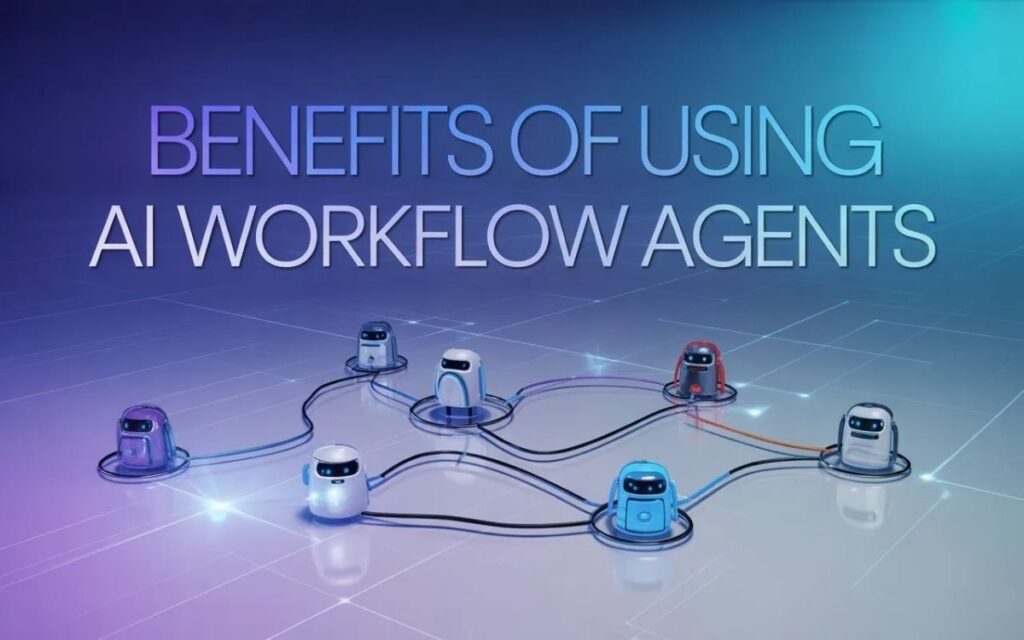
AI workflow agents bring major advantages to companies of all sizes. One of the biggest benefits is productivity. When businesses use AI workflow automation systems, they reduce repetitive tasks and free employees to focus on strategic work. This is where how AI workflow agents improve productivity becomes very clear.
Another major benefit is cost savings. Companies reduce operational expenses by automating tasks that once required manual labor. At the same time, accuracy improves because machines don’t get tired or distracted. This makes AI automation tools essential for competitive industries.
A short comparison table highlights the impact:
| Area | Before AI Workflow Agents | After AI Workflow Agents |
| Task Speed | Slow | Fast |
| Cost | High | Reduced |
| Accuracy | Human error | High precision |
| Scalability | Limited | Flexible |
Businesses also benefit from better decision-making. With AI-powered workflow management, leaders receive real-time insights that help them act quickly. This creates stronger, more responsive organizations.
Use Cases of AI Workflow Agents in AI-Powered Workflow Management
AI workflow agents are used across many industries. In marketing and sales, they handle customer segmentation, email campaigns, and lead scoring. This is a strong example of AI automation for marketing and sales, where companies increase conversions with minimal manual effort.
In healthcare, these systems manage patient records, appointment scheduling, and diagnostic support. In finance, they detect fraud, automate reporting, and monitor transactions. E-commerce companies use them for inventory tracking and order fulfillment.
A real case study comes from a UK-based retail brand. They implemented AI tools that automate business processes to manage their customer support system. Within three months, response time improved by 60 percent and customer satisfaction increased significantly.
This shows how companies use AI workflow agents is not just theory, it is already transforming industries globally.
AI Workflow Agents vs Traditional Automation Tools
The biggest difference between AI workflow agents and traditional systems lies in intelligence. Traditional automation tools follow fixed rules, while AI agents adapt and learn. This is why the difference between AI agents and automation tools is becoming a major discussion in tech industries.
Traditional systems are useful for simple tasks, but they fail when situations change. AI workflow agents, however, adjust dynamically. They use real-time data and machine learning to improve outcomes.
Here is a simple comparison:
| Aspect | Traditional Automation | AI Workflow Agents |
| Intelligence | Low | High |
| Flexibility | Fixed | Adaptive |
| Learning | None | Continuous |
| Decision-making | Rule-based | Data-driven |
Because of this, many companies are upgrading to AI automation technology to stay competitive in fast-moving markets.
Challenges and Limitations of AI Automation Systems
Even though AI workflow are powerful, they come with challenges. One major concern is data privacy. Companies must protect sensitive information while using enterprise AI automation systems. Regulations in the UK, USA, and Canada require strict compliance.
Another challenge is complexity. Implementing AI task automation systems requires technical expertise. Many businesses struggle with integration into older systems. This slows down adoption for small and medium companies.
A simple breakdown of challenges includes:
| Challenge | Impact |
| Data Privacy | Security risks |
| High Setup Cost | Initial investment |
| Integration Issues | System compatibility |
| Skill Gap | Lack of trained experts |
Despite these issues, companies continue adopting AI workflow automation systems because long-term benefits outweigh short-term difficulties.
Future of AI and Intelligent Systems
The future of AI agents looks highly advanced. Experts predict that businesses will move toward fully autonomous operations powered by the future of AI workflow automation technology. This means systems will not only assist but also manage entire business functions.
We are already seeing early versions of this in AI-driven business operations, where systems manage logistics, marketing, and customer support without human input. In the next decade, autonomous AI agents will become standard in most industries.
A major shift will also happen in jobs. Instead of replacing humans, AI will transform roles. People will focus more on creativity and strategy while machines handle execution. This leads to better efficiency and smarter organizations.
Best Practices for Implementing AI Agents in Business
Successful adoption of AI agents requires a smart approach. Businesses should start small and scale gradually. Testing AI workflow automation tools in one department first helps reduce risk and improve results.
Data quality is another key factor. Clean and structured data improves the performance of machine learning automation tools. Without good data, even the best systems fail.
Companies should also train employees to work alongside AI. This ensures smooth collaboration between humans and machines.
A simple guide includes:
| Step | Action |
| Start Small | Pilot projects |
| Improve Data | Clean datasets |
| Train Teams | AI skill development |
| Scale Gradually | Expand systems |
These steps ensure successful implementation of AI agents for small businesses and large enterprises alike.
Conclusion
AI workflow agents are no longer future technology, they are already reshaping industries today. They combine intelligence, automation, and adaptability to create powerful systems that improve productivity and reduce costs. As AI workflow automation continues to evolve, businesses in the UK, USA, and Canada will increasingly depend on these systems to stay competitive.
The shift toward intelligent workflow systems is not just about technology. It is about building smarter, faster, and more efficient organizations. Companies that adopt early will lead the future, while others may struggle to keep up.
In the end, AI agents are not replacing humans. Instead, they are becoming powerful partners in building the next generation of digital business.
FAQs
1. What are AI workflow agents and how do they work?
AI workflow agents are smart systems that automate tasks, learn from data, and make decisions to improve business processes.
2. How do AI agents improve productivity?
They reduce manual work, speed up tasks, and allow teams to focus on higher-value activities instead of repetitive jobs.
3. What is the difference between AI agents and automation tools?
Automation tools follow fixed rules, while AI agents learn, adapt, and make intelligent decisions based on real-time data.
4. Are AI workflow agents suitable for small businesses?
Yes, small businesses can use them to save time, cut costs, and automate marketing, support, and operations easily.
5. Will AI workflow agents replace human workers?
No, they mainly assist humans by handling repetitive tasks, while people focus on creativity and strategy.
