

- Why Big Tech is committing an unprecedented $650 billion to AI infrastructure in 2026
- How does this spending compare to the past decade of technology investments
- The four tech giants driving this historic AI infrastructure boom
- What companies are actually buying with this massive capital expenditure
- Why investors are both excited and worried about this spending level
- The global chip and component shortages that this investment is creating
- What this mega-spending means for smaller companies and startups competing in AI
Big Tech is expected to spend $650 billion on AI infrastructure in 2026. Google, Amazon, Meta, and Microsoft are building massive data centers. Each company’s 2026 budget exceeds the combined budgets of the past three years. They are buying AI chips, servers, cooling systems, and power infrastructure. This represents the biggest corporate spending boom this century. However, questions remain about when these investments will generate profits.
The Staggering Numbers Behind AI Investment
Something extraordinary is happening in technology spending right now. Four American tech giants are committing unprecedented capital to AI infrastructure. Bloomberg just revealed the shocking total for 2026.
Specifically, Google, Amazon, Meta, and Microsoft will spend approximately $650 billion this year. This figure represents capital expenditures for data centers and equipment. Moreover, it marks the largest corporate spending boom this century.
Each company’s 2026 budget surpasses its combined spending from 2023-2025. Additionally, any single company’s investment would set records individually. This scale is simply unprecedented in modern business history.
Breaking Down the $650 Billion Investment
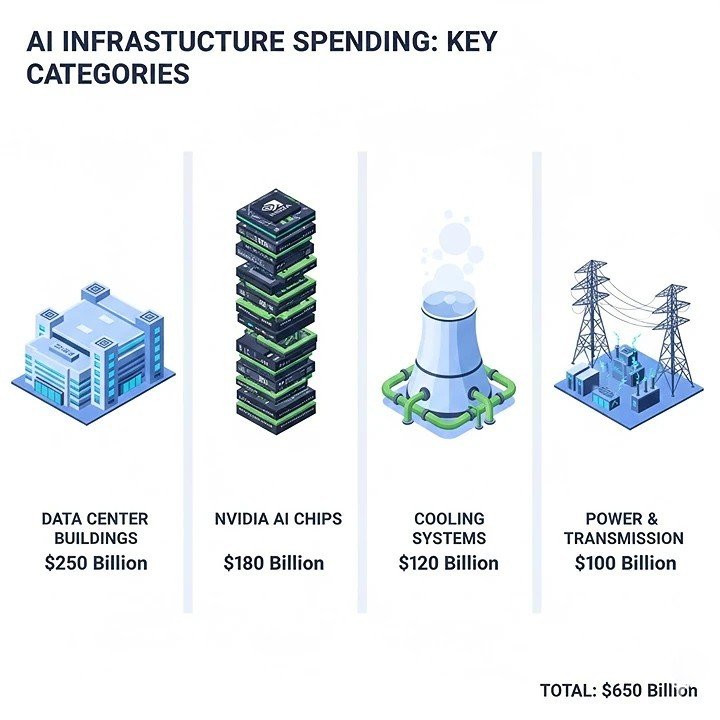
The money is going toward specific infrastructure components. Understanding these investments reveals Big Tech’s AI strategy clearly.
Data Center Construction
New data centers are rising across America rapidly. These facilities are enormous compared to traditional buildings. Furthermore, they require years of planning and construction.
Each data center costs billions of dollars individually. Land acquisition alone requires massive upfront investment. Additionally, construction employs thousands of workers for years.
AI Chip Purchases
NVIDIA dominates the AI chip market currently. Its H200, B200, and GB200 chips command premium prices. Consequently, chip purchases consume enormous portions of AI budgets.
However, supply cannot meet current demand levels. Therefore, companies are desperately securing long-term supply agreements. Additionally, they are investing in alternative chip manufacturers strategically.
Cooling and Power Systems
AI chips generate tremendous heat during operation. Therefore, advanced cooling systems are essential. Moreover, these systems consume significant amounts of electricity continuously.
Power infrastructure represents another major expense category. Data centers require dedicated power plants in some cases. Additionally, renewable energy investments are becoming necessary for sustainability.
Networking Equipment
High-speed connections between servers are critical for AI workloads. Consequently, networking equipment represents substantial ongoing costs. Furthermore, bandwidth requirements keep increasing as models grow larger.
Why Companies Are Betting Everything on AI
Business leaders face immense pressure to adopt AI quickly. Several factors are driving this unprecedented investment level.
The AI Arms Race
No company wants to fall behind in AI development. Microsoft’s early OpenAI partnership created competitive pressure. Consequently, rivals rushed to match or exceed Microsoft’s capabilities.
This dynamic creates a self-reinforcing cycle of spending. Each company’s investment forces competitors to invest more. Therefore, the arms race accelerates continuously without clear limits.
Market Dominance Stakes
Leaders believe AI will fundamentally reshape entire industries. Early movers might dominate markets for decades ahead. Conversely, laggards risk becoming irrelevant competitors quickly.
Therefore, companies view massive AI spending as an existential necessity. Missing this transition could destroy decades of business success. Consequently, boards approve spending levels previously unimaginable for companies.
Investor Expectations
Wall Street demands aggressive AI investment from tech giants. Stock prices reward companies announcing major AI initiatives. Conversely, cautious approaches trigger sharp selloffs immediately.
This creates pressure to spend regardless of near-term profitability. Companies must demonstrate AI leadership to maintain valuations. Therefore, capital discipline takes a backseat to competitive positioning.
Historical Context: Unprecedented Scale
Comparing 2026 spending to historical investment reveals its extraordinary nature. No previous technology transition generated comparable capital commitments.
Bigger Than the Dot-Com Boom
The late 1990s internet boom seemed massive at the time. However, 2026 AI spending dwarfs that era’s investments completely. Additionally, individual company budgets exceed the entire industry spending from that period.
The dot-com boom eventually ended in spectacular crashes. Whether AI follows similar patterns remains a critical question.
Surpassing Cloud Computing Transition
Cloud computing required substantial infrastructure investment over the past decade. Nevertheless, 2026 AI spending exceeds peak cloud investment significantly. Moreover, the acceleration timeline is much more compressed now.
Cloud infrastructure has been built gradually over fifteen years or more. Conversely, AI infrastructure is scaling exponentially within just three years.
The Global Supply Chain Impact
This massive spending is creating severe market distortions worldwide. Component manufacturers cannot keep pace with demand currently.
AI Chip Scarcity
NVIDIA’s production capacity cannot satisfy current orders completely. Therefore, waiting periods extend for months or even years. Additionally, prices remain elevated due to persistent shortages.
Other chip manufacturers are ramping production capacity aggressively. However, catching NVIDIA’s technological lead requires years of development. Consequently, the shortage will certainly persist throughout 2026.
Memory Component Squeeze
AI workloads demand enormous amounts of high-performance memory. Consequently, DRAM and HBM prices are rising rapidly. Furthermore, consumer electronics manufacturers face supply constraints as a result.
PC makers are even exploring Chinese memory suppliers now. This shift has significant geopolitical implications for technology supply chains. Additionally, it may trigger regulatory scrutiny in Western markets.
Power Infrastructure Constraints
Electricity demand from AI data centers is stressing regional grids. Some areas cannot provide sufficient power for planned facilities. Therefore, companies are investing in dedicated power generation capacity.
This includes renewable energy projects and even nuclear power plants. The energy requirements are staggering and still growing exponentially.
What This Means for Smaller Companies
The $650 billion spending spree creates both opportunities and challenges. Smaller players must navigate this landscape strategically to survive.
Increased Competition for Resources
Startups face difficulty accessing AI chips and cloud capacity. Big Tech’s enormous purchases consume the available supply completely. Therefore, smaller companies pay premium prices for limited resources.
This creates an uneven playing field for AI development. Well-funded startups struggle while bootstrapped companies face impossible obstacles.
Cloud Service Opportunities
However, Big Tech’s infrastructure investments create new possibilities simultaneously. Companies can access cutting-edge AI capabilities through cloud services. Therefore, they avoid massive capital expenditures themselves.
This democratizes AI access for organizations lacking billions in capital. Cloud providers offer powerful AI tools at relatively affordable prices.
Niche Market Opportunities
Component shortages create opportunities for alternative suppliers and solutions. Companies offering efficiency improvements or specialized hardware can thrive. Additionally, software optimization tools gain importance as hardware remains scarce.
The Profitability Question
Despite massive investments, profitability remains uncertain for AI initiatives. This disconnect worries some investors and analysts significantly.
Revenue Growth Lags Investment
AI services are generating revenue for tech giants currently. However, income growth trails capital expenditure increases dramatically. Therefore, return on investment timelines remain unclear and potentially distant.
Some analysts compare this to the dot-com era’s irrational exuberance. Companies spent billions on infrastructure before proving sustainable business models.
Bubble Concerns Intensify
The AI bubble discussion has intensified throughout early 2026. Spending levels seem disconnected from current revenue generation completely. Moreover, valuation multiples appear stretched by historical standards.
If the bubble bursts, economic consequences could be severe. However, gradual deflation might allow necessary adjustments without catastrophic losses.
Looking Ahead: What Happens Next?
The $650 billion spending level likely represents a peak year. Several factors suggest moderation may follow in 2027 and beyond.
Infrastructure Saturation
Companies are building enormous capacity in 2026. This infrastructure will serve needs for several years ahead. Therefore, future spending may decrease as capacity utilization improves.
Efficiency Improvements
New AI models are becoming more efficient constantly. They accomplish more with less computational power than before. Consequently, hardware requirements may plateau despite continued AI advancement.
Regulatory Pressures
Governments worldwide are scrutinizing Big Tech’s market power increasingly. Antitrust concerns might constrain future acquisition and expansion plans. Additionally, environmental regulations could limit data center construction permits.

Frequently Asked Questions
Companies believe AI will fundamentally reshape entire industries. Early leaders might dominate markets for decades ahead. Conversely, companies falling behind risk becoming irrelevant quickly.
Microsoft’s OpenAI partnership created competitive pressure on rivals. Each company’s investment forces competitors to spend more. Additionally, Wall Street rewards aggressive AI investment with higher valuations. Therefore, capital discipline takes a backseat to competitive positioning currently.
The spending covers multiple infrastructure categories simultaneously. New data centers require billions for construction alone. AI chips from NVIDIA and others consume enormous budgets.
Additionally, cooling systems handle tremendous heat from AI processors. Power infrastructure provides electricity for energy-hungry operations. Furthermore, networking equipment efficiently connects thousands of servers. Each component is essential for AI development.
This spending dwarfs previous technology booms completely and dramatically. The dot-com era investments seem small by comparison. Additionally, individual company budgets exceed the entire industry spending from that period.
Cloud computing required a substantial investment over the past fifteen years, gradually. However, AI infrastructure is scaling much faster within just three years. Each company’s 2026 budget surpasses its past three years combined. This represents unprecedented corporate spending in modern business history.
Many analysts see troubling parallels to previous bubbles historically. Sky-high spending precedes proven business models currently and worryingly. Additionally, revenue growth trails investment increases dramatically right now.
However, others argue AI’s impact justifies the investment completely. Unlike dot-com companies, tech giants generate massive profits already. Furthermore, they can afford sustained investment without external funding. Whether bubble concerns prove valid depends on AI adoption rates.
Big Tech’s purchases consume available chip and component supply. Therefore, startups pay premium prices for limited resources now. This creates an uneven competitive playing field for development.
However, cloud services democratize AI access somewhat for smaller players. Companies can use powerful AI tools without massive capital expenditure. Additionally, component shortages create opportunities for efficiency and optimization tools. Niche suppliers offering alternatives can thrive in this environment successfully.
