
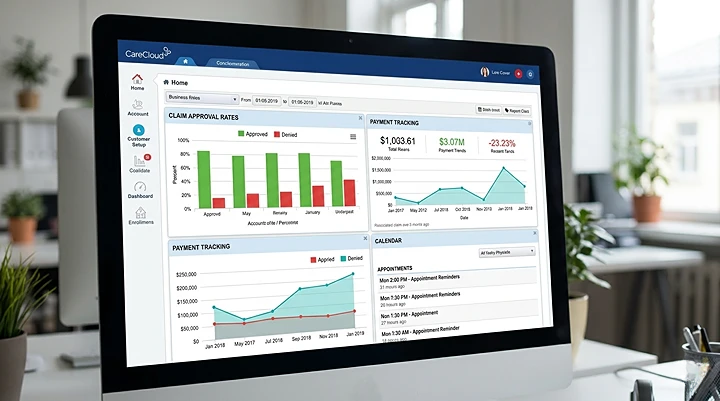
- What Is CareCloud? Company Overview & History
- Core Products: Revenue Cycle Management (RCM)
- Electronic Health Records (EHR) Features
- Practice Management (PM) Tools
- Patient Experience Management (PXM) & Telehealth
- Wellsoft Named Top Emergency Medicine EHR for 2026
- MAP App Evolution at HFMA Conference
- Marketware AI for Physician Recruitment
- CareCloud Pricing: $649 per Month Starting Cost
- CareCloud vs AthenaHealth vs Carepatron vs EHR YOUR WAY
- Customer Base: 45,000+ Providers & 184 Active Clients
- Geographic Presence: USA, UK, India
- Pros and Cons from Real User Reviews
- Financial Health & Nasdaq Stock Performance (CCLD)
- Who Should Use CareCloud? (Buying Guide)
The healthcare technology world is changing fast. One company leading this change is CareCloud. Based in Somerset, New Jersey, CareCloud builds cloud-based software for medical practices. Their platform helps doctors, nurses, and clinic staff manage their daily work more easily.
I have gathered fresh data from multiple reliable sources for this article. Everything you will read here is current as of April 2026. Whether you run a small clinic or a large hospital, this guide will help you understand what CareCloud offers and whether it fits your needs.
What Exactly Is CareCloud?
CareCloud is a healthcare technology company. They sell software that helps medical practices run better. The company went public on Nasdaq. You can find their stock under the ticker symbols CCLD and CCLDO.
Their main product is an all-in-one operating system for healthcare providers. This system handles patient scheduling, medical records, and billing. More than 45,000 providers currently use CareCloud to manage their practices. The company was founded in 2009 and is headquartered in Miami Beach, Florida.
The company’s mission is simple. They want to bring “disciplined innovation” to healthcare. This means using artificial intelligence to reduce paperwork. It also means helping doctors spend more time with their patients and less time on administrative tasks.
Core Products and Services
Let me walk you through what CareCloud actually offers. Their platform comes with several connected modules. Each module solves a specific problem for medical practices.
Revenue Cycle Management (RCM)
Getting paid for medical services is complicated. CareCloud’s RCM solution helps practices handle this process. The system automates claims submission, tracks payments, and manages denials.
The company claims impressive results. CareCloud reports a 90% collection rate and a 30% reduction in accounts receivable. They process tens of thousands of claims every day. Their average turnaround time is 7 to 14 days.
One real-world example shows these results in action. Doctors on Call Maui partnered with CareCloud. They cut their days in accounts receivable from more than 22 days down to just 8.5 days. That is a huge improvement for any medical practice.
Electronic Health Records (EHR)
CareCloud Charts is their electronic health records solution. It helps doctors document patient visits digitally. The system comes with pre-built templates for different medical specialties. You can also customize these templates for your specific needs.
Practice Management (PM)
Running a medical office involves many moving parts. CareCloud’s practice management tools help with patient scheduling, appointment reminders, insurance verification, and claims processing. Users particularly praise the scheduling module. One reviewer noted that you can organize providers in any order you want, not just alphabetically.
Patient Experience Management (PXM)
CareCloud also helps practices connect with their patients. Their patient portal, called Breeze, allows patients to book appointments online. They can also access their medical records and communicate with providers. For remote care, CareCloud Live offers HIPAA-compliant telehealth services.

Recent Achievements in 2026
CareCloud has been getting significant industry recognition this year. Let me share the highlights.
Wellsoft Named Top Emergency Medicine EHR
Black Book Research just named CareCloud’s Wellsoft system as the top-rated EHR for Emergency Medicine in 2026. This recognition came from independent surveys of over 33,000 physician practices.
Chris Langehaug, Senior Vice President of Sales at CareCloud, explained why this matters. He said, “Wellsoft was purpose-built for emergency medicine, where speed, visibility, and reliability are not optional”.
This is not Wellsoft’s first award. The system has been recognized by KLAS Research more than ten times as the top Emergency Department Information System.
MAP App Evolution at HFMA Conference
In March 2026, CareCloud attended the HFMA Revenue Cycle Conference in Arlington, Texas. They showcased the continued evolution of their MAP App. This is a web-based revenue cycle benchmarking tool.
The MAP App helps healthcare organizations measure their revenue cycle performance against peer facilities. CareCloud acquired this platform from HFMA and has since invested heavily in expanding its capabilities.
Marketware AI for Physician Recruitment
CareCloud also presented at the 2026 AAPPR Annual Conference in Orlando, Florida. They showcased their Marketware physician strategy platform. This tool helps healthcare organizations turn physician recruitment into a data-driven process.
The platform will soon launch new AI functionality. This AI will intelligently match clinical candidates with the best-fit job opportunities. The goal is to accelerate hiring and reduce administrative burden.
Market Position and Customer Base
Let me share some market data to give you a perspective. CareCloud currently serves 184 active customers in the medical billing category. Their market share in this category is approximately 2.55%, ranking them second in their space.
Here is where their customers are located:
- United States: 162 customers (90% of their base)
- United Kingdom: 5 customers (2.78%)
- India: 3 customers (1.67%)
The majority of CareCloud’s customers are small practices with 0 to 9 employees. There are 69 companies in this category. Medium-sized practices with 20 to 49 employees (41 companies) and 100 to 249 employees (26 companies) also use the platform.
Some notable enterprise clients include:
- Omega Healthcare Management Services (10,000+ employees)
- Baptist Health (10,000+ employees)
- Detroit Medical Center (10,000+ employees)
- Persistent Systems (10,000+ employees, based in Pune, India)
- Wolters Kluwer (10,000+ employees, based in the Netherlands)
Pricing: What Will You Pay?
Now for the important question. How much does CareCloud cost?
The pricing varies depending on which modules you need. According to Software Advice, CareCloud’s starting price is $649 per month. This is for their core platform.
For smaller practices, CareCloud offers more affordable options through their competitors. However, CareCloud itself focuses on medium to large practices. The company does not offer a permanently free version. A free trial is available so you can test the software before committing.
CareCloud vs Competitors
Let me compare CareCloud with other popular options. This will help you see where it fits in the market.
CareCloud vs AthenaHealth
AthenaHealth dominates the medical billing category with a massive 96.08% market share. CareCloud holds 2.55% of this market. But market share is not everything.
CareCloud users consistently rate the platform well for ease of use. In user reviews, CareCloud scores 3.8 out of 5 for ease of use. The platform’s strongest feature is its flexibility in organizing providers in custom orders.
CareCloud vs Carepatron
Carepatron is a newer, more affordable option. It starts at just $22 per month. It scores higher than CareCloud in user satisfaction across several categories:
| Feature | CareCloud | Carepatron |
|---|---|---|
| Ease of Use | 3.8/5 | 4.6/5 |
| Value for Money | 3.3/5 | 4.5/5 |
| Customer Support | 3.4/5 | 4.6/5 |
| Functionality | 3.5/5 | 4.3/5 |
However, there is a trade-off. CareCloud is built for larger, multi-provider practices. Carepatron targets smaller clinics and solo practitioners. If you have a bigger team, CareCloud’s features may be worth the higher price.
CareCloud vs EHR YOUR WAY
EHR YOUR WAY starts at $800 per month, making it more expensive than CareCloud. However, it scores higher across all categories:
| Feature | CareCloud | EHR YOUR WAY |
|---|---|---|
| Ease of Use | 3.8/5 | 4.8/5 |
| Value for Money | 3.3/5 | 4.8/5 |
| Customer Support | 3.4/5 | 4.9/5 |
The choice here is cost versus features. EHR YOUR WAY offers more flexibility and better support. But you pay a premium for it.
Pros and Cons from Real User Reviews
I analyzed verified user reviews to find out what actual customers like and dislike about CareCloud.
What Users Like
User-friendly interface. Multiple reviewers praise the platform’s intuitive design. One user with over 30 years of experience called it “the most user-friendly system I have worked with in over 30 years”.
Flexible provider organization. The ability to arrange providers in custom orders is a small but appreciated feature. Many systems only offer alphabetical sorting.
Good for medium to large practices. The platform scales well. It can handle multi-location operations and complex workflows.
What Users Dislike
System instability with multiple tabs. This is the most common complaint. Users report that the system “seems to kick you off if you have more than one page open”.
No free trial for the full platform. While some competitors offer free trials, CareCloud does not. You need to commit before you can fully test the system.
Learning curve. Some users find that it takes time to get used to the new system. Alignment with internal processes is required for optimal results.
Financial Health and Stock Performance
For those interested in CareCloud as an investment, here is the financial picture.
CareCloud trades on Nasdaq under the ticker CCLD. As of March 2026, the stock has a market capitalization of approximately $123 million. The price-to-earnings ratio is around 72.8, which is relatively high.
The stock has traded between $1.14 and $4.01 over the past year. The average analyst target price is $3.25.
Key financial metrics show:
- The company recently reported record net income
- They achieved their first full-year positive EPS since going public
- Q4 revenue of $34.42 million beat analyst expectations
Analyst sentiment is mixed. One analyst has upgraded the stock to “strong-buy.” However, the overall consensus rating is “Hold”.
Who Should Use CareCloud?
After reviewing all the data, here is my honest recommendation.
CareCloud is a good fit if:
- You run a multi-provider medical practice
- You need an integrated EHR, PM, and RCM in one platform
- You want AI-powered tools to reduce administrative work
- You serve patients in emergency or urgent care settings
- You have 5 to 50 providers in your practice
Consider alternatives if:
- You are a solo practitioner (look at Carepatron or ClinicSense)
- You need the absolute lowest price (CareCloud starts at $649/month)
- Your practice is very large, with 100+ providers (AthenaHealth has more market share)
- You require extensive customization (EHR YOUR WAY scores higher for flexibility)

Final Thoughts
CareCloud has established itself as a solid player in healthcare technology. The company serves over 45,000 providers and continues to grow. Recent recognition from Black Book Research validates their clinical technology. New product launches show their commitment to innovation.
The platform’s strengths are clear. Users love the intuitive interface and the flexibility in scheduling. The AI-powered RCM tools help practices get paid faster. And the Wellsoft system is genuinely top-tier for emergency medicine.
However, the platform has room for improvement. The system instability with multiple tabs frustrates users. The lack of a free trial makes it harder to test before buying. And the pricing puts it out of reach for very small practices.
For most medium-sized medical practices, CareCloud offers good value. The $649 monthly investment brings significant efficiency gains. If you currently waste hours on paperwork and billing issues, this could pay for itself quickly.
My advice? Contact CareCloud for a demo. Ask specific questions about your workflows. See if the system stays stable during your busiest hours. And ask current users about their support experiences. This hands-on research will tell you more than any review ever could.
