
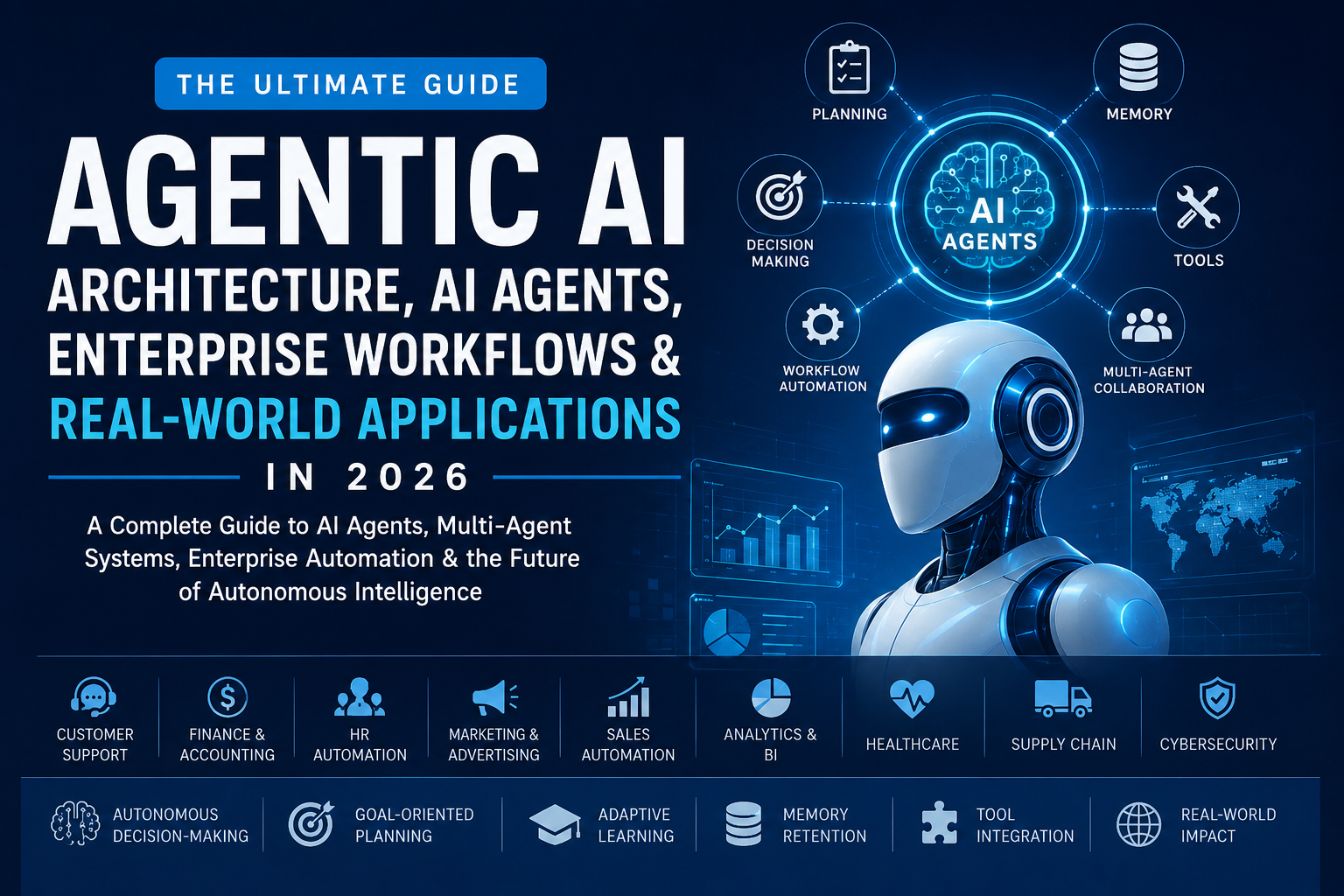
Agentic AI: The Future of Autonomous AI Systems in 2026
Introduction to Agentic AI
Artificial intelligence is evolving beyond basic automation into systems capable of reasoning, planning, and executing tasks independently. This new generation of intelligent systems is known as Agentic AI. In 2026, businesses are increasingly adopting AI agents to automate enterprise workflows, improve operational efficiency, and deliver personalized customer experiences at scale.
Unlike traditional AI tools that only respond to prompts, Agentic AI systems can analyze objectives, make decisions, retain memory, interact with external tools, and continuously improve through feedback loops. According to enterprise AI trends and industry research, organizations investing in autonomous AI systems are seeing significant improvements in productivity, scalability, and workflow automation.
This guide explains how Agentic AI works, its core architecture, enterprise applications, challenges, and the long-term impact of autonomous AI systems across industries.
What is Agentic AI?
Agentic AI refers to autonomous AI systems designed to complete tasks with minimal human supervision. These systems combine Large Language Models (LLMs), memory frameworks, planning engines, and tool integrations to solve complex problems in real time.
Modern AI agents are capable of:
- Autonomous decision-making
- Goal-oriented task execution
- Adaptive learning
- Memory retention
- Multi-step workflow automation
- Collaboration with other AI agents
Unlike traditional chatbots or rule-based automation systems, Agentic AI can proactively manage workflows, retrieve data, update enterprise software, and optimize business operations.
Industry experts consider Agentic AI one of the most important advancements in enterprise automation because it bridges the gap between conversational AI and autonomous digital operations.
Core Components of Agentic AI
Large Language Models (LLMs)
Large Language Models are the reasoning engine behind Agentic AI systems. Popular models such as GPT, Gemini, and Claude help AI agents understand context, process information, generate responses, and perform advanced reasoning tasks.
These models enable AI systems to analyze large datasets, summarize information, automate communication, and support enterprise decision-making.
Memory Systems
Memory architecture plays a critical role in Agentic AI performance. Short-term memory helps AI maintain conversational context, while long-term memory stores historical interactions and workflow data for future use.
Many enterprises now use vector databases for AI memory retrieval because they improve contextual accuracy and information recall across large datasets.
Planning and Decision-Making Engines
Planning engines allow AI agents to break complex objectives into executable tasks. Decision-making systems evaluate multiple outcomes and select the most effective actions based on goals, business rules, and real-time data.
This capability enables AI agents to operate autonomously in enterprise environments.
Tool Integration and Workflow Automation
Agentic AI systems integrate with APIs, CRMs, ERP systems, databases, analytics dashboards, and cloud platforms. These integrations allow AI agents to automate repetitive business operations such as customer support, reporting, invoice processing, and marketing optimization.
Workflow orchestration frameworks help coordinate tasks between multiple systems and AI agents for improved scalability and operational efficiency.
Real-World Applications of Agentic AI
Customer Support Automation
AI support agents are transforming customer service operations by providing 24/7 support, instant ticket resolution, and personalized interactions. Autonomous AI systems can retrieve real-time customer information, analyze previous conversations, and deliver faster responses with reduced operational costs.
Finance and Accounting Automation
Businesses are increasingly using Agentic AI for invoice processing, fraud detection, expense management, and financial forecasting. Accounts payable and accounts receivable AI agents help automate payment approvals, duplicate detection, collections management, and cash flow monitoring.
These systems improve financial accuracy while reducing manual administrative work.
Marketing and Sales Automation
AI-powered marketing systems optimize campaign performance using audience segmentation, conversion analysis, ad targeting, and predictive analytics. Sales automation tools assist with lead scoring, customer follow-ups, CRM updates, and prospect outreach.
Organizations using AI-driven marketing strategies are improving customer engagement and increasing conversion rates through data-driven optimization.
HR and Enterprise Workflow Automation
Human resource departments are adopting AI workflow automation for employee onboarding, resume screening, interview scheduling, and training management. AI agents streamline repetitive administrative tasks and improve operational efficiency across enterprise departments.
Industries such as healthcare, finance, cybersecurity, logistics, SaaS, and eCommerce are rapidly implementing AI-driven workflow systems to improve scalability and productivity.
Challenges and Governance in Agentic AI
AI Hallucinations and Reliability
AI systems may occasionally generate inaccurate or misleading information, commonly known as hallucinations. Businesses must implement validation systems and human oversight to ensure reliable outputs.
Data Privacy and Security Risks
Since AI agents interact with enterprise systems and sensitive business data, organizations must prioritize cybersecurity, access control, and regulatory compliance to reduce risks.
Ethical AI Usage
Responsible AI development requires transparency, accountability, and ethical governance frameworks. Enterprises must ensure AI systems align with legal requirements and organizational policies.
Infrastructure Costs
Deploying large-scale autonomous AI systems requires advanced computing resources, cloud infrastructure, and ongoing optimization, which may increase operational costs for some businesses.
The Future of Agentic AI
Industry analysts predict that Agentic AI will become a foundational technology for enterprise automation over the next decade. Autonomous AI employees, multi-agent collaboration networks, and self-managing enterprises are expected to redefine business operations.
Future AI systems will deliver hyper-personalized customer experiences, real-time analytics, predictive decision-making, and intelligent workflow management across connected enterprise platforms.
Businesses investing in AI integration today are positioning themselves for long-term competitive advantages in automation, scalability, and operational intelligence.
Conclusion
Agentic AI represents the next major evolution of artificial intelligence. By combining advanced LLMs, memory systems, planning engines, and enterprise workflow automation, AI agents are transforming how modern businesses operate.
From customer support and finance to marketing, HR, and cybersecurity, organizations are using autonomous AI systems to improve productivity, efficiency, and customer experiences at scale.
While challenges such as data privacy, governance, and infrastructure costs remain important considerations, the long-term impact of Agentic AI is expected to reshape enterprise technology and digital transformation in the years ahead.
Frequently Asked Questions (FAQ)
What is Agentic AI?
Agentic AI is an autonomous AI system capable of reasoning, planning, learning, and performing tasks independently with minimal human supervision.
How is Agentic AI different from traditional AI?
Traditional AI mainly reacts to commands, while Agentic AI can make decisions, retain memory, use tools, and automate multi-step workflows autonomously.
What are AI agents?
AI agents are intelligent software systems designed to complete tasks, interact with tools, analyze information, and automate workflows independently.
Which industries use Agentic AI?
Industries such as healthcare, finance, logistics, cybersecurity, SaaS, eCommerce, and enterprise automation actively use Agentic AI technologies.
Is Agentic AI the future of automation?
Yes. Industry experts believe Agentic AI will play a major role in the future of enterprise automation because of its scalability, efficiency, and autonomous decision-making capabilities.
