Year: 2026

  • Agentic AI: AI Agents, Enterprise Workflows & Real-World Applications in 2026

    Agentic AI: AI Agents, Enterprise Workflows & Real-World Applications in 2026

    Agentic AI: The Future of Autonomous AI Systems in 2026

    Introduction to Agentic AI

    Artificial intelligence is evolving beyond basic automation into systems capable of reasoning, planning, and executing tasks independently. This new generation of intelligent systems is known as Agentic AI. In 2026, businesses are increasingly adopting AI agents to automate enterprise workflows, improve operational efficiency, and deliver personalized customer experiences at scale.

    Unlike traditional AI tools that only respond to prompts, Agentic AI systems can analyze objectives, make decisions, retain memory, interact with external tools, and continuously improve through feedback loops. According to enterprise AI trends and industry research, organizations investing in autonomous AI systems are seeing significant improvements in productivity, scalability, and workflow automation.

    This guide explains how Agentic AI works, its core architecture, enterprise applications, challenges, and the long-term impact of autonomous AI systems across industries.

    What is Agentic AI?

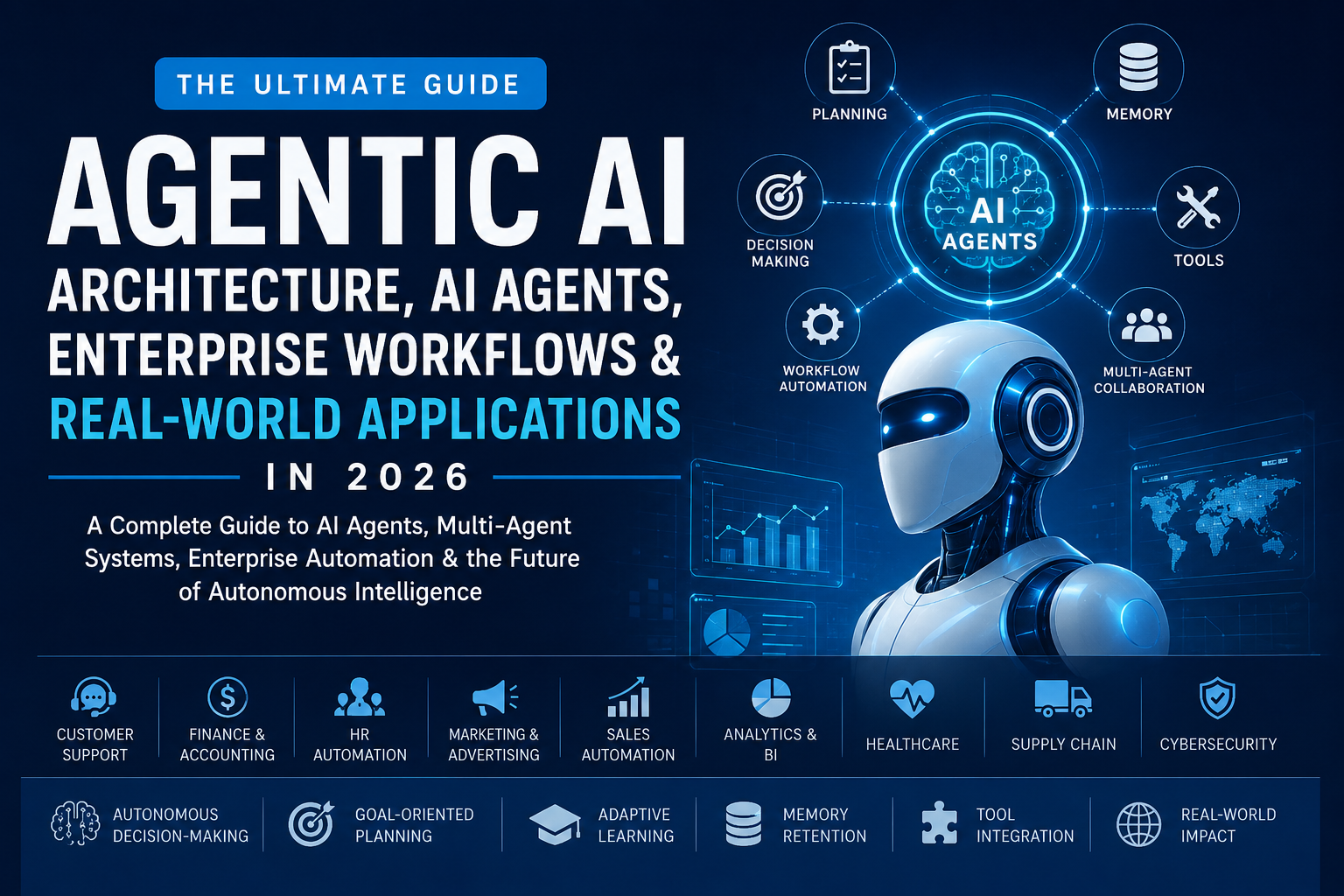
    Agentic AI refers to autonomous AI systems designed to complete tasks with minimal human supervision. These systems combine Large Language Models (LLMs), memory frameworks, planning engines, and tool integrations to solve complex problems in real time.

    Modern AI agents are capable of:

    • Autonomous decision-making
    • Goal-oriented task execution
    • Adaptive learning
    • Memory retention
    • Multi-step workflow automation
    • Collaboration with other AI agents

    Unlike traditional chatbots or rule-based automation systems, Agentic AI can proactively manage workflows, retrieve data, update enterprise software, and optimize business operations.

    Industry experts consider Agentic AI one of the most important advancements in enterprise automation because it bridges the gap between conversational AI and autonomous digital operations.

    Core Components of Agentic AI

    Large Language Models (LLMs)

    Large Language Models are the reasoning engine behind Agentic AI systems. Popular models such as GPT, Gemini, and Claude help AI agents understand context, process information, generate responses, and perform advanced reasoning tasks.

    These models enable AI systems to analyze large datasets, summarize information, automate communication, and support enterprise decision-making.

    Memory Systems

    Memory architecture plays a critical role in Agentic AI performance. Short-term memory helps AI maintain conversational context, while long-term memory stores historical interactions and workflow data for future use.

    Many enterprises now use vector databases for AI memory retrieval because they improve contextual accuracy and information recall across large datasets.

    Planning and Decision-Making Engines

    Planning engines allow AI agents to break complex objectives into executable tasks. Decision-making systems evaluate multiple outcomes and select the most effective actions based on goals, business rules, and real-time data.

    This capability enables AI agents to operate autonomously in enterprise environments.

    Tool Integration and Workflow Automation

    Agentic AI systems integrate with APIs, CRMs, ERP systems, databases, analytics dashboards, and cloud platforms. These integrations allow AI agents to automate repetitive business operations such as customer support, reporting, invoice processing, and marketing optimization.

    Workflow orchestration frameworks help coordinate tasks between multiple systems and AI agents for improved scalability and operational efficiency.

    Real-World Applications of Agentic AI

    Customer Support Automation

    AI support agents are transforming customer service operations by providing 24/7 support, instant ticket resolution, and personalized interactions. Autonomous AI systems can retrieve real-time customer information, analyze previous conversations, and deliver faster responses with reduced operational costs.

    Finance and Accounting Automation

    Businesses are increasingly using Agentic AI for invoice processing, fraud detection, expense management, and financial forecasting. Accounts payable and accounts receivable AI agents help automate payment approvals, duplicate detection, collections management, and cash flow monitoring.

    These systems improve financial accuracy while reducing manual administrative work.

    Marketing and Sales Automation

    AI-powered marketing systems optimize campaign performance using audience segmentation, conversion analysis, ad targeting, and predictive analytics. Sales automation tools assist with lead scoring, customer follow-ups, CRM updates, and prospect outreach.

    Organizations using AI-driven marketing strategies are improving customer engagement and increasing conversion rates through data-driven optimization.

    HR and Enterprise Workflow Automation

    Human resource departments are adopting AI workflow automation for employee onboarding, resume screening, interview scheduling, and training management. AI agents streamline repetitive administrative tasks and improve operational efficiency across enterprise departments.

    Industries such as healthcare, finance, cybersecurity, logistics, SaaS, and eCommerce are rapidly implementing AI-driven workflow systems to improve scalability and productivity.

    Challenges and Governance in Agentic AI

    AI Hallucinations and Reliability

    AI systems may occasionally generate inaccurate or misleading information, commonly known as hallucinations. Businesses must implement validation systems and human oversight to ensure reliable outputs.

    Data Privacy and Security Risks

    Since AI agents interact with enterprise systems and sensitive business data, organizations must prioritize cybersecurity, access control, and regulatory compliance to reduce risks.

    Ethical AI Usage

    Responsible AI development requires transparency, accountability, and ethical governance frameworks. Enterprises must ensure AI systems align with legal requirements and organizational policies.

    Infrastructure Costs

    Deploying large-scale autonomous AI systems requires advanced computing resources, cloud infrastructure, and ongoing optimization, which may increase operational costs for some businesses.

    The Future of Agentic AI

    Industry analysts predict that Agentic AI will become a foundational technology for enterprise automation over the next decade. Autonomous AI employees, multi-agent collaboration networks, and self-managing enterprises are expected to redefine business operations.

    Future AI systems will deliver hyper-personalized customer experiences, real-time analytics, predictive decision-making, and intelligent workflow management across connected enterprise platforms.

    Businesses investing in AI integration today are positioning themselves for long-term competitive advantages in automation, scalability, and operational intelligence.

    Conclusion

    Agentic AI represents the next major evolution of artificial intelligence. By combining advanced LLMs, memory systems, planning engines, and enterprise workflow automation, AI agents are transforming how modern businesses operate.

    From customer support and finance to marketing, HR, and cybersecurity, organizations are using autonomous AI systems to improve productivity, efficiency, and customer experiences at scale.

    While challenges such as data privacy, governance, and infrastructure costs remain important considerations, the long-term impact of Agentic AI is expected to reshape enterprise technology and digital transformation in the years ahead.

    Frequently Asked Questions (FAQ)

    What is Agentic AI?

    Agentic AI is an autonomous AI system capable of reasoning, planning, learning, and performing tasks independently with minimal human supervision.

    How is Agentic AI different from traditional AI?

    Traditional AI mainly reacts to commands, while Agentic AI can make decisions, retain memory, use tools, and automate multi-step workflows autonomously.

    What are AI agents?

    AI agents are intelligent software systems designed to complete tasks, interact with tools, analyze information, and automate workflows independently.

    Which industries use Agentic AI?

    Industries such as healthcare, finance, logistics, cybersecurity, SaaS, eCommerce, and enterprise automation actively use Agentic AI technologies.

    Is Agentic AI the future of automation?

    Yes. Industry experts believe Agentic AI will play a major role in the future of enterprise automation because of its scalability, efficiency, and autonomous decision-making capabilities.

  • Beginner Guide to AI Chatbots for Online Businesses 2026

    Beginner Guide to AI Chatbots for Online Businesses 2026

    Introduction

    Ever feel like you’re stuck waiting forever for answers online, switching between tabs just to figure something simple out? It can get frustrating when you just want quick help, but everything feels slow or confusing. That’s exactly why so many people are turning to AI chatbots to make life a little easier and faster.

    In this blog, we’ll break down what ai chatbots actually are and why they’re becoming so popular in everyday use. You’ll also see how they can help with tasks, answer questions, and even save you time in ways you might not expect. By the end, you’ll have a clear, simple understanding of how they work and how you can use them to your advantage.

    What Are AI Chatbots?

    AI Chatbots are intelligent software programs designed to simulate human conversation. They use artificial intelligence chatbots technology to understand user messages and respond in a natural, human-like way. Instead of waiting for a human agent, customers get instant replies.

    At their core, these systems act like a digital assistant for your business. They can answer questions, guide users through products, and even help with basic troubleshooting. Many conversational AI platforms now rely on them to improve customer interaction without increasing support costs.

    In simple terms, AI Chatbots make communication faster, smarter, and more scalable. They reduce pressure on human teams while ensuring customers always feel heard.

    How AI Chatbots Work

    To understand AI Chatbots, you need to know how they process language. These systems use machine learning chatbots technology to learn from data and improve over time. The more conversations they handle, the better they become at responding.

    When a user sends a message, the chatbot breaks it down using natural language processing. It then analyzes intent, context, and keywords before generating the best possible reply. This is what powers AI customer support systems across modern websites.

    Behind the scenes, these bots are constantly learning patterns. This allows them to respond more accurately and handle complex queries without human intervention. Over time, they become more efficient and reliable.

    Why Online Businesses Need AI Chatbots

    Online businesses today rely heavily on speed and availability. Customers don’t want to wait hours for answers. This is why AI Chatbots have become essential for modern digital operations.

    They help businesses provide instant support, capture leads, and improve engagement. With chatbot automation tools, even small teams can manage thousands of conversations at once without delays or missed messages.

    AI Chatbots in Real Business Use Cases

    In real-world scenarios, AI Chatbots are used for order tracking, answering FAQs, and guiding users through purchases. For example, an online store can help customers choose products instantly while also suggesting related items. This improves both user experience and sales performance.

    Businesses also use AI-powered virtual assistant systems to manage bookings, handle complaints, and collect feedback. This level of automation helps companies stay active 24/7 without hiring large support teams.

    Key Features of AI Chatbots

    Modern AI Chatbots come with powerful features designed to improve business operations. One of the most important is automation, which allows businesses to respond instantly without human involvement. This reduces delays and improves efficiency.

    Another key feature is personalization. These smart AI messaging bots can adjust responses based on user behavior and past interactions. Many systems also support chatbot integration for websites, making it easy to connect with ecommerce chatbot solutions and CRM tools.

    Additionally, they can operate 24/7 without breaks. This ensures customers always receive support, even outside business hours. Over time, this consistency builds trust and improves customer satisfaction.

    Types of AI Chatbots for Businesses

    There are different types of AI Chatbots, each designed for specific use cases. Rule-based chatbots follow predefined scripts and are best for simple tasks. AI-driven bots, on the other hand, learn and adapt through interactions.

    Ecommerce chatbot solutions are widely used in online stores. They help customers find products, track orders, and complete purchases. Meanwhile, marketing automation chatbot systems focus on lead generation and customer engagement.

    Some businesses also use hybrid models that combine rule-based logic with AI learning. This approach offers both structure and flexibility, depending on customer needs.

    Benefits of Using AI Chatbots in Online Business

    The benefits of AI Chatbots go far beyond simple messaging. They help businesses reduce response time and improve customer satisfaction significantly. Quick replies often lead to better user experiences and higher conversion rates.

    Another major advantage is cost efficiency. With customer service automation AI, companies can handle large volumes of queries without expanding their support teams. This reduces operational costs while maintaining quality service.

    Businesses also benefit from improved sales. When customers get instant answers, they are more likely to complete purchases. Many companies report higher conversion rates after integrating chatbot for business website solutions.

    Challenges of AI Chatbots

    Even though AI Chatbots are powerful, they still come with challenges. One common issue is understanding complex human emotions. While they handle simple queries well, they may struggle with sensitive or unclear requests.

    Another challenge is deciding between AI chatbot vs human customer support. Humans still outperform bots in empathy-driven situations. This means businesses must balance automation with human interaction carefully.

    There are also technical challenges, such as setup complexity and training requirements. Businesses need to ensure proper configuration to avoid poor user experiences.

    How to Choose the Best AI Chatbot for Your Business

    Choosing the right AI Chatbots solution depends on your business goals. Start by identifying what you want the chatbot to do, whether it’s support, sales, or marketing.

    Next, consider ease of use and integration. The best chatbot platform for business owners should connect easily with your website and tools. If you’re a beginner, free AI chatbot tools for beginners can be a good starting point.

    Scalability is also important. As your business grows, your chatbot should handle increasing traffic without performance issues. Always choose tools that support chatbot automation for ecommerce stores and marketing systems.

    Future of AI Chatbots in Online Business

    The future of AI Chatbots is becoming more advanced and intelligent. Businesses are moving toward systems that feel more human and predictive. Instead of just responding, they will anticipate user needs.

    Soon, digital assistants for business tools will manage entire workflows automatically. From customer service to sales forecasting, everything will become more integrated and seamless.

    We will also see improvements in voice interaction and emotional intelligence. The future of AI chatbots in digital business is focused on creating smoother, faster, and more natural customer experiences.

    FAQs

    1. What are AI chatbots used for in online businesses?

    They are used for customer support, lead generation, sales assistance, and automating repetitive tasks.

    2. Do AI chatbots improve customer support?

    Yes, they provide instant responses, reduce waiting time, and improve overall customer satisfaction.

    3. Can small businesses afford AI chatbots?

    Yes, many affordable and free tools are available, making them accessible for small businesses.

    4. How difficult is chatbot integration for websites?

    Most modern tools offer simple drag-and-drop or plugin-based integration, making setup easy.

    5. Are AI chatbots better than human support agents?

    They are faster for basic tasks, but humans are still better for complex or emotional issues.

    Conclusion

    AI Chatbots have become a powerful tool for modern online businesses. They help automate communication, improve customer service, and increase efficiency across multiple areas.

    As technology continues to evolve, businesses that adopt AI early will gain a strong competitive advantage. Whether you run a small store or a large platform, integrating chatbot solutions today can help you stay ahead in the fast-moving digital world. If you want more helpful guides and practical content on digital growth and AI tools, you can also explore https://goshywrites.com/ for more insights.

  • AI Data Center News 2026: Growth, Investment, and Innovation Insights

    AI Data Center News 2026: Growth, Investment, and Innovation Insights

    Keeping up with ai data center news can feel overwhelming, especially when every week there’s a new breakthrough, upgrade, or massive investment announcement. If you’ve been trying to understand what’s really changing in the world of AI infrastructure, it’s easy to feel like you’re always one step behind. Most updates are full of technical terms that don’t really explain what it means for everyday users or businesses.

    In this blog post, we’ll break down the latest news in a simple and clear way so you can actually understand what’s happening and why it matters. You’ll get key insights into new developments, trends shaping the industry, and what to expect next in AI-powered data centers. By the end, you’ll have a much clearer picture of where this fast-moving technology is heading.

    Introduction to AI Data Center News in 2026

    The world of technology is moving faster than most people can keep up with, and ai data center news has become one of the most talked-about topics in 2026. Every week, new announcements about massive AI infrastructure projects, cloud expansions, and chip breakthroughs are reshaping how digital systems work. If you’ve felt like this space is confusing or overly technical, you’re not alone.

    What makes this topic even more interesting is how deeply it affects everyday digital life. From apps you use to search engines and streaming platforms, everything now depends on powerful AI systems running in large-scale data centers. In this article, we’ll break down the latest news, explain what is driving the growth, and show you where the industry is heading next.

    What Is Driving the Growth of Data Centers?

    The demand behind modern ai data center news is mostly driven by one major factor: artificial intelligence itself. AI models today require massive computing power, especially for training large language models and running real-time applications. This has led to rapid expansion of artificial intelligence data centers around the world.

    Another key driver is the explosive rise of cloud-based services. Companies are no longer relying on small server setups. Instead, they are shifting toward hyperscale data centers that can handle AI computing infrastructure at global levels. As a result, AI server farms are growing faster than traditional IT systems ever did, pushing cloud data center expansion into a new era.

    Major Investments in AI Data Center Infrastructure

    When looking at news, one trend stands out clearly: huge investments from tech giants. Companies like Microsoft, Google, Amazon, and Meta are pouring billions into building next generation data centers designed specifically for AI workloads.

    These investments are not just about size but also about efficiency. Modern data center investment trends focus heavily on GPU clusters for AI training, advanced cooling systems, and distributed computing networks. The goal is simple: build faster, smarter, and more scalable infrastructure that can support the future of AI powered cloud computing.

    How AI Is Changing Data Architecture

    One of the most fascinating shifts in news is how AI itself is now reshaping data center design. Instead of traditional static systems, new facilities are becoming intelligent and adaptive. This means data center automation AI is now used to manage performance, cooling, and workload distribution.

    In addition, machine learning infrastructure is being built directly into operations. For example, AI systems can now predict hardware failures before they happen or automatically balance server loads. This evolution marks a shift toward fully autonomous next generation data centers that require less human intervention and deliver higher efficiency.

    Energy Consumption Challenges in Data Centers

    A major concern highlighted in news is energy usage. AI systems require enormous computing power, and that means high electricity consumption. Many experts are now asking: how much energy do AI use, and is it sustainable long term?

    To solve this, companies are investing in green data centers and sustainable computing systems. Liquid cooling technology is also becoming more common because it reduces heat more efficiently than traditional air cooling. Still, energy remains one of the biggest challenges in AI infrastructure growth, and it will likely shape future innovation.

    Role of Cloud Computing in AI News

    Cloud computing plays a central role in every discussion about ai news. Without cloud platforms, modern AI systems would not scale the way they do today. Cloud providers are now integrating AI powered cloud computing directly into their infrastructure to support real-time processing and global accessibility.

    This shift has also improved cloud scalability solutions. Businesses no longer need to build their own infrastructure. Instead, they can access powerful AI systems through cloud networks. This has made advanced computing more accessible while accelerating the expansion of distributed computing networks worldwide.

    Key Companies Leading Data Expansion

    When analyzing ai data center news, it’s impossible to ignore the companies leading this transformation. Tech giants like Amazon Web Services, Microsoft Azure, Google Cloud, and Nvidia are at the center of this growth.

    These companies are not just building infrastructure; they are defining the future of AI computing infrastructure. Nvidia, for example, plays a crucial role in semiconductor chips for AI, which power almost every modern AI workload. Meanwhile, cloud providers are expanding hyperscale data centers globally to meet increasing demand.

    Innovation Trends in AI Data Centers

    Innovation is moving quickly in the world of ai data center news. One major trend is edge computing AI, which allows data processing closer to users instead of relying only on central servers. This reduces latency and improves performance.

    Another major innovation is liquid cooling technology, which is becoming essential for managing heat in high-density AI server farms. At the same time, data center automation AI is improving efficiency by reducing manual operations. These advancements are shaping smarter, faster, and more sustainable systems.

    Regional Growth of AI Data Centers

    Global expansion is another major theme in ai data center news. The United States remains a leader, but regions like the Middle East, Europe, and Asia-Pacific are rapidly increasing their investments in AI infrastructure.

    Countries are building cloud data center expansion projects to support local digital economies. This regional growth is not just about technology but also about digital independence. Many governments now see AI infrastructure growth as a strategic priority for economic development.

    Challenges Facing AI Data Center Industry

    Despite rapid progress, ai data center news also highlights several challenges. One major issue is cost. Building and maintaining AI server farms is extremely expensive due to hardware, energy, and cooling requirements.

    Another challenge is scalability. As AI models become larger, infrastructure must constantly evolve. There is also pressure to improve sustainability while handling increasing workloads. These challenges show that while growth is strong, the industry still faces important technical and environmental limits.

    Future of AI Data Centers Beyond 2026

    future-of-ai-data-centers

    Looking ahead, AI data center news suggests that the future will be defined by even deeper integration between AI and infrastructure. We can expect fully autonomous data centers powered by AI systems that manage themselves in real time.

    Advancements in semiconductor chips for AI and cloud scalability solutions will continue to push performance boundaries. At the same time, sustainable computing systems will become a necessity rather than an option. The future of AI data centers in 2026 and beyond will focus on speed, intelligence, and energy efficiency.

    FAQs

    What is driving AI data center growth?

    The main drivers are increasing AI workloads, cloud adoption, and demand for high-performance computing infrastructure.

    How much energy do AI data centers use?

    They consume large amounts of electricity due to GPU-heavy processing, but new cooling and efficiency systems are helping reduce usage.

    Which companies are leading AI data center expansion?

    Major leaders include Microsoft, Google, Amazon, and Nvidia, all investing heavily in AI infrastructure.

    What is the future of AI data centers?

    The future will focus on automation, sustainability, and faster AI-powered cloud computing systems.

    Are AI data centers sustainable?

    They are improving with green technologies, but energy efficiency remains a major challenge for the industry.

    Conclusion

    The evolution of ai data center news shows how quickly the digital world is transforming. From massive infrastructure investments to AI-driven automation, the industry is entering a new era of computing power and intelligence.

    As demand continues to grow, AI data centers will become the backbone of global technology systems. The next few years will define how efficient, sustainable, and powerful these systems become, shaping the future of digital innovation for everyone. If you want to explore more insights like this in a simple and easy-to-understand way, you can visit https://goshywrites.com/ for more helpful content and updates.

  • AI Transformation Is a Problem of Governance in 2026

    AI Transformation Is a Problem of Governance in 2026

    Introduction:

    In 2026, AI transformation goes beyond adding technology to existing systems. It redefines the thinking, decision, and operational approaches of entire organizations. For organizations in the UK, USA, and Canada, AI transformation in business effectively means integrating intelligent systems into all organizational levels and business functions. AI transformation in business means a complete rethinking of the business functions of hiring, marketing, finance, logistics, and legal. AI transformation in business is much more than automation; today’s AI systems are capable of sophisticated decision making and are designed to accomplish tasks in the real world unassisted.

    AI transformation in business is governance issue. The technologies integrate in a way organizations cannot control and begin to govern the organization almost immediately. The transformation vs adoption dichotomy creates a governance issue because transformation means an organization is dependent on technology. There is increasing understanding across different contexts that AI transformation in business and the governance issues it creates is a race against the speed of control relative to the pace of technological advancement.

    Transformation introduces issues such as machine learning model drift, unpredictable outputs, and scaling. Without strong data governance in AI, the financial and reputational risks of using AI are high. This is why industry experts strongly recommend the integration of control and governance frameworks in the design of AI systems.

    Why AI Transformation Is a Governance Problem

    The rapid transformation brought on by AI is a challenge for governance. Technology changes faster than accountability. That’s what makes AI transformation a governance issue. Improving services is, of course, a key priority for businesses. Sadly, during this process, many of them neglect ethical considerations and potential long-term challenges. When AI systems make decisions about client loans, staff recruitment, or health care support, it is hard to identify who is accountable. This is especially problematic.

    AI systems are often considered “black boxes,” so even knowing the outputs of an AI system does not inform decision-makers about how the AI arrived at that output. This leads to a breakdown of corporate responsibility, aggravated by the AI output control crisis. The absence of transparency leads to distrust, and corporations begin to struggle to meet the emerging AI-related legal frameworks, particularly in the European Union region with the EU AI Act.

    An issue of fragmentation is also present. During the broad deployment of enterprise AI systems, many governance frameworks become fragmented and are not consistently implemented. The fragmentation of enterprise AI systems is a challenge for businesses because it introduces decision-making inconsistency and operational errors caused by algorithm bias. In such an environment, governance is not optional. Governance becomes the basis for trust, safety, and the overall performance of AI systems.

    WhyAI Transformation Strategies Fail Without Governance

    AI transformation is a governance issue, as many AI projects fail due to a lack of governance frameworks. The majority of failed AI projects, according to many consulting firms, are the result of poor governance and a lack of oversight and accountability frameworks.

    Without AI risk management, organizations begin using siloed systems. One department could apply AI to a program using up-to-date data, while another uses out-of-date data. This leads to inconsistent outcomes and fails to meet business objectives. Companies that don’t implement monitoring and auditing for their AI systems miss early-stage errors, and small disruptions become larger, more costly issues.

    The absence of AI policies and standards is another of the leading disruptive factors. In the absence of development policies, disparate departments create their own models. It is only a matter of time before disruptive duplicative models are found when the business is finally able to scale.

    Reasons for

    AI Transformation Project Failure and Their Business Impact

    • Poor governance structure
    • Inconsistent results
    • No data standardization
    • Low prediction accuracy
    • Lack of monitoring
    • Late error detection
    • Weak accountability
    • Regulatory exposure
    • The failures of the systems prove that without governance AI is unstable, ineffective, and expensive.

    AI Transformation Governance Versus Traditional IT Governance

    Most IT governance efforts deal with the management of the governance framework, software updates, and the performance of systems. IT systems are static until the next manual update. In contrast, AI systems operate with a level of autonomy and manage some risk on their own. This creates a fundamentally different risk management challenge.

    Contemporary AI governance frameworks include oversight for ethical implications, rules for transparency, and a mandate for ongoing evaluation of AI models. Unlike most IT systems, AI models change in ways that require governance to be constantly updated and maintained. This drift in machine learning models places a premium on ongoing governance. As such, AI Transformation Is a Problem of Governance in the complex realities of the contemporary digital world.

    In addition, the ethical dimension of IT governance is virtually non-existent. By contrast, the ethical dimension of AI governance is concerned with ensuring fairness of outcomes, such as for employment or lending decisions. In the absence of ethical AI governance, organizations may face negative outcomes, such as discrimination and loss of reputation. This manifests the AI Transformation Is a Problem of Governance in the majority of industries that deal with sensitive information and automated decision-making.

    Basic Elements of a Good AI Governance Framework

    A good AI transformation governance framework ensures that a business’s use of AI is innovative and responsible. For governance to work effectively, there should be both transparency and accountability for AI systems and the outcomes that those systems produce. AI governance frameworks must also safeguard the privacy and security of the sensitive data that AI systems process. AI governance frameworks must also safeguard the privacy and security of the sensitive data that AI systems process. AI governance systems must also ensure that systems are monitored throughout the entire AI lifecycle.

    Oversight of ethics and compliance is equally as essential. Responsible use of AI reduces bias and promotes fairness, and while maintaining legal compliance. AI transformation governance is focused on incorporating innovative solutions while ensuring responsible use.

    The AI Transformation Governance Maturity Model: An Overview

    Establishing AI transformation governance isn’t instantaneous. Organizations advance through staged levels. Early stage companies are typically disorganized, while more established companies implement governance layers through all levels of their decision-making framework. This evolution demonstrates ai transformation aligns with governance across all levels of maturity.

    At early stages, usage of AI is mostly unsupervised. Later stages allow greater levels of monitoring with more autonomy. Organizations at later stages of maturity design governance that enables oversight and monitoring before the need actually arises.

    • Maturity Level
    • Characteristics
    • Initial
    • No governance
    • Developing
    • Basic policies
    • Defined
    • Standardized rules
    • Optimized
    • Continuous oversight
    • These maturity levels depict governance and how it stabilizes and enhances operational performance.

    Governance of AI: Board and Leadership Roles

    The defining characteristics of enterprise AI governance are the actions taken by senior leadership. AI governance in the absence of senior leadership is generally unstructured. The board’s understanding of risks and ethical compliance is imperative to responsible guidance of transformation efforts.

    Leading from the front is the most important requirement for all governance of AI. The investment of resources governs from a place of policy rather than a place of reaction. When senior management understands the implications of governance on the transformation of AI, then the alignment of the innovative with the long-term strategic of the organization takes precedence over the short-term.

    Why is Executive Accountability Important for AI Oversight?

    Having accountable executives means that AI systems will not be deployed without oversight. AI risk management and governance strategies are expected to be understood and approved by the Board. Without oversight, organizations may be sued and suffer public outrage.

    AI Oversight Integrity as a Result of the EU AI Act and Other Emerging Regulations

    Most countries are in the process of developing stricter regulations, and the EU AI Act is the first of its kind. The EU AI Act will shape compliance to AI Acts in the UK, USA and Canada. Developing AI Systems with Risk and Safety focused regulations will become the corporate standard due to strict compliance regulations.

    The AI transformation of governance, especially in the Healthcare and Finance sectors, is warranted by this challenge.

    Major Governance Issues Related to the Deployment of AI Systems

    Most organizations are becoming aware of the problems related to governance caused by the deployment of AI systems. One of the major issues is the lack of coordination of the numerous AI teams. This results in inconsistent work and wasted resources. Another challenge is the lack of skills to manage sophisticated AI systems.

    Most companies experience the challenge of the AI systems being able to operate at a high level in a contained environment, but not once deployed to an enterprise level. Without adequate oversight and auditing of AI systems, these failures may remain hidden, until the damage is done.

    Developing an AI Governance Framework: A Practical Guide

    Creating structured AI governance means first establishing accountability and ownership and creating AI policies as well as AI development standards. After policies and standards are set, monitoring mechanisms are established.

    Ensuring the continuous assessment of AI lifecycle management also means the governance framework is flexible. Depending on the stage of development, governance takes precedence over business strategy to ensure the longevity of the structure.

    Using AI Transformation Governance as a Business Strategy

    Robust AI transformation governance creates competitive advantage, particularly when developing AI ethically. Furthermore, the development of ethical AI strengthens AI governance, reduces regulatory risk, and improves both the performance and reputation of an organization.

    When AI governance is integrated into business strategy, the performance of organizations improves. This is especially true when optimizing the quality of business decisions and operations. Governance transforms the use of AI from a business risk to a strategic advantage.

    Final Thoughts

    Both governance and AI are transforming the business landscape in North America and the United Kingdom. The use of AI without appropriate governance is the equivalent of racing ahead while blind.

    Organizations that will invest in AI governance and oversight will have a competitive advantage. Those that will not invest in AI governance will risk failing operationally and will be subjected to regulatory scrutiny.

    Overall, the companies that achieve the best results will be the ones that integrate innovation and accountability. These companies will ensure that AI is working both effectively and efficiently. For more information on artificial intelligence, digital acceleration, and advanced content strategies, you can continue perusing the site for more balanced and thoughtful perspectives on technology and content.

    FAQs

    What will AI governance be like in 2026?

    AI governance in 2026 will be systems of rules and controls implemented to govern AI systems to ensure equity, safety and compliance.

    Why is AI transformation a governance issue?

    Because the speed of AI evolution is greater than the speed of policy generation, creating risks related to accountability and ethical governance.

    How do organizations demonstrate AI accountability?

    They establish clear ownership structures and design feedback mechanisms to monitor and justify every AI-related decision.

    What leads to the failure of AI systems in organizations?

    Inadequate data governance, poor oversight, and issues like model drift and algorithm bias.

    What are the benefits of AI governance for organizations?

    It delivers a competitive edge, fosters trust, and enables organizations to leverage AI at scale in a safe and prudent manner.

  • AI App Builder: Create Apps Without Coding Easily Using AI App Builder Tools in 2026

    AI App Builder: Create Apps Without Coding Easily Using AI App Builder Tools in 2026

    Introduction to AI App Builder

    The digital world is shifting fast, and AI App Builder tools are now at the center of that change. Across the UK, USA, and Canada, people are discovering a smarter way to build apps without coding skills. Instead of hiring expensive developers, users now rely on AI-powered app creation systems that turn ideas into real applications in minutes. This shift is not just a trend. It is a complete transformation of how software is built today.

    What makes AI App so powerful is its simplicity combined with intelligence. These platforms use automation and machine learning to guide users through the entire development process. As a result, beginners and professionals alike can focus on creativity instead of technical coding. Many experts even call it the fastest way to create an app without coding, especially for startups and small businesses trying to enter the digital market quickly.

    What is an AI App Builder?

    An AI App Builder is a modern solution that helps users create applications without writing a single line of code. It belongs to the world of no-code app development platforms, where visual tools and AI systems handle the technical side of development. This means you simply describe your idea, and the system builds the structure, design, and features automatically.

    To understand what an AI app builder is and how it works, imagine giving instructions to a smart assistant. The platform analyzes your input, selects the right templates, and creates a working app. This is part of AI-based software development, which reduces complexity and speeds up production. Many businesses now prefer intelligent app builder software because it removes technical barriers completely.

    How AI App Builders Work

    The process behind AI App Builder tools is based on automation and intelligent learning models. These systems analyze user requirements and convert them into functional app structures. They use AI application development tools to design layouts, connect databases, and even suggest features automatically.

    Most platforms rely on drag and drop app builder systems combined with app development automation. This allows users to visually build applications while AI handles the backend logic. For example, if you want an e-commerce app, the system automatically adds payment gateways, product pages, and user authentication.

    Here is a simple breakdown of how it works:

    StepProcess
    Idea InputUser describes app concept
    AI AnalysisSystem interprets requirements
    Auto DesignUI is generated automatically
    Feature SetupFunctions are added by AI
    TestingApp is optimized for performance

    This entire system shows how AI helps in app development by reducing time, cost, and complexity.

    Key Features of AI App Builder Tools

    Modern AI App Builder tools come packed with powerful features that make development simple and fast. One of the most important features is AI-driven app design platforms, which automatically generate clean and modern user interfaces. This eliminates the need for design skills.

    Another major feature is cross-platform app builder support. It allows users to create apps that work on Android, iOS, and web at the same time. This makes mobile app builder software more efficient for businesses targeting multiple audiences. Many platforms also include app prototyping with AI, which helps users test ideas before launching.

    These features make AI App systems a core part of modern rapid app development tools, especially for startups and freelancers.

    Benefits of Using AI App Builder

    benefits-of-using-ai-app-builder

    The biggest benefit of AI App Builder tools is that they allow anyone to create mobile apps without programming skills. This opens doors for entrepreneurs, students, and small businesses who previously could not afford development teams.

    Another advantage is speed. Users can build apps without coding using AI tools in a fraction of the time compared to traditional methods. These systems also help reduce errors because AI automatically checks and optimizes the app during creation.

    A simple comparison shows the difference:

    Traditional DevelopmentAI App Builder
    Weeks or monthsMinutes or hours
    High costLow cost
    Coding requiredNo coding needed

    These benefits clearly show why AI App is becoming a global trend in low-code no-code development.

    Best Use Cases of AI App Builders

    The flexibility of AI App Builder tools makes them useful in many industries. Startups use them for startup app development tools because they can quickly test ideas without spending large budgets. This helps them launch faster and adjust based on feedback.

    Educators, freelancers, and small businesses also use these tools for easy app creation using AI software. For example, a fitness trainer can build a personal training app, while a restaurant can create a booking system. These platforms show how startups use AI app builders to grow faster in competitive markets.

    Popular AI App Builder Platforms

    Today’s market is filled with best no-code AI app builder platforms that offer different features depending on user needs. Some focus on business apps, while others specialize in creative or educational tools.

    These platforms are part of AI tools for building Android and iOS apps, allowing users to reach global audiences quickly. Many of them also include automation, analytics, and integration features that support AI-powered app creation at scale.

    A key fact is that over 60% of new startups in 2026 use some form of AI app builder tools for their first product launch.

    Challenges of AI App Builders

    Despite their benefits, AI App Builder platforms still face challenges. One major issue is limited customization. While they are powerful, they may not support very complex or unique systems.

    Another challenge is scalability. Some mobile app builder software solutions struggle with large enterprise-level applications. This is why developers still play a role in advanced systems.

    However, improvements in AI-based software development are rapidly solving these problems, making tools more flexible every year.

    AI App Builder vs Traditional App Development

    Traditional development requires coding expertise, large teams, and longer timelines. In contrast, AI Apps platforms focus on speed and simplicity. They use app development automation to handle technical tasks instantly.

    Many experts believe that AI app builders replacing developers is a key question today. The answer is not fully yes, but they are changing the role of developers. Instead of coding everything, developers now focus more on customization and innovation.

    This shift shows how AI-driven app design platforms are reshaping the industry.

     Future of AI App Builders

    The future of AI App Builder tools looks extremely promising. Experts predict that the future of AI in app development will include fully automated systems where apps are built using voice commands or simple text prompts.

    We will also see stronger integration of cross-platform app builder systems that work instantly across all devices. These tools will become more intelligent, learning from user behavior to improve app performance automatically.

    In the coming years, AI application development tools will likely become the standard for digital creation worldwide.

    Conclusion

    The rise of AI App Builder platforms marks a major shift in how apps are created. From startups to enterprises, everyone is now exploring the best platforms for no-code app building to save time and reduce costs.

    As technology evolves, AI App Builder tools will continue to grow smarter and more powerful. They are not just simplifying development. They are redefining how we think about innovation, creativity, and digital growth in the modern world.

    FAQs

    1. What is an AI App Builder and how does it work?
    An AI App Builder is a no-code tool that uses AI to turn ideas into apps by generating design, features, and structure automatically.

    2. Can I build apps without coding using AI tools?
    Yes, you can build apps without coding using AI App Builder platforms that handle all technical development through automation.

    3. Are AI app builders good for beginners?
    Yes, they are perfect for beginners because they require no coding skills and offer simple drag-and-drop interfaces with AI support.

    4. Do AI app builders create Android and iOS apps?
    Most AI App Builder platforms support cross-platform development, allowing you to build apps for both Android and iOS easily.

    5. Are AI app builders replacing traditional developers?
    Not completely. They reduce manual coding but developers are still needed for complex customization and advanced app systems.

  • Best AI Apps to Boost Productivity in 2026: Complete Guide to Smarter Work and Efficiency

    Best AI Apps to Boost Productivity in 2026: Complete Guide to Smarter Work and Efficiency

    Introduction: Why AI Apps Are Changing Productivity in 2026

    The digital world is moving faster than ever, and ai apps are now at the center of this transformation. In 2026, professionals in the UK, USA, and Canada depend on AI apps to manage tasks, create content, and make smarter decisions in less time. These tools are no longer optional. They are part of daily work culture.

    What makes ai apps so powerful is their ability to learn and adapt. They don’t just follow commands. Instead, they analyze behavior and suggest better ways to work. As a result, people can improve productivity with AI while reducing stress and mental fatigue. Whether you are a student, freelancer, or business owner, these tools are reshaping how you work and think.

    In simple words, AI apps help you do more in less time. They allow users to automate repetitive tasks, save time using AI tools, and focus on meaningful work instead of boring routines.

    What Are AI Apps and How Do They Improve Productivity?

    Modern ai apps are advanced digital tools built using machine learning and automation systems. These AI-based applications understand user behavior and complete tasks intelligently. Instead of manual effort, they rely on AI-powered solutions that think, predict, and execute actions.

    The biggest advantage of ai apps is their ability to streamline workflow. For example, they can summarize long emails, generate reports, or schedule meetings automatically. This helps users increase work efficiency without extra effort. Many professionals now call them essential digital productivity tools because they reduce complexity in everyday tasks.

    A major reason behind their popularity is their flexibility. From writing to coding, AI apps fit into almost every profession. They are not just tools. They are assistants that help users optimize time management and work smarter.

    Key Benefits of Using AI Apps in Daily Life

    The rise of AI app has changed how people handle everyday responsibilities. One major benefit is their ability to enhance daily productivity by simplifying routine tasks. Whether it is organizing schedules or drafting messages, these tools act like personal assistants.

    Another powerful benefit is their ability to reduce manual effort. Instead of doing repetitive work, users can rely on intelligent automation apps that complete tasks instantly. This allows individuals to focus on creativity and decision-making.

    A simple comparison shows the difference:

    Task TypeWithout AI AppsWith AI Apps
    Email Writing15–20 minutes2–3 minutes
    Data EntryManual & slowAutomated instantly
    SchedulingConfusing & time-consumingSmart AI suggestions

    Many users also rely on AI tools for daily tasks because they help maintain balance in both personal and professional life. As a result, AI app for efficiency are now part of modern lifestyles across the globe.

    Best AI Apps to Boost Productivity in 2026

    The market is full of the latest AI apps, but only a few stand out for performance and reliability. These ai apps fall into different categories based on their purpose, such as writing, design, automation, and task management.

    Businesses and individuals now depend on AI productivity apps to handle complex workflows. These tools are designed to support smart work with AI, helping users complete tasks faster and with fewer errors.

    Let’s explore the most powerful categories shaping the future of productivity.

    AI Writing Assistants

    AI writing tools are among the most popular AI apps for content creation in 2026. They help users write blogs, emails, reports, and social media posts in seconds. These tools are widely used by marketers and bloggers who want to boost workplace efficiency without spending hours writing.

    A freelancer in New York shared this experience:
    “I used to spend 3 hours writing client content. Now I finish it in 30 minutes using AI writing assistants.”

    These tools also help users improve grammar, tone, and clarity while maintaining a natural writing style. They are essential AI tools for freelancers and content creators worldwide.

    AI Task and Project Management Apps

    Managing tasks becomes simple with ai apps for time management. These tools automatically organize deadlines, assign priorities, and track progress. They are widely used in remote teams across Canada and the UK.

    These AI apps for remote work ensure that teams stay connected and productive. They help users simplify complex tasks and reduce confusion in project planning. Many companies now rely on them as core AI tools for better performance.

    AI Design and Creativity Tools

    Creative professionals benefit greatly from AI app for Android and iPhone that generate visuals, edit images, and suggest design ideas. These AI tools for content creation allow even beginners to produce professional-level designs.

    These tools also support smart AI applications that analyze trends and suggest modern design patterns. Designers now use them to speed up workflows and explore creative possibilities they could not imagine before.

    AI Automation Tools

    Automation has become a game changer in 2026. AI automation tools help businesses handle emails, data processing, and customer support without human intervention. These tools are designed to automate repetitive tasks and improve efficiency.

    A small UK startup reported a 40% productivity boost after using automation tools. This proves how AI-driven productivity solutions are transforming modern businesses.

    These tools are now essential for companies that want to stay competitive in fast-moving markets.

    AI Note-Taking and Research Apps

    Students and professionals use AI apps for students to take notes, summarize lectures, and organize research materials. These tools help users enhance daily productivity by turning long content into simple summaries.

    Researchers also use them to analyze data faster. These AI software for productivity tools are especially useful for academic work where time and accuracy matter.

    How to Choose the Right AI App for Your Needs

    Choosing the right ai app depends on your goals. Some users need writing support, while others need automation or design help. The key is to identify your daily challenges first.

    A simple evaluation method includes checking usability, integration, and performance. The best top AI tools for work are those that adapt to your workflow instead of complicating it. Always choose tools that help you improve productivity with AI naturally.

    Free vs Paid AI Apps – Which One Is Better?

    free-vs-paid-ai-apps

    Many users start with free AI app for productivity because they are easy to access. These tools are great for learning and small tasks. However, they often come with limited features.

    Paid ai app offer advanced functions, better accuracy, and faster performance. They are designed for professionals who want long-term results and stronger AI-powered solutions.

    Here is a quick comparison:

    FeatureFree AI AppsPaid AI Apps
    FeaturesLimitedAdvanced
    SpeedModerateFast
    AccuracyBasicHigh
    SupportLimitedPriority

    In most cases, paid tools provide better value for serious users.

    Tips to Maximize Productivity Using AI Apps

    To get the most out of AI app, users should combine them with smart planning. Instead of relying fully on automation, it is better to guide the tools for better results.

    Professionals who use AI tools for better performance often review their workflows weekly. This helps them identify areas where they can optimize time management and improve output.

    Experts suggest using AI for personal productivity alongside traditional methods. This balance ensures better control and long-term efficiency.

    Future of AI Apps in Productivity

    The future of AI apps is highly advanced and exciting. Experts predict that by 2026 and beyond, these tools will become more personalized and intelligent. They will predict user needs before actions are taken.

    We will also see deeper integration of AI in everyday life, where everything from emails to project planning is handled by smart systems. This will redefine how people work globally.

    A tech analyst stated:
    “The next generation of AI will not just assist work. It will think with you.”

    This shows how the future of AI in work is moving toward full automation and smart decision-making systems.

    Conclusion

    In today’s world, ai app are no longer just helpful tools. They are essential partners in productivity. From writing and design to automation and research, these tools are reshaping how people work across the UK, USA, and Canada.

    As technology evolves, AI apps will continue to grow smarter, faster, and more useful. Those who adopt them early will always stay ahead in productivity and innovation.

    FAQs

    1. What are the best AI apps in 2026 for productivity?
    The best AI apps 2026 include writing, task management, and automation tools that help users work faster and smarter daily.

    2. How do AI apps improve productivity?
    AI apps improve productivity by automating repetitive tasks, saving time, and helping users focus on important work instead.

    3. Are AI apps useful for students and freelancers?
    Yes, AI apps are highly useful for students and freelancers as they help with writing, research, planning, and time management.

    4. Do I need paid AI apps or are free ones enough?
    Free AI apps are good for basics, but paid AI apps offer better features, accuracy, and advanced productivity tools.

    5. Can AI apps replace human work completely?
    No, AI apps support human work but do not fully replace creativity, decision-making, or emotional intelligence in tasks.

  • AI Agents News: Latest Updates in Artificial Intelligence (2026 Guide to AI Innovation)

    AI Agents News: Latest Updates in Artificial Intelligence (2026 Guide to AI Innovation)

    Introduction to AI Agents News and Artificial Intelligence Updates

    AI agents news is moving fast in 2026, and you probably feel that shift already. Every week brings new artificial intelligence updates that change how businesses work in the UK, USA, and Canada. These updates are not small tweaks. Instead, they reshape entire systems through autonomous AI systems that think and act like digital workers.

    Interestingly, companies now track AI agents’ news like stock market reports. Why? Because even one update can improve productivity or cut costs dramatically. For example, a new AI workflow automation news release can instantly upgrade how customer support runs in global companies. So, staying updated is no longer optional. It is survival in a fast digital economy powered by AI innovation breakthroughs and next-gen AI technologies.

    What Are AI Agents in Artificial Intelligence? Understanding AI Agents Latest News

    AI agents are intelligent software systems that perform tasks, make decisions, and learn from data. They sit inside modern enterprise AI solutions and act like digital employees. Unlike basic bots, they don’t just follow instructions. Instead, they adapt using machine learning advancements and real-time feedback loops.

    When you read what is the latest news about AI agents, you’ll notice one key idea. These agents are becoming more independent. They now handle workflows, customer support, data analysis, and even decision-making in business environments. This shift is part of a bigger movement called AI-driven decision systems, where machines help humans think faster and smarter.

    To make it simple, here is how AI agents work in real life:

    StepWhat Happens
    InputAI receives data from systems
    ProcessingIt analyzes patterns using AI models
    DecisionIt selects the best action
    ExecutionIt performs the task automatically
    LearningIt improves from outcomes

    This cycle runs continuously inside smart AI assistants and AI automation tools updates, making systems more efficient every day.

    Latest Developments in AI Agents (2026 Updates and AI Developments)

    The year 2026 has brought massive changes in AI. One major highlight in AI agents’ latest news is the rise of fully autonomous systems that can manage entire workflows without supervision. These systems are part of generative AI agents, which make decisions instead of just following rules.

    Another big shift comes from AI agent technology trends, where companies now deploy multi-agent systems. These systems allow different AI agents to work together like a digital team. For example, one agent handles data collection while another manages customer responses. Together, they form a powerful ecosystem of AI-powered automation tools updates.

    A recent case study from a US logistics company shows the impact clearly. After adopting advanced AI agents, they reduced delivery delays by 42 percent. At the same time, customer satisfaction increased significantly. This proves that AI agents news and AI developments 2026 are not theoretical. They are already changing real business outcomes.

    Here are key trends shaping the industry:

    TrendImpact
    Multi-agent systemsBetter coordination
    Generative AI agentsSmarter decision-making
    Real-time learningFaster adaptation
    Cloud-based AIEasy scalability

    How AI Agents Are ChaHow AI Agents Are Changing Industries with Intelligent Automation News

    Industries are transforming rapidly due to intelligent automation news and continuous AI breakthroughs. In finance, agents detect fraud instantly. Healthcare teams use them to assist with diagnosis, while retailers rely on them to personalize shopping in real time. Each industry benefits differently, but the outcome is the same: faster and smarter operations.

    For example, a UK banking system recently integrated AI-driven decision systems to manage fraud detection. As a result, false alerts dropped by 30 percent. Meanwhile, approval processes became faster. This shows how AI is transforming business automation is not just theory but real-world impact.

    Another interesting example comes from Canada, where healthcare providers use AI agents to monitor patient data. These systems act like smart AI assistants, alerting doctors when anomalies appear. This reduces response time and improves patient safety.

    Transparency remains a key concern in AI agents news conversations

    Here is how industries currently use AI agents:

    • Finance uses AI for fraud detection and trading decisions
    • Healthcare uses AI for diagnostics and patient monitoring
    • Retail uses AI for personalization and inventory control
    • Logistics uses AI for routing and delivery optimization

    These examples highlight the growing importance of AI workflow automation news in modern industries.

    Top AI Agent Tools Making News in 2026 AI Innovation Breakthroughs

    The rise of AI automation tools updates has introduced powerful platforms that dominate AI agents news. These tools help companies automate tasks, analyze data, and improve decision-making processes.

    Many businesses now rely on platforms built for enterprise AI solutions. These tools support everything from customer support to advanced analytics. They are part of a larger ecosystem of next-gen AI technologies that reshape how companies operate , and they continue to gain attention in AI agents news for their rapid real-world adoption.

    ?

    Here is a comparison of popular AI agent tool categories:

    Tool TypePurposeIndustry
    Workflow AI AgentsAutomate tasksBusiness operations
    Generative AI AgentsCreate content & decisionsMarketing & research
    Analytical AI SystemsData insightsFinance & analytics

    A quote from an industry analyst sums it up well:

    “AI agents are no longer tools. They are becoming digital colleagues.”

    This reflects how the latest breakthroughs in generative AI agents are shaping the future of automation.

    Benefits of AI Agents in Modern Systems and AI Workflow Automation News

    benefits-of-ai-agents

    The benefits of AI agents are becoming clearer with every AI agent’s latest news update. One major advantage is speed. Tasks that once took hours now complete in seconds. Another benefit is accuracy, especially in data-heavy industries.

    Businesses using AI-driven decision systems report better productivity and lower costs. This happens because AI reduces human error and improves consistency. As a result, teams can focus more on strategy instead of repetitive work.

    A quick breakdown of benefits:

    BenefitImpact
    SpeedFaster operations
    AccuracyFewer mistakes
    ScalabilityEasy growth
    EfficiencyLower costs

    Companies also use AI innovation breakthroughs to improve customer experience. For example, e-commerce brands now personalize product suggestions in real time using AI agents.

    Challenges and Concerns in AI Agent Development and AI AI Developments 2026

    Even though AI is powerful, it comes with challenges. One major issue is trust. Businesses often ask whether autonomous AI systems make safe decisions. Transparency remains a key concern in AI agents news discussions.

    Another challenge is job disruption. Many people worry about AI agents replacing human jobs. While AI automates tasks, it also creates new roles in AI management and system supervision. So the reality is more balanced than extreme predictions.

    Security is another concern. Since AI systems process sensitive data, companies must ensure strong protection. Without it, risks increase significantly in AI-driven decision systems.

    Future of AI Agents in Artificial Intelligence and Next-Gen AI Technologies

    The future of AI agents looks extremely advanced. Experts believe that the future of AI agents in 2026 and beyond will involve fully autonomous digital ecosystems. These systems will run entire companies with minimal human input.

    We are moving toward a world where autonomous AI systems collaborate across industries. They will manage supply chains, customer service, and even financial planning. This shift represents the next phase of next-gen AI technologies.

    Here is a simple forecast:

    YearDevelopment
    2026Multi-agent systems expand
    2027Fully autonomous workflows
    2028AI-managed enterprises

    A key insight from researchers states:

    “The future is not human versus machine. It is human with machines.”

    This reflects how AI innovation breakthroughs will shape global industries.

    Why AI Agents News Matters for Businesses and AI Innovation Breakthroughs

    Businesses that follow AI agents’ news updates gain a strong competitive advantage. They understand trends early and adopt tools before competitors. This helps them stay ahead in fast-moving industries.

    Companies also use AI workflow automation news to improve decision-making. When new tools launch, they quickly adjust strategies. This flexibility is crucial in modern markets powered by AI automation tool updates.

    A real example comes from a USA-based SaaS company. They integrated smart AI assistants into their workflow and improved efficiency by 50 percent in six months. This shows how staying updated drives real business growth.

    Conclusion

    AI agents are shaping the future of technology faster than ever. Every AI agent’s latest news update shows progress in intelligence, automation, and decision-making. Businesses in the UK, USA, and Canada are already adapting to this shift.

    The rise of AI-driven decision systems and generative AI agents marks a new era. Companies that embrace these tools will lead innovation. Those that ignore them risk falling behind in a world driven by AI developments in 2026 and beyond.

    In the end, AI agents are not just technology. They are the foundation of tomorrow’s digital economy, and their influence continues to grow across every industry discussed in AI agents news.

    FAQs

    1. What is the latest news about AI agents?

    AI agents are becoming more autonomous in 2026, handling complex tasks, decision-making, and workflow automation across industries.

    2. How are AI agents changing artificial intelligence?

    They shift AI from simple task execution to intelligent decision systems that learn, adapt, and operate independently.

    3. Are AI agents replacing human jobs?

    Not fully. They automate repetitive tasks but also create new roles in AI management, oversight, and strategy.

    4. How do autonomous AI systems work?

    They collect data, analyze patterns, make decisions, execute actions, and continuously improve through machine learning.

    5. What are the best AI agent platforms in 2026?

    Top platforms focus on enterprise AI solutions, generative AI agents, and workflow automation tools for businesses.

  • AI Workflow Agents: The Future of Intelligent Automation and AI Workflow Automation in Business

    AI Workflow Agents: The Future of Intelligent Automation and AI Workflow Automation in Business

    Introduction to AI Workflow Agents and AI Workflow Automation

    AI workflow agents are quickly changing how businesses run daily operations across the UK, USA, and Canada. At their core, they are autonomous AI agents designed to handle tasks, make decisions, and optimize processes without constant human control. These systems sit inside modern AI workflow automation environments where they connect apps, analyze data, and execute actions in real time. Unlike traditional tools, they don’t just follow instructions, they think, learn, and adapt as conditions change.

    Today, companies rely heavily on AI-powered workflow management because speed and accuracy matter more than ever. Businesses no longer want slow manual processes or rigid systems. Instead, they prefer flexible intelligent workflow systems that can scale easily. For example, a marketing team can use AI productivity tools to automatically schedule campaigns, track engagement, and adjust targeting without manual input. This shift marks a major step in digital workflow automation, where intelligence replaces repetition.

    A simple comparison helps you understand the difference:

    Traditional SystemsAI Workflow Agents
    Rule-based actionsAdaptive decision-making
    Manual monitoringSelf-learning automation
    Limited scalabilityHigh scalability
    Static workflowsDynamic workflows

    In short, what AI workflow agents are and how they work becomes clear when you see them as digital workers that never sleep and constantly improve performance.

    How AI Workflow Agents Work in Intelligent Workflow Systems

    AI workflow agents function through a mix of data processing, machine learning, and automation logic. They operate inside AI task automation systems where they receive input, analyze patterns, and execute actions across platforms. These agents are deeply connected with machine learning automation tools, which help them improve accuracy over time. Every action they take becomes part of a learning cycle that strengthens future decisions.

    When a business uses AI automation tools, the workflow usually follows a structured path. First, data enters the system from emails, apps, or customer interactions. Then the AI agent processes this data using trained models. After that, it selects the best action, such as sending a response, updating records, or triggering another system. Finally, it learns from the outcome and adjusts its behavior.

    A real-world example shows this clearly. Imagine an online store in Canada. A customer places an order. The AI workflow agent checks inventory, updates stock, sends confirmation emails, and schedules delivery automatically. No human steps in unless something unusual happens.

    This process is often compared with robotic process automation (RPA) AI, but AI workflow agents go further because they think instead of just repeating steps. That is why businesses increasingly invest in enterprise AI automation to reduce workload and improve speed.

    Key Features of AI Workflow Agents in AI Workflow Automation Systems

    AI workflow agents stand out because they combine intelligence with execution. One major feature is autonomy. These systems can operate as autonomous AI agents, meaning they do not require constant human direction. They analyze conditions and make decisions based on learned data patterns.

    Another powerful feature is integration. These agents connect with tools like CRMs, marketing platforms, and finance software. This creates a seamless ecosystem of AI-driven business operations, where every tool communicates with each other automatically.

    Here is a simple breakdown of key features:

    FeatureDescription
    AutonomyWorks independently
    Learning AbilityImproves through data
    IntegrationConnects with business tools
    ScalabilityHandles large workloads
    AdaptabilityAdjusts to changes

    These features make smart workflow software highly valuable for modern companies. They also support workflow optimization tools that improve efficiency across departments. Businesses that adopt these systems often see faster turnaround times and fewer operational errors.

    Benefits of Using AI Workflow Agents in Business Process Automation AI

    AI workflow agents bring major advantages to companies of all sizes. One of the biggest benefits is productivity. When businesses use AI workflow automation systems, they reduce repetitive tasks and free employees to focus on strategic work. This is where how AI workflow agents improve productivity becomes very clear.

    Another major benefit is cost savings. Companies reduce operational expenses by automating tasks that once required manual labor. At the same time, accuracy improves because machines don’t get tired or distracted. This makes AI automation tools essential for competitive industries.

    A short comparison table highlights the impact:

    AreaBefore AI Workflow AgentsAfter AI Workflow Agents
    Task SpeedSlowFast
    CostHighReduced
    AccuracyHuman errorHigh precision
    ScalabilityLimitedFlexible

    Businesses also benefit from better decision-making. With AI-powered workflow management, leaders receive real-time insights that help them act quickly. This creates stronger, more responsive organizations.

    Use Cases of AI Workflow Agents in AI-Powered Workflow Management

    AI workflow agents are used across many industries. In marketing and sales, they handle customer segmentation, email campaigns, and lead scoring. This is a strong example of AI automation for marketing and sales, where companies increase conversions with minimal manual effort.

    In healthcare, these systems manage patient records, appointment scheduling, and diagnostic support. In finance, they detect fraud, automate reporting, and monitor transactions. E-commerce companies use them for inventory tracking and order fulfillment.

    A real case study comes from a UK-based retail brand. They implemented AI tools that automate business processes to manage their customer support system. Within three months, response time improved by 60 percent and customer satisfaction increased significantly.

    This shows how companies use AI workflow agents is not just theory, it is already transforming industries globally.

    AI Workflow Agents vs Traditional Automation Tools

    The biggest difference between AI workflow agents and traditional systems lies in intelligence. Traditional automation tools follow fixed rules, while AI agents adapt and learn. This is why the difference between AI agents and automation tools is becoming a major discussion in tech industries.

    Traditional systems are useful for simple tasks, but they fail when situations change. AI workflow agents, however, adjust dynamically. They use real-time data and machine learning to improve outcomes.

    Here is a simple comparison:

    AspectTraditional AutomationAI Workflow Agents
    IntelligenceLowHigh
    FlexibilityFixedAdaptive
    LearningNoneContinuous
    Decision-makingRule-basedData-driven

    Because of this, many companies are upgrading to AI automation technology to stay competitive in fast-moving markets.

    Challenges and Limitations of AI Automation Systems

    Even though AI workflow are powerful, they come with challenges. One major concern is data privacy. Companies must protect sensitive information while using enterprise AI automation systems. Regulations in the UK, USA, and Canada require strict compliance.

    Another challenge is complexity. Implementing AI task automation systems requires technical expertise. Many businesses struggle with integration into older systems. This slows down adoption for small and medium companies.

    A simple breakdown of challenges includes:

    ChallengeImpact
    Data PrivacySecurity risks
    High Setup CostInitial investment
    Integration IssuesSystem compatibility
    Skill GapLack of trained experts

    Despite these issues, companies continue adopting AI workflow automation systems because long-term benefits outweigh short-term difficulties.

    Future of AI and Intelligent Systems

    The future of AI agents looks highly advanced. Experts predict that businesses will move toward fully autonomous operations powered by the future of AI workflow automation technology. This means systems will not only assist but also manage entire business functions.

    We are already seeing early versions of this in AI-driven business operations, where systems manage logistics, marketing, and customer support without human input. In the next decade, autonomous AI agents will become standard in most industries.

    A major shift will also happen in jobs. Instead of replacing humans, AI will transform roles. People will focus more on creativity and strategy while machines handle execution. This leads to better efficiency and smarter organizations.

    Best Practices for Implementing AI Agents in Business

    Successful adoption of AI agents requires a smart approach. Businesses should start small and scale gradually. Testing AI workflow automation tools in one department first helps reduce risk and improve results.

    Data quality is another key factor. Clean and structured data improves the performance of machine learning automation tools. Without good data, even the best systems fail.

    Companies should also train employees to work alongside AI. This ensures smooth collaboration between humans and machines.

    A simple guide includes:

    StepAction
    Start SmallPilot projects
    Improve DataClean datasets
    Train TeamsAI skill development
    Scale GraduallyExpand systems

    These steps ensure successful implementation of AI agents for small businesses and large enterprises alike.

    Conclusion 

    AI workflow agents are no longer future technology, they are already reshaping industries today. They combine intelligence, automation, and adaptability to create powerful systems that improve productivity and reduce costs. As AI workflow automation continues to evolve, businesses in the UK, USA, and Canada will increasingly depend on these systems to stay competitive.

    The shift toward intelligent workflow systems is not just about technology. It is about building smarter, faster, and more efficient organizations. Companies that adopt early will lead the future, while others may struggle to keep up.

    In the end, AI agents are not replacing humans. Instead, they are becoming powerful partners in building the next generation of digital business.

    FAQs

    1. What are AI workflow agents and how do they work?
    AI workflow agents are smart systems that automate tasks, learn from data, and make decisions to improve business processes.

    2. How do AI agents improve productivity?
    They reduce manual work, speed up tasks, and allow teams to focus on higher-value activities instead of repetitive jobs.

    3. What is the difference between AI agents and automation tools?
    Automation tools follow fixed rules, while AI agents learn, adapt, and make intelligent decisions based on real-time data.

    4. Are AI workflow agents suitable for small businesses?
    Yes, small businesses can use them to save time, cut costs, and automate marketing, support, and operations easily.

    5. Will AI workflow agents replace human workers?
    No, they mainly assist humans by handling repetitive tasks, while people focus on creativity and strategy.

  • iPhone 18 Pro Colors: Four New Shades, But No Black Option

    iPhone 18 Pro Colors: Four New Shades, But No Black Option

    • Four New Colors Expected for iPhone 18 Pro
    • Dark Cherry (Pantone 6076) – New Signature Deep Wine Red
    • Light Blue (Pantone 2121) – Soft Airy Shade
    • Dark Gray (Pantone 426C) – Closest Option to Black
    • Silver (Pantone 427C) – Returning Classic Neutral
    • No Black Option for Second Year in a Row
    • Foldable iPhone Ultra May Offer Black & Space, Gray
    • Dark Cherry Would Be First Red on Pro Model Since 2022
    • iPhone 18 Pro Launch Expected September 2026
    • Pricing Likely to Stay the Same as the Current Model

    Apple is getting ready to launch the iPhone 18 Pro this September. And if you love black phones, I have some bad news for you. The company is reportedly skipping black again this year.

    Instead, Apple is preparing four new color options. The headliner is a deep wine shade called Dark Cherry. Let me walk you through every rumored color, what is changing, and when you can expect to see these phones in stores.

    The Four Rumored Colors for iPhone 18 Pro

    According to supply chain sources, Apple is working on four distinct finishes for the iPhone 18 Pro and Pro Max. These colors are still in development. But here is what the company is testing right now.

    Light Blue (Pantone 2121)

    This shade looks similar to the Mist Blue color on the current base iPhone 17. It is a soft, airy blue that feels calm and sophisticated. If you like subtle colors, this might be your pick.

    Dark Cherry (Pantone 6076)

    This is the big one. Dark Cherry is a deep wine-like red. It is much more muted than last year’s bright Cosmic Orange. Think less fruit punch, more fine wine. Bloomberg’s Mark Gurman confirmed Apple is testing a deep red finish for the Pro models.

    Dark Gray (Pantone 426C)

    This is your closest option to black. Dark Gray is a rich, almost charcoal shade. But Apple is not calling it black. The company has reportedly canceled the classic black option for the second year in a row.

    Silver (Pantone 427C)

    Silver is returning from the current generation. It is a clean, bright neutral that never goes out of style. This is probably the safest choice for most buyers.

    Close-up shot of iPhone 18 Pro back glass in Dark Cherry red color, showing the deep wine-like shade and premium matte texture
    Fig 2: Dark Cherry is expected to be the signature color for iPhone 18 Pro. It is a deep wine red, much more muted than last year’s bright orange.

    Wait, No Black Option Again?

    That is correct. Apple has not offered a black or dark gray Pro iPhone since the iPhone 16 Pro. Last year’s iPhone 17 Pro launched in only three colors: Silver, Cosmic Orange, and Deep Blue. Black was completely absent.

    The same thing is happening this year. According to Weibo leaker Instant Digital, Apple will not offer a black color option for the iPhone 18 Pro. This is surprising. Black is usually a staple color for premium phones.

    Some earlier leaks suggested Apple was considering brown and purple finishes. According to Gurman, those shades are simply different versions of the same red concept.

    What About the Foldable iPhone?

    Apple is also launching a foldable iPhone this year. It might be called the iPhone Ultra. And here is good news for fans of classic colors. Apple plans to stay away from fun colors for the foldable model.

    Gurman said the foldable iPhone will stick to more conservative shades like space gray, black, and silver or white. So if you want a dark, professional-looking iPhone, the foldable might be your best option.

    Dark Cherry: The Signature Color for 2026

    Every year, Apple introduces a signature color for its Pro models. Last year, it was Cosmic Orange. That shade was very popular, especially in China. Some reports say it helped Apple hit record iPhone sales there.

    This year, the signature color is Dark Cherry. It is a deep, wine-like red. The hue is much closer to wine than a bright cherry red . It looks classy and bold at the same time.

    If Dark Cherry makes it to the final lineup, this will be a historic moment. It would be the first time red appears on a Pro model iPhone. The last red iPhone was the iPhone 14 with the (PRODUCT)RED finish in 2022.

    Why Is Apple Changing the Colors?

    Apple changes its color lineup every year for one simple reason. It wants new phones to look different from old ones. A fresh color makes people want to upgrade.

    The company also tests many colors before making a final decision. Last year, Apple considered launching the iPhone 17 Pro in black or steel gray. Neither color made it to production. The same situation could repeat with the upcoming model. One of the four rumored shades might be dropped before the September launch.

    When Will We Know for Sure?

    September 2026 is the anticipated release window for the iPhone 18 Pro and Pro Max. Mass production has not started yet. So Apple still has time to make changes to the color lineup.

    The foldable iPhone Ultra might arrive later in the year after the September event.

    What About Pricing?

    Good news for your wallet. The iPhone 18 Pro is expected to keep the same starting price as the current model. In Hong Kong, that means around 9,399 HKD for the base model. Apple is absorbing higher component costs instead of passing them to customers.

    Quick Summary: iPhone 18 Pro Colors at a Glance

    Color NamePantone CodeNotes
    Light Blue2121Similar to current Mist Blue
    Dark Cherry6076New signature color, deep wine red
    Dark Gray426CClosest to black
    Silver427CReturning from current generation
    Comparison image showing iPhone 18 Pro colors (Light Blue, Dark Cherry, Dark Gray, Silver) on top and iPhone 17 Pro colors (Silver, Cosmic Orange, Deep Blue) below
    Fig 3: iPhone 18 Pro colors (top) compared to last year’s iPhone 17 Pro colors (bottom). Cosmic Orange is gone, replaced by Dark Cherry.

    Final Thoughts

    The iPhone 18 Pro color lineup is shaping up to be interesting. Dark Cherry is a bold, classy choice for anyone who wants to stand out. Light Blue and Silver offer softer, more traditional options. And Dark Gray gives you a dark finish without being true black.

    If you absolutely need a black iPhone, you might be disappointed. Apple seems committed to keeping black out of the Pro lineup for now. Your best bet is either the Dark Gray option or the upcoming foldable iPhone.

    We will know the final colors closer to September. But for now, these four shades are the ones to watch.

    FAQs for iPhone 18 Pro Colors 

    QuestionShort Answer
    What colors?Light Blue, Dark Cherry, Dark Gray, Silver
    Black option?No – Dark Gray is the closest
    Release date?September 2026
    Price change?Expected to stay the same
    First red Pro?Yes, if Dark Cherry launches

    Q1: What colors will the iPhone 18 Pro come in?

    According to the latest leaks and supply chain reports, the iPhone 18 Pro will likely come in four colors. These are Light Blue, Dark Cherry (deep wine red), Dark Gray, and Silver. Dark Cherry is expected to be the new signature color for 2026, replacing last year’s Cosmic Orange.

    Q2: Is Apple releasing a black iPhone 18 Pro?

    No. Based on current information, Apple will not offer a true black option for the iPhone 18 Pro. This would be the second year in a row without a black Pro model. The closest option will be Dark Gray, which is a charcoal-like shade. If you want a black iPhone, you may need to look at the rumored foldable iPhone Ultra instead.

    Q3: When will the iPhone 18 Pro be released?

    Apple is expected to launch the iPhone 18 Pro and Pro Max in September 2026. This follows the company’s usual release schedule for new iPhones. Mass production has not started yet, so the final color lineup could still change before the official announcement.

    Q4: Will the iPhone 18 Pro cost more than the current model?

    The starting price for the iPhone 18 Pro is expected to stay the same as the current model. Apple is reportedly absorbing higher component costs rather than passing them to customers. In markets like Hong Kong, that means around 9,399 HKD for the base model. Pricing in other regions may vary.

    Q5: Has Apple ever made a red Pro iPhone before?

    No. If Dark Cherry makes it to the final production, this would be the first time a red shade appears on a Pro model iPhone. The last red iPhone was the iPhone 14 with the (PRODUCT)RED finish back in 2022, and that was on the standard model, not the Pro. So Dark Cherry would be a historic first for Apple’s premium lineup.

    Official Sources & Authoritative Guides:

  • Who’s Richer: Google or Apple? A 2026 Wealth Showdown

    Who’s Richer: Google or Apple? A 2026 Wealth Showdown

    • Apple Leads as Most Valuable Brand at $607.6 Billion
    • Google’s Brand Value Stands at $433.1 Billion (3rd Place)
    • Market Cap Battle: Apple ($3.8T) vs Google ($3.58T)
    • Google Briefly Surpassed Apple in January 2026
    • AI Race: Google’s Gemini & Ironwood TPU Impress Investors
    • Apple Intelligence 2.0 Delayed Until Mid-2026
    • iPhone Revenue Hits $85.27 Billion (23.3% Growth)
    • Google Cloud Revenue Jumps 48% to $17.66 Billion
    • Apple’s Ecosystem Has 2.5+ Billion Active Devices
    • Final Verdict: Apple Is Richer, But Google Is Catching Fast

    The tech world loves a good rivalry. And few debates spark more curiosity than the financial face-off between Google and Apple. Both are absolute giants. But which one is actually “richer”?

    The answer changes depending on how you measure wealth. Do you look at brand reputation? Total company value? Or maybe yearly profits? Let me break down all three ways and give you a clear picture of where these two titans stand in 2026.

    Round 1: Most Valuable Brand

    When we talk about “rich” in terms of public perception and reputation, we look at brand value. This measures how much the name “Apple” or “Google” is worth on its own.

    According to the Brand Finance Global 500 report for 2026, Apple keeps its crown as the world’s most valuable brand. The report valued Apple at an incredible $607.6 billion. That is up from $574.5 billion last year.

    Google sits in third place on this same list. Its brand value comes in at $433.1 billion. Microsoft is actually in second place between them, valued at $565.3 billion.

    So, in terms of pure brand power and reputation, Apple is significantly “richer” than Google. The Apple brand alone is worth almost $175 billion more than Google’s brand. That is a massive gap.

    Winner: Apple

    Round 2: Market Capitalization (Total Company Value)

    This is the most common way people compare company wealth. Market capitalization is the total value of a company’s shares. It tells you what the stock market thinks the entire business is worth.

    And here is where things get really interesting in 2026.

    For most of the past six years, Apple has had a higher market cap than Google. But that changed dramatically in early 2026. In January 2026, Alphabet (Google’s parent company) surpassed Apple in market valuation for the first time since 2019.

    What caused this shift? The answer is Artificial Intelligence. Investors are pouring money into companies leading the AI revolution. Google has impressed the market with its Gemini AI models and its in-house TPU chips called “Ironwood.” Meanwhile, Apple has faced criticism for being slower to roll out its generative AI features.

    However, the market cap race is very volatile. As of April 2026, Apple’s market cap sits around $3.8 trillion, while Alphabet’s is about $3.58 trillion. They keep trading places. NVIDIA is currently the world leader at over $4.3 trillion, but between Apple and Google, it remains a neck-and-neck battle.

    Currently, Apple holds a slight lead. But Google proved earlier this year that it can take the top spot.

    Winner: Apple (by a narrow margin)

    Bar chart showing Apple's market cap at 3.8 trillion dollars and Google's market cap at 3.58 trillion dollars, with Apple bar slightly taller in blue and Google bar in red
    Fig 2: Apple currently leads Google in market capitalization, but the gap is very narrow. Both companies keep trading places in 2026.

    Round 3: Financial Performance and Revenue

    Brand value is nice, but actual cash flow pays the bills. Let us look at who is making more money.

    In the most recent quarterly reports, Apple showed it is still a hardware powerhouse. The iPhone generated $85.27 billion in revenue, which was a 23.3% increase from last year. Their high-margin Services business hit an all-time high of $30.01 billion.

    Google is strong in different areas. Their Cloud business grew 48% to $17.66 billion, with operating income more than doubling. Search remains a cash cow, holding steady at $63.07 billion.

    To put it all in perspective, the “Big 4” tech companies (Amazon, Apple, Google, and Microsoft) had a combined revenue of $1.86 trillion over the past 12 months. This sum is actually larger than the GDP of most countries on earth.

    Both companies are extremely profitable. However, Apple’s profit margins on hardware and services tend to be higher than Google’s margins on advertising and cloud computing.

    Winner: Tie (Both are massively profitable)

    Why Did Google Beat Apple in January 2026?

    That brief moment in January when Google took the lead tells us a lot about where the market is heading. Investors are now prioritizing AI leadership over hardware stability.

    Google launched the “Ironwood” TPU (an AI chip) and released the powerful Gemini 3 model. These moves convinced Wall Street that Google is the real deal in AI. In contrast, Apple had to postpone its “Apple Intelligence 2.0” update until mid-2026, which frustrated some investors.

    However, Apple has one massive advantage: its ecosystem. With over 2.5 billion active devices, Apple Intelligence has the potential to put AI features directly into the hands of a huge audience instantly. When Apple finally releases its AI tools, the race could flip again.

    Line graph showing two lines, one for Google stock going up and one for Apple stock, with the lines crossing in January 2026 where Google briefly went higher
    Fig 3: In January 2026, Google briefly overtook Apple in market value. The AI race helped Google gain investor confidence.

    Final Verdict: Who Is Really Richer?

     Strictly speaking, in terms of brand value, Apple is the clear winner by almost $200 billion. When considering market cap right now, Apple has a slight lead, though Google briefly overtook it earlier this year. If we look at revenue growth, Google’s Cloud is accelerating faster, but Apple’s iPhone just had its best quarter ever.

    So, who is richer?

    The answer is Apple. They lead in brand perception and current market value. But the gap is closing fast. Google has the momentum in the AI sector, and that is what investors care about most right now.

    The race for the richest tech company is no longer just about phones and ads. It is about who controls the future of artificial intelligence. For now, Apple holds the crown. But Google is right there, waiting to take it.

    FAQs for Google vs Apple

    QuestionShort Answer
    Who is richer?Apple leads, but Google is very close
    Did Google ever beat Apple?Yes, in January 2026
    What makes Apple valuable?iPhone, Services, 2.5B devices
    What makes Google valuable?Ads, Cloud, AI leadership
    Better investment?Both are good; diversify

    Q1: Who is actually richer, Google or Apple?

    In terms of brand value, Apple is richer at $607.6 billion versus Google’s $433.1 billion. In terms of market capitalization, Apple also leads slightly at $3.8 trillion compared to Google’s $3.58 trillion as of April 2026. However, Google briefly overtook Apple in January 2026. So Apple holds the crown right now, but the race is very close.

    Q2: Did Google ever beat Apple in total company value?

    Yes. In January 2026, Alphabet (Google’s parent company) surpassed Apple in market valuation for the first time since 2019. Investors were impressed by Google’s AI progress with Gemini models and Ironwood TPU chips. Apple had delayed its own AI features, which made investors nervous. The lead did not last long, but it proved Google can compete at the very top.

    Q3: What makes Apple so valuable?

    Apple’s strength comes from three things. First, the iPhone generates over $85 billion in quarterly revenue. Second, their Services business (App Store, Apple Music, iCloud) hit a record $30 billion. Third, Apple has over 2.5 billion active devices worldwide. This massive ecosystem keeps users locked in. When people buy one Apple product, they often buy more.

    Q4: What makes Google so valuable?

    Google’s power comes from advertising and cloud computing. Google Search alone generated over $63 billion in recent quarters. Their Cloud business grew 48% to $17.66 billion, with operating profit more than doubling. Google is also seen as a leader in artificial intelligence with Gemini AI and custom TPU chips. Investors believe AI will drive Google’s next phase of growth.

    Q5: Which company is a better investment right now?

    This depends on your investment style. Apple offers stability, huge cash reserves, and a loyal customer base. Google offers faster growth potential, especially in AI and cloud computing. Both companies pay no dividend (they reinvest profits into growth). Most financial advisors recommend holding both for diversification. Neither is a bad choice. But always do your own research before investing.

    Official Sources & Authoritative Guides:

    https://ayeshanarratives.com/apples-ai-leadership-shuffle-signals-strategic-push-amid-industry-race/